India Explores IMEC as a Strategic Trade Route Amid Chokepoint Threats
Synopsis
India is exploring the India-Middle East-Europe Economic Corridor (IMEC) as a strategic safeguard for its trade and energy flows, amid rising geopolitical tensions and maritime chokepoint threats. This initiative could enhance national security and economic resilience.
Key Takeaways
IMEC is a strategic initiative for India’s trade and energy security.
Geopolitical instability necessitates alternative trade routes.
The Bab el-Mandeb Strait is a significant chokepoint.
India's naval presence is being enhanced in the region.
IMEC could mitigate risks from global disruptions.
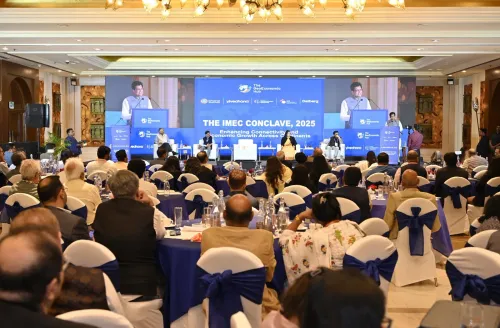
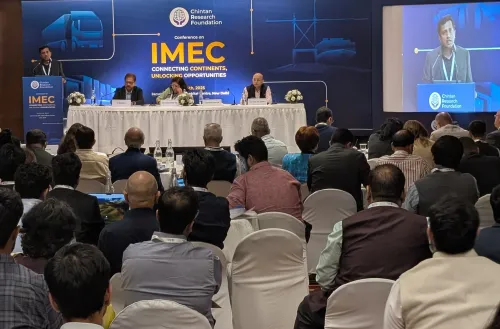
New Delhi, April 14 (NationPress) India is strategically inclined to view the India–Middle East–Europe Economic Corridor (IMEC) not solely as a commercial connectivity initiative but as a potential safeguard for national security and economic stability.
The ongoing geopolitical turmoil presents a unique opportunity for India to urge partner nations to accelerate the execution of vital rail-link agreements, improve harmonization of customs and standards, and establish unified rules for governance in the energy and digital corridors, as indicated by a report released on Tuesday.
According to the findings from the New Delhi-based International Centre for Peace Studies, with persistent political determination and adequate funding, IMEC could serve as a robust alternative framework for India’s trade and energy transactions with Europe, effectively mitigating both current global disruptions and future crises.
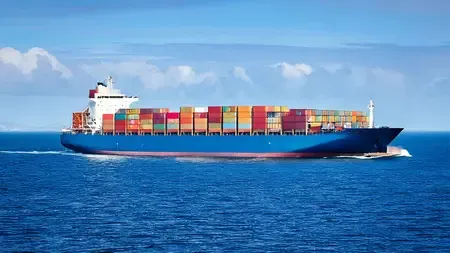
The report highlighted that the Bab el-Mandeb Strait has become a crucial geopolitical hotspot, with activities from Houthi and Iranian factions posing threats to global trade, energy supply, and digital infrastructure. As the 'Gate of Grief' manages 10% of worldwide maritime oil and nearly 20% of internet data traffic, any interruptions would necessitate expensive detours around Africa. This situation presents a significant macroeconomic threat to India, as 95% of its trade is maritime-based.
“The India-Middle East-Europe Economic Corridor (IMEC) provides an essential strategic buffer. By incorporating a network of land and maritime routes, IMEC offers a resilient alternative that circumvents vulnerable sea chokepoints,” the report elaborated.
In light of ongoing strife in the West Asian region, the report indicated that should a situation similar to that of the Strait of Hormuz arise at the Bab el-Mandeb Strait, it would lead to severe economic disruptions, straining both supply chains and energy distribution.
“This shift in focus towards another critical strait follows the recent attacks by the Iran-backed Houthis in Yemen, who fired ballistic missiles at Israel. Since the commencement of the US-Israeli conflict with Iran on February 28, Iran has targeted Gulf allies of the USA, weaponizing the Strait of Hormuz and causing global energy shocks. Concurrently, Israel is engaged in conflict with the Hezbollah group in southern Lebanon,” the report pointed out.
“Experts view the Houthis' formal involvement in this conflict as a potential risk to the crucial maritime chokepoint—Bab el-Mandeb—linking Asia, Africa, and Europe,” it added.
The report noted that despite the Houthi blockade following the Gaza conflict, India successfully managed its trade and energy flows through a combination of rerouting, cost management, naval signaling, and contingency measures.
India adopted a “calibrated strategy” by refraining from participating in the US-led Operation Prosperity Guardian while significantly boosting the Indian Navy's surveillance and operational presence in the Gulf of Aden and northern Arabian Sea.
Emphasizing the strategic importance of IMEC, the report stated, “In response to regional maritime disturbances, alternatives are being sought to enhance regional security coordination, improve risk-sharing in insurance, and diversify routes, including the India-Middle East corridor, as a medium-term solution to chokepoint vulnerabilities.”
Point of View
The exploration of IMEC by India highlights a proactive stance towards ensuring economic resilience and national security amidst growing geopolitical challenges. This initiative is essential for maintaining stable trade and energy flows critical to India's economic vitality.
NationPress
19 Sept 2026
Frequently Asked Questions
Why is IMEC significant for India?
IMEC is significant for India as it offers an alternative route for trade and energy flows, reducing dependence on vulnerable maritime chokepoints and enhancing national security.
What challenges does India face regarding maritime trade?
India faces challenges related to geopolitical instability in regions like the Bab el-Mandeb Strait and the Strait of Hormuz, which threaten global trade and energy security.
How is India responding to these challenges?
India is enhancing its naval presence, adopting a calibrated approach to security, and exploring alternative trade routes like IMEC to mitigate risks associated with maritime chokepoints.
What role do regional tensions play in this context?
Regional tensions, particularly involving Iran and its allies, significantly impact maritime security and trade routes, prompting India to seek more secure alternatives.