North Korea slams Japan's security overhaul as 'brazen challenge to global peace'
Synopsis
North Korea has labelled Japan's sweeping security overhaul — including revised arms export rules and a pledge to hit 2% of GDP on defence by March 2026 — a 'sly scheme' to revive its war capability. With Tokyo scrapping decades-old weapons export restrictions and fast-tracking its military buildup, Pyongyang's condemnation signals deepening fault lines across East Asia.
Key Takeaways
North Korea condemned Japan's security overhaul on Monday , calling it "a brazen challenge to global peace and humanity" via Rodong Sinmun .
Japan is revising its National Security Strategy , National Defence Strategy , and Defence Buildup Program within 2026 .
Revised arms export rules now allow Japan to sell lethal weapons — including destroyers and missiles — to countries with qualifying defence information-protection agreements.
Prime Minister Sanae Takaichi pledged in October 2025 to raise Japan's defence budget to 2% of GDP by March 2026 , two years ahead of schedule.
Pyongyang accused Tokyo of harbouring a "reinvasion" ambition, deploying historically charged language rooted in Japan's colonial past.
North Korea on Monday sharply criticised Japan's move to overhaul its key security legislation, calling it "a brazen challenge to global peace and humanity." The condemnation, published in Rodong Sinmun — the official mouthpiece of the ruling Workers' Party of Korea — marks Pyongyang's most direct public rebuke of Tokyo's accelerating defence reforms to date.
What Japan Is Revising
Japan is seeking to revise three foundational security documents — the National Security Strategy, the National Defence Strategy, and the Defence Buildup Program — within 2026. The effort is widely seen as a response to China's growing military presence in the region and broader regional security threats, according to Yonhap News Agency.
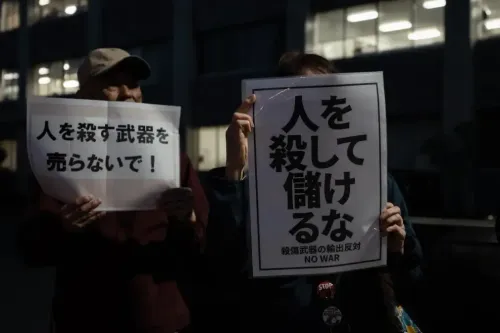
Last month, the Japanese government officially revised "the three principles on transfer of defence equipment and technology" and their implementation guidelines to allow overseas sales of weapons, including those with lethal capabilities — a move that drew large-scale protests domestically, local media reported. The revisions scrap rules that previously limited Japan's defence equipment exports to five non-combat categories: rescue, transport, warning, surveillance, and minesweeping.
Under the new framework, defence equipment will be divided into "weapons" and "non-weapons" categories based on lethal or destructive capability, according to Xinhua, citing Kyodo News. Non-weapons such as warning and control radar systems remain unrestricted for export, while weapons — including destroyers and missiles — can now be exported to countries that have signed information-protection agreements with Japan.
North Korea's Condemnation
Pyongyang denounced the overhaul as a "sly scheme" by Japan to "realise their ambition of reinvasion amid escalating global tensions," the Rodong Sinmun article stated. The article specifically flagged the revision's core provisions — an increased defence budget, the lifting of restrictions on arms exports, and the expansion of military capabilities — concluding that the changes are "undoubtedly aimed at reviving its arms industry and increasing its war capability."
Japan's Defence Budget Push
In October 2025, Japanese Prime Minister Sanae Takaichi pledged to raise Japan's defence budget to 2% of GDP by March 2026 — two years ahead of the original plan — and to revise the National Security Strategy and two other key defence documents by the end of 2026. The accelerated timeline signals a structural shift in Tokyo's security posture that goes well beyond symbolic gestures.
Notably, this is not the first time North Korea has condemned Japanese defence initiatives, but the language deployed in this instance — invoking "reinvasion" — draws on historically charged rhetoric that resonates strongly in the region given Japan's colonial past. Whether Pyongyang's rebuke prompts any diplomatic response from Tokyo remains to be seen, but analysts expect Japan to press ahead with its reforms regardless.
Regional Implications
Japan's defence overhaul is unfolding against a backdrop of heightened tensions across East Asia, with China's military assertiveness in the South China Sea and Taiwan Strait, and North Korea's continued ballistic missile tests keeping regional security on edge. The export of lethal weapons by Japan — previously a near-taboo under its post-war pacifist constitution — represents a significant departure from decades of restraint and is being watched closely by allies and adversaries alike.
Point of View
Not random outrage — it is designed to activate historical anxieties across the region and complicate Japan's diplomatic positioning. But the more consequential story is Japan's own transformation: scrapping post-war arms export taboos and racing toward a 2% GDP defence budget two years ahead of schedule is a structural break, not an incremental adjustment. Mainstream coverage tends to frame this through the lens of North Korean provocation, but the real driver is the China variable — Tokyo is quietly recalibrating its entire security architecture in response to Beijing's military assertiveness. The question that goes largely unasked is whether Japan's allies, particularly South Korea, are fully aligned with this acceleration, or whether historical grievances will undermine the very regional security coalition Tokyo is trying to build.
NationPress
6 Oct 2026
Frequently Asked Questions
Why is North Korea criticising Japan's security document revision?
North Korea has condemned Japan's overhaul of its National Security Strategy and related documents as a 'sly scheme' to revive its arms industry and war capability. Pyongyang's Rodong Sinmun accused Tokyo of harbouring reinvasion ambitions amid escalating global tensions.
What changes has Japan made to its arms export rules?
Japan revised 'the three principles on transfer of defence equipment and technology' to allow overseas sales of lethal weapons, including destroyers and missiles, to countries with qualifying defence information-protection agreements. The previous rules restricted exports to five non-combat categories only.
What is Japan's defence budget target and timeline?
Japanese Prime Minister Sanae Takaichi pledged in October 2025 to raise Japan's defence budget to 2% of GDP by March 2026 — two years ahead of the original plan — marking a significant acceleration of the country's military buildup.
Which three security documents is Japan revising?
Japan is revising the National Security Strategy, the National Defence Strategy, and the Defence Buildup Program, with all three revisions targeted for completion within 2026.
What is the broader regional context of Japan's security overhaul?
Japan's defence reforms are widely seen as a response to China's growing military presence in the region, alongside threats from North Korea's continued ballistic missile tests. The overhaul represents a significant departure from Japan's post-war pacifist security posture.