US-Japan reaffirm North Korea complete denuclearisation at Tokyo talks
Synopsis
Washington and Tokyo have drawn a hard line: North Korea's nuclear programme is not a 'closed issue,' regardless of what Russia says. Meeting in Tokyo for the Extended Deterrence Dialogue, US and Japanese officials jointly condemned China's opaque nuclear buildup and flagged Pyongyang's new centrifuge unveiling — signalling that the Indo-Pacific security compact is tightening precisely as the Russia-North Korea axis deepens.
Key Takeaways
The US and Japan held the Extended Deterrence Dialogue in Tokyo on 9-10 June 2025 , reaffirming commitment to North Korea's complete denuclearisation .
Both nations rejected Russia's characterisation of Pyongyang's nuclear ambitions as a 'closed issue.' The joint statement flagged China's 'dramatic and opaque nuclear weapons buildup' as a shared concern.
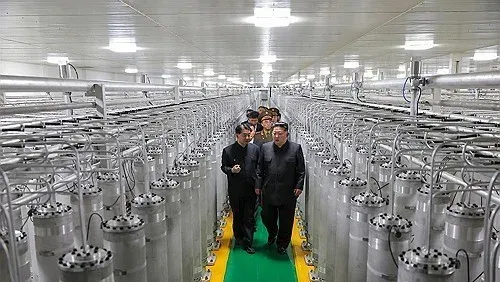
North Korea reportedly unveiled new centrifuges last week and announced plans to expand nuclear forces 'at an exponential rate.' US chargé d'affaires Howard Solomon reiterated Washington's position at the IAEA board of governors meeting in Vienna on Tuesday .
Japan encouraged the US to pursue multilateral strategic stability talks, including arms control dialogues with China and Russia .
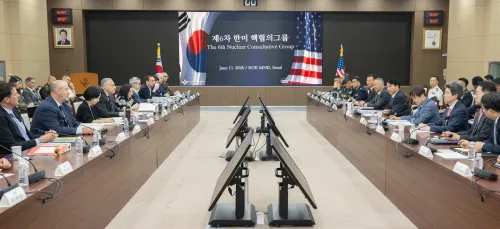
The United States and Japan on 9-10 June 2025 jointly reaffirmed their commitment to the complete denuclearisation of North Korea and explicitly rejected Russia's characterisation of Pyongyang's nuclear ambitions as a 'closed issue', according to a joint statement issued following bilateral defence talks in Tokyo. The allies convened the Extended Deterrence Dialogue at Japan's foreign ministry on Monday and Tuesday, underscoring deepening security cooperation amid mounting regional threats.
What the Joint Statement Said
The statement declared that 'both delegations discussed China's dramatic and opaque nuclear weapons buildup and rejected Russia's notion that the DPRK's pursuit of nuclear weapons was a closed issue.' DPRK refers to the Democratic People's Republic of Korea, North Korea's official name.
The two sides also discussed US efforts to modernise and adapt its nuclear forces, alongside Japan's evolving defence policy and capabilities, citing 'increasing regional nuclear threats' as the driving rationale.
Tokyo's Push for Multilateral Stability
Japan used the dialogue to encourage the US to pursue multilateral 'strategic stability' talks aimed at averting a nuclear arms race, reducing nuclear risks, addressing concerns about nuclear testing, and bolstering transparency — including through arms control dialogues with China and Russia. This reflects Tokyo's increasingly assertive posture on non-proliferation, a notable shift from its traditionally cautious diplomatic stance.
The meeting was co-chaired by the US State Department, the US Department of Defence, and Japan's foreign and defence ministries. Participants included representatives from the Japan Joint Staff, US Joint Staff, US Strategic Command, US Indo-Pacific Command, and US Forces Japan.
US Reiterates Concern at IAEA Board Meeting
In a parallel development on Tuesday, Howard Solomon, chargé d'affaires ad interim at the US Mission to International Organisations in Vienna, echoed Washington's position before the International Atomic Energy Agency (IAEA) board of governors meeting.
'Statements and actions by some to state that these programs are a closed issue are unacceptable and undermine the nonproliferation regime,' Solomon said, according to a transcript from the US mission's website. He added that the US remains 'gravely concerned' about North Korea's ongoing nuclear activities.
'The DPRK continues to advance its destabilising weapons of mass destruction and ballistic missile programs in violation of multiple UN Security Council resolutions. These programs pose a threat to America, our allies, and others, and undermine security in the region,' he said.
Pyongyang's Escalating Nuclear Activity
Solomon also highlighted that Pyongyang last week unveiled purportedly new centrifuges for producing weapons-grade nuclear material and announced plans to expand its nuclear forces 'at an exponential rate.' This comes amid a broader pattern of North Korea accelerating weapons development in defiance of international sanctions, with 2024 and early 2025 marking a particularly active period of missile tests and nuclear facility expansions.
Notably, Russia's deepening ties with Pyongyang — including reported arms transfers linked to the war in Ukraine — have complicated the traditional non-proliferation consensus, making Washington and Tokyo's joint pushback diplomatically significant. How the alliance manages the triangular dynamic between China, Russia, and North Korea will define the next phase of Indo-Pacific security architecture.
Point of View
If left unchallenged, erodes the entire non-proliferation architecture. What is missing from mainstream coverage is the Japan angle: Tokyo's call for multilateral strategic stability talks, including with China and Russia, signals that Japan is no longer content to be a passive beneficiary of US extended deterrence but wants a seat at the arms-control table. Meanwhile, North Korea's centrifuge unveiling — timed to coincide with these talks — suggests Pyongyang is calibrating its escalation ladder with precision. The alliance's resolve is clear; whether it translates into effective deterrence against a North Korea emboldened by Russian patronage is the harder question.
NationPress
26 Oct 2026
Frequently Asked Questions
What was agreed at the US-Japan Extended Deterrence Dialogue in Tokyo?
The US and Japan reaffirmed their joint commitment to the complete denuclearisation of North Korea and rejected Russia's claim that Pyongyang's nuclear pursuit is a 'closed issue.' The talks, held on 9-10 June 2025 at Japan's foreign ministry, also addressed China's nuclear buildup and US nuclear force modernisation.
Why did the US and Japan reject Russia's 'closed issue' position on North Korea?
Washington and Tokyo argue that accepting North Korea's nuclear status as irreversible would undermine the global non-proliferation regime. Russia's deepening ties with Pyongyang, including reported arms transfers, have made its position increasingly at odds with the traditional international consensus on denuclearisation.
What did North Korea do that alarmed the US ahead of these talks?
North Korea last week unveiled purportedly new centrifuges capable of producing weapons-grade nuclear material and announced plans to expand its nuclear forces 'at an exponential rate,' according to US chargé d'affaires Howard Solomon, speaking at the IAEA board of governors meeting in Vienna.
What role did the IAEA meeting in Vienna play in this diplomatic push?
On Tuesday, Howard Solomon, the US chargé d'affaires ad interim in Vienna, used the IAEA board of governors meeting to reinforce Washington's position, stating that labelling North Korea's nuclear programme a 'closed issue' is 'unacceptable and undermines the nonproliferation regime.'
What is Japan's position on broader nuclear arms control?
Japan encouraged the US to pursue multilateral strategic stability talks to prevent a nuclear arms race, reduce nuclear risks, and increase transparency — including through arms control dialogues with China and Russia. This marks a more proactive Japanese stance on non-proliferation diplomacy.