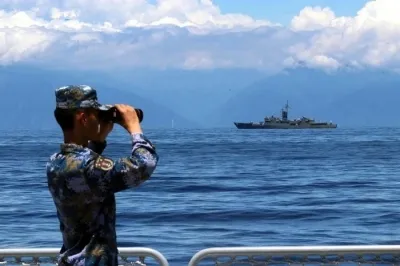
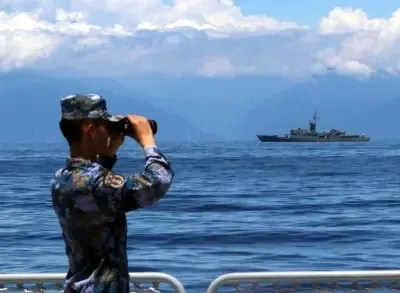
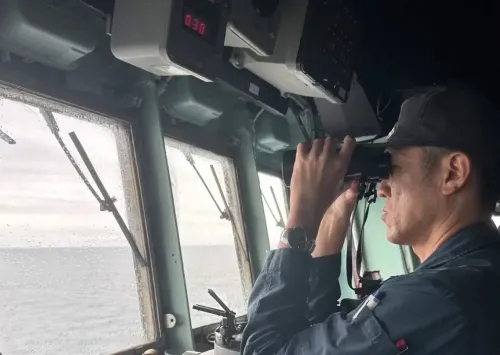
China's Taiwan maritime drills may be annexation rehearsals, report warns
Synopsis
A research vessel quietly detected three times near Taiwan's largest naval base since May is no anomaly — it's part of a calculated Chinese strategy to normalise maritime dominance around Taiwan. The report warns that if the US and its allies keep treating these dual-use incursions as scientific exercises, they risk missing the strategic rehearsal happening right in front of them.
Key Takeaways
Chinese research vessel Tong Ji , commissioned in 2025 , has been detected three times near Taiwan since May , each time near sensitive naval installations.
The vessel's latest appearance was southwest of Liuqiu Island , near Kaohsiung — home to Taiwan's largest naval base and naval academy.
The report warns Beijing is using dual-use 'civilian' vessels to collect seabed mapping and acoustic data with direct military utility.
A second vessel, Lan Hai 201 , conducted a fisheries survey east of Taiwan after Japan and the Philippines announced maritime boundary plans in June .
The report urges the US and allies to treat these incursions as strategic rehearsals, not isolated scientific missions, warning they could enable a future blockade or annexation.
Beijing's growing assertiveness in Taiwan's surrounding waters — including repeated incursions by dual-use research vessels near key naval installations — could be laying the groundwork for a future blockade, invasion, or forced annexation, according to a recent report. The United States and its allies are urged to treat these activities not as routine scientific exercises but as strategic rehearsals for establishing maritime dominance over the island.
The Tong Ji Vessel: Science or Surveillance?
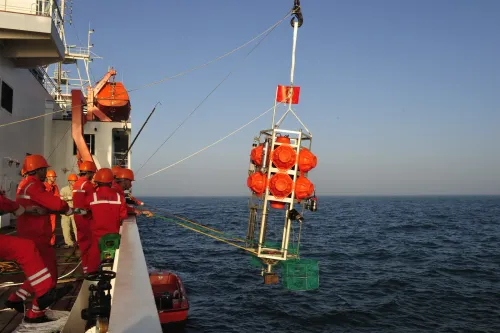
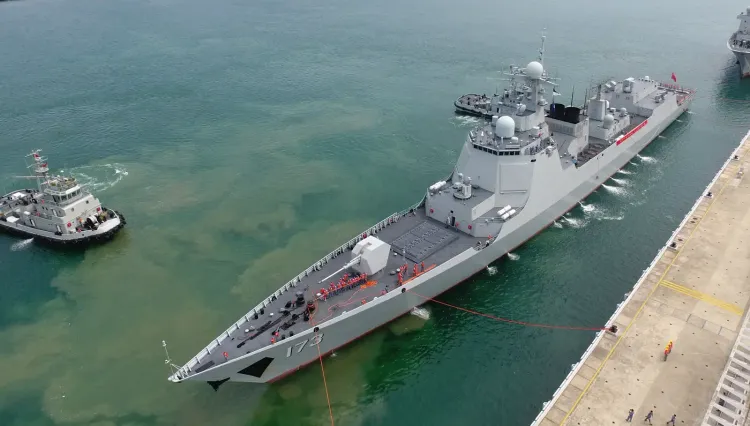
At the centre of recent concerns is the Chinese research vessel Tong Ji, commissioned in 2025 and weighing approximately 2,000 tonnes. According to the report, the ship is outfitted with advanced sonar systems, acoustic sensors, and remotely operated vehicles capable of seabed mapping — capabilities with clear military applications in submarine warfare and anti-submarine operations.
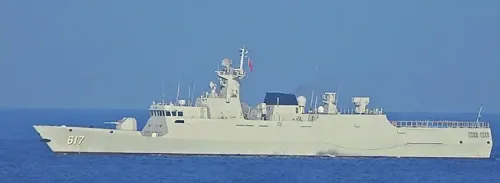
The Tong Ji has reportedly been detected three times near Taiwan since May, each time operating in proximity to sensitive naval facilities. Its latest appearance was southwest of Liuqiu Island, near Kaohsiung — home to Taiwan's naval academy and its largest naval base. Taiwanese coastguard vessels shadowed the ship and issued formal warnings, but the vessel's repeated returns, the report argues, highlight Beijing's disregard for Taiwan's sovereignty.
'The recent sighting of the mainland Chinese research vessel Tong Ji near Taiwan's largest naval base is not an isolated incident but part of a calculated campaign to normalise China's presence around the island,' the report stated, adding that these missions are 'thinly veiled intelligence operations, laying the groundwork for future naval and submarine warfare.'
Wider Escalation Pattern Around Taiwan
The Tong Ji is not alone. The report notes that Beijing has increasingly deployed a combination of 'civilian' research ships, coastguard patrols, and military manoeuvres to encircle Taiwan. This pattern reportedly intensified after Japan and the Philippines announced plans in June to delineate their maritime boundaries east of Taiwan — a move Beijing condemned as an infringement on its sovereignty.
Shortly after that announcement, another Chinese vessel — Lan Hai 201 — conducted what was described as a fisheries survey east of Taiwan, fuelling suspicions of dual-use intelligence collection, according to the report.
'The CCP's strategy is unmistakable: use research ships, coastguard patrols, and military drills to encircle Taiwan, erode its autonomy, and prepare the ground for annexation,' the report stated.
The Dual-Use Strategy: Weaponising Civilian Platforms
The report argues that the Chinese Communist Party (CCP) is deliberately blurring the line between civilian and military operations. By embedding vessels equipped with advanced sensors near Taiwan's naval bases, Beijing reportedly collects critical data for submarine navigation, anti-submarine warfare, and seabed mapping — all of which are operationally essential for any future blockade or amphibious invasion scenario.
Notably, Beijing has never formally renounced the use of force to achieve what it terms 'reunification' with Taiwan. Critics argue this makes the pattern of dual-use deployments far more consequential than it might appear on the surface.
Strategic Implications for the US and Its Allies
The report urged Washington and its partners to recalibrate how they interpret Chinese maritime activity in the Taiwan Strait and surrounding waters. Rather than treating each vessel as an isolated diplomatic incident, the report recommends viewing the cumulative pattern as a coordinated campaign to erode Taiwan's strategic position over time.
If these activities go unchecked, the report warns, they could progressively create the conditions necessary for a blockade or forced annexation — not through a single dramatic military move, but through incremental normalisation of Chinese dominance in Taiwan's adjacent waters. How Taiwan, the US, and regional allies respond to each successive intrusion will likely shape the strategic calculus in the years ahead.
Point of View
Taken alone, appears deniable and sub-threshold; taken together, they constitute progressive erosion of Taiwan's maritime buffer. What the report does not fully address is the question of deterrence design: if every warning by Taiwan's coastguard is ignored without consequence, the incremental normalisation it describes will accelerate. The burden of response, increasingly, falls on how the US and its regional partners choose to define what counts as an act of coercion — and whether they have the political will to treat it as one.
NationPress
14 Sept 2026
Frequently Asked Questions
What is the Chinese vessel Tong Ji and why is it significant near Taiwan?
The Tong Ji is a 2,000-tonne Chinese research vessel commissioned in 2025 , equipped with advanced sonar, acoustic sensors, and remotely operated vehicles capable of seabed mapping. It has been detected three times near Taiwan since May, each time near sensitive naval bases, raising concerns about dual-use intelligence collection with direct military applications.
Why does the report consider China's maritime activity a rehearsal for annexation?
The report argues that Beijing is using a pattern of research ship deployments, coastguard patrols, and military drills to incrementally normalise its presence around Taiwan and collect data essential for a blockade or invasion. It notes that China has never renounced the use of force for 'reunification,' making this cumulative maritime pressure strategically significant.
What happened near Taiwan after Japan and the Philippines announced maritime boundary plans?
After Japan and the Philippines announced plans in June to delineate their maritime boundaries east of Taiwan — a move Beijing condemned — another Chinese vessel, Lan Hai 201 , conducted a fisheries survey east of Taiwan, fuelling suspicions of dual-use intelligence gathering.
What is the report's recommendation to the US and its allies?
The report urges the United States and allied nations to reframe how they interpret Chinese maritime activities around Taiwan — treating them as coordinated strategic rehearsals for establishing dominance rather than isolated scientific exercises. It warns that failing to do so could allow conditions for a blockade or forced annexation to develop unchecked.
How has Taiwan responded to these maritime incursions?
Taiwan's coastguard vessels have shadowed the Tong Ji and issued formal warnings during its incursions. However, the vessel's repeated returns despite these warnings highlight the limits of Taiwan's current response and, according to the report, China's willingness to test and push those limits.