Is China Taking Advantage of Workers for Manufacturing Gains?
Synopsis
Explore how China's manufacturing supremacy is rooted in labor exploitation under a repressive system, highlighting stark contrasts in productivity with Tesla factories in the US and Shanghai. Discover the implications of these practices on global manufacturing dynamics.
Key Takeaways
China's manufacturing edge is linked to labor exploitation.
Production efficiency varies significantly between regions.
Tesla's Shanghai factory produces nearly half of its global EVs.
Labor practices affect global market dynamics .
New facilities like the Megafactory showcase China's energy sector growth .
New Delhi, Jan 9 (NationPress) The significant edge that China holds in the manufacturing industry compared to other nations is not merely a result of economies of scale or the country’s swift adoption of Western technologies. Rather, it stems from the exploitation of labor within a restrictive framework, as highlighted by a recent report.
According to an article featured in The Diplomat, China’s advantage extends beyond efficiency and technology. It is deeply rooted in a labor system designed to minimize costs through lax enforcement, extended working hours, and wage suppression. This creates a structural cost disparity that reflects a different regulatory landscape concerning labor rights and the burdens placed upon workers.
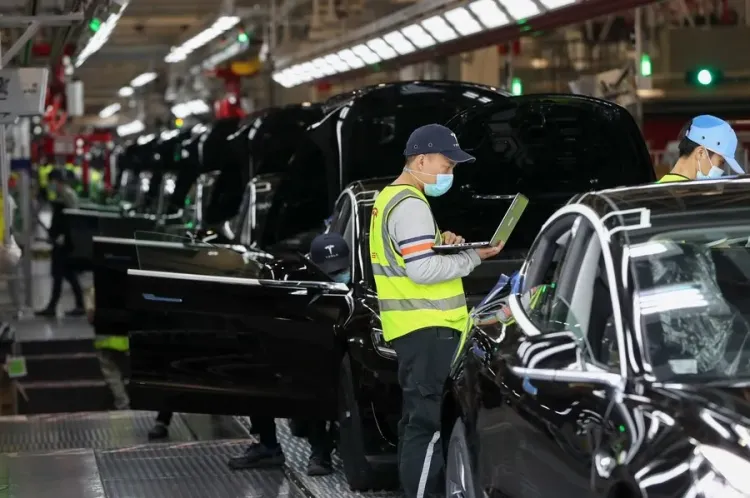
To illustrate this point, the article compares the car production rates between Tesla's factories in the United States and Shanghai.
In 2023, Tesla’s Fremont factory in California employed 20,000 workers and produced approximately 560,000 vehicles, translating to about 28 vehicles per worker annually. In contrast, Tesla’s Shanghai Gigafactory, with a similar workforce, manufactured nearly 1 million vehicles, equating to nearly 50 vehicles per worker each year.
On December 8, 2024, Tesla's Gigafactory in Shanghai celebrated the rollout of its 4 millionth vehicle, marking a significant milestone as the US automaker deepens its engagement in line with China's burgeoning new energy sector, according to a report by Xinhua.
This Shanghai facility, Tesla's first gigafactory outside the US, began construction in January 2019 and produced its inaugural vehicle by December of that same year.
Now, the factory churns out a new vehicle approximately every 30 seconds, contributing to nearly half of Tesla’s global electric vehicle deliveries.
It took over 30 months for the plant to achieve its first 1 million vehicles, while the output surged from 3 million to 4 million in just about 14 months, according to the company.
Serving both the mainland Chinese market and international customers, vehicles from this factory are exported to Europe and the Asia-Pacific region. In October, the Shanghai facility shipped over 35,000 vehicles abroad, marking the highest monthly export volume in two years, as reported by the company.
In February, Tesla's new Megafactory in Shanghai, dedicated to producing energy-storage batteries, commenced operations, marking its second major facility in Shanghai and the first of its kind outside the United States, according to the Xinhua report.
Point of View
It is crucial to recognize the complexities of global manufacturing. While China's labor practices raise ethical concerns, they also highlight the need for fair competition and standards in the industry, ultimately benefiting consumers and fostering innovation.
NationPress
1 Oct 2026
Frequently Asked Questions
What factors contribute to China's manufacturing advantage?
China's manufacturing advantage is largely due to a labor system that allows for lower costs through lax enforcement of labor laws, extended working hours, and wage suppression.
How does Tesla's Shanghai factory compare to its Fremont factory?
Tesla's Shanghai Gigafactory produces nearly 50 vehicles per worker annually, significantly outpacing the Fremont factory, which produces about 28 vehicles per worker per year.
What milestones has Tesla's Shanghai Gigafactory achieved?
The Shanghai Gigafactory achieved the milestone of producing its 4 millionth vehicle by December 8, 2024, and accounts for nearly half of Tesla’s global electric vehicle deliveries.
What is the impact of China's labor practices on the global market?
China's labor practices create a cost disparity that challenges manufacturers worldwide, raising questions about fair competition and labor rights in the industry.
What is the significance of Tesla's new Megafactory in Shanghai?
Tesla's Megafactory in Shanghai, dedicated to energy-storage batteries, represents the company's continued investment in China's rapidly expanding energy sector.