Congo's Presidential Election Kicks Off Amidst Controversy
Synopsis
Congo's Presidential election is underway, with over three million voters heading to the polls. Incumbent President Sassou N'Guesso seeks a fifth term amidst a fragmented opposition. Observers from international organizations are monitoring the election process.
Key Takeaways
Over three million voters are participating in the election.
Denis Sassou N'Guesso seeks a fifth consecutive term .
Polling stations are open from 7 a.m. to 6 p.m. local time.
International observers are monitoring the election for transparency .
The opposition appears fragmented , raising concerns about competitiveness.
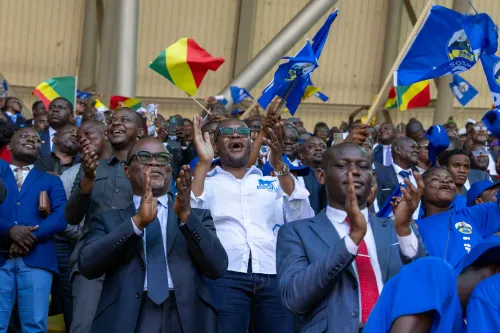
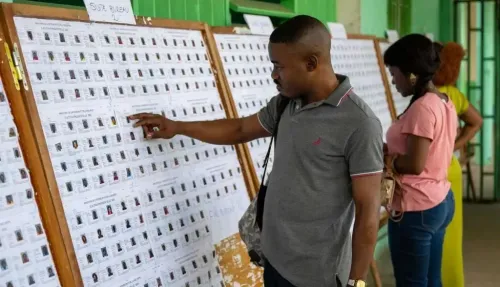
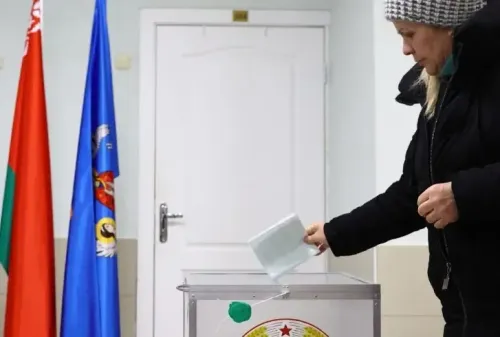
Brazzaville, March 15 (NationPress) Over three million registered voters in the Republic of Congo are set to cast their ballots on Sunday for the Presidential election, with polling stations operating from 7 a.m. to 6 p.m. local time.
A decree from the Interior Ministry indicates that a total of 6,620 polling stations have been established across 4,011 centers within the 15 departments of the nation, as reported by Xinhua news agency.
Seven candidates are competing in this election, including the current President, Denis Sassou N'Guesso.
According to the electoral regulations, the President is elected through direct universal suffrage using a two-round majority voting system.
At 82 years old, Denis Sassou N'Guesso is vying for a fifth consecutive term under the banner of the Presidential Majority, which is a coalition of nearly 20 political parties.
Among the other candidates is Joseph Kignoumbi Kia Mboungou, a Member of Parliament and leader of 'The Chain' Party, who is making his fifth attempt since 2002.
Also in the race is Anguios Nganguia Engambe, President of the Party for Action of the Republic, who is competing for the fourth time since 2009.
Media analyses suggest that while six candidates are opposing Sassou N'Guesso, the primary Opposition appears to be fragmented and largely absent, positioning him to secure another five-year term.
International observation missions from the International Organisation of the Francophonie and the African Union have arrived in Brazzaville to monitor the election.
During his campaign, Sassou N'Guesso emphasized his achievements in the economy, particularly his efforts to modernize the nation’s infrastructure and enhance the gas and agricultural sectors to achieve self-sufficiency.
Sassou N'Guesso first governed Congo-Brazzaville under a one-party system from 1979 until 1992, after which he lost the inaugural multi-party elections but later regained power through a civil war in 1997.
He has been re-elected in 2002, 2009, 2016, and 2021, with the Opposition claiming that these elections were neither transparent nor fair.
The former French colony, which gained independence in 1960, has maintained close ties with both France and Russia and is the third-largest oil producer in sub-Saharan Africa, heavily reliant on hydrocarbons that represent over three-quarters of its export revenue.
Point of View
The focus remains on the incumbent, Denis Sassou N'Guesso, who is seeking to extend his long tenure. Despite the presence of multiple candidates, the opposition's fragmentation raises questions about the election's competitiveness. Observers from international bodies will play a crucial role in assessing the fairness of the process.
NationPress
3 Oct 2026
Frequently Asked Questions
When are the polling stations open for the Congo Presidential election?
Polling stations are open from 7 a.m. to 6 p.m. local time on election day.
How many candidates are contesting the Presidential election in Congo?
There are seven candidates contesting the Presidential election in the Republic of Congo.
What is the electoral system used for the Presidential election in Congo?
The President is elected through direct universal suffrage using a two-round majority system.
Who is the incumbent President of Congo?
The incumbent President is Denis Sassou N'Guesso, who is running for a fifth consecutive term.
What is the significance of the international observers in this election?
International observers from organizations like the African Union and the International Organisation of the Francophonie are present to monitor the election process and ensure its fairness.