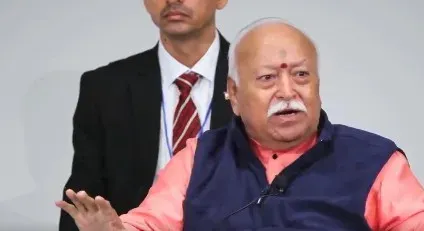
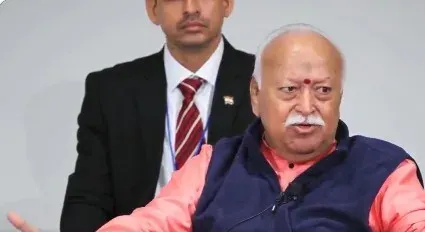
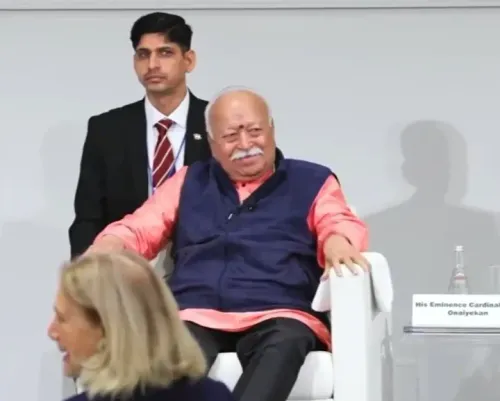
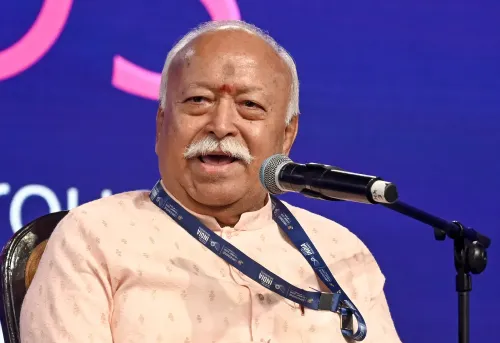
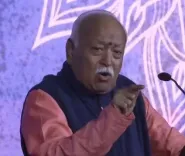
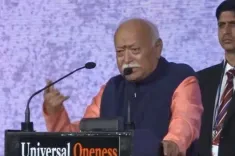
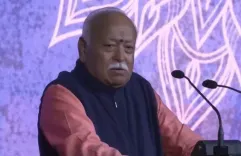
RSS chief Mohan Bhagwat at New York: Dharma is not religion, it's a universal law
Synopsis
At Madison Square Garden in New York, RSS chief Mohan Bhagwat reframed dharma not as a religious identity but as a universal law of balance — one that holds individuals, society, and the environment in equilibrium. His call for India to demonstrate this through practice, not preaching, signals how the RSS is projecting its civilisational worldview onto a global stage.
Key Takeaways
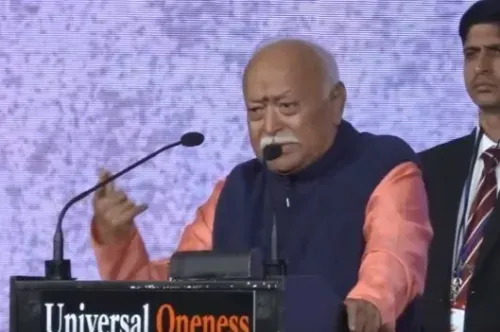
RSS chief Mohan Bhagwat addressed the Universal Oneness Celebration at Madison Square Garden , New York , on 30 August .
Bhagwat defined dharma as ‘the rule through which the universe is sustained,’ explicitly distinguishing it from religion or worship.
He argued that dharma requires individuals, society, and the environment to ‘proceed and progress together’ — without one being sacrificed for another.
He called on India and Indians worldwide to demonstrate this principle through practice, not preaching.
The RSS , founded in Nagpur in 1925 , has Bhagwat as its sixth Sarsanghchalak since 2009 .
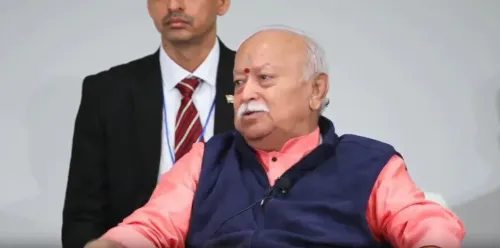
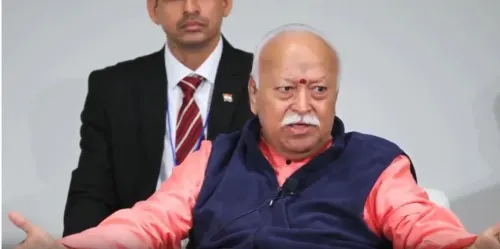
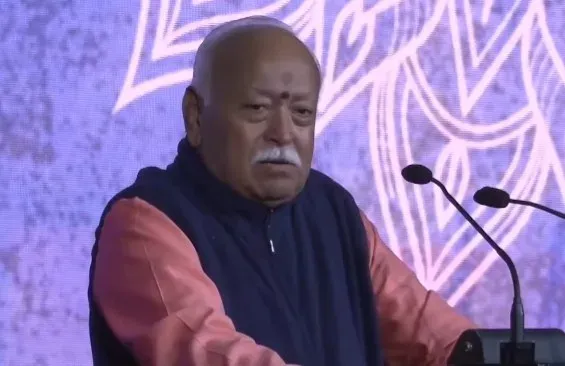
Rashtriya Swayamsevak Sangh (RSS) chief Mohan Bhagwat on 30 August told a gathering in New York that dharma must not be conflated with religion or worship, framing it instead as a universal governing principle that sustains balance across individuals, society, and the natural world. He made the remarks while addressing the Universal Oneness Celebration at Madison Square Garden.
Dharma as a Universal Principle
Bhagwat drew a clear line between dharma and organised religion. “Dharma is not religion. It is not a worship. It is beyond all this,” he said. He described dharma as “the rule through which the universe is sustained” and through which “human beings can manage the dualities of life.”
The RSS chief argued that dharma enables different dimensions of existence to advance simultaneously rather than at each other’s expense. “It is not that societal progress will happen only when individuals are suppressed. No. It is not that society had to be suppressed to make individual successes. No,” he said. “Individual, society and the environment, they have to proceed together, progress together.”
Balance of Body, Mind and Intellect
Bhagwat extended the principle inward, applying it to human development itself. “Your body, your mind, intellect, they have to proceed together, progress together,” he said, describing dharma as a middle path that unites rather than divides.
He offered a compact definition: “This principle, which unites everything, which upholds everything, which doesn’t cause a rift, let not that happen, and which balances everything, which is a middle path, that is Dharma.”
Unity Beneath Diversity
Bhagwat grounded his argument in what he called the oneness of existence. Visible differences among people, he said, do not erase a deeper shared reality. “Our destiny is to give that to the world and the solid foundation on which this Dharma is perceived is the oneness, unity of existence,” he said.
He called on people to recognise the same animating principle within themselves and within others, and to act for the broader welfare of the world. “You have to see that principle inside you. And at the same time, you have to see that principle inside others,” he said. “Everything and everybody in the world. And work for their benefit. For the welfare of the world.”
India’s Role and the Call to Practice
Bhagwat argued that human life carries inherent purpose — both self-realisation and service. “Human life is not purposeless. It is not meaningless. It is not a simple coincidence,” he said. “Human life is given to give this knowledge to everybody and live that knowledge for our own liberation, for the benefit of the world.”
He placed a specific responsibility on India and on Indians abroad, cautioning against mere rhetoric. “That is the mission Bharat has to accomplish. That is the message Bharatiyas world over have to give by their own example, not by preaching, by practice,” he said.
He closed by affirming the coexistence of difference and unity: “Because diversity is natural and unity is truth. That we must understand and shape our life according to this.”
The Rashtriya Swayamsevak Sangh was founded in Nagpur in 1925 by Keshav Baliram Hedgewar. Bhagwat became its sixth Sarsanghchalak in 2009 after serving in several senior positions within the organisation. His New York appearance marks one of his most prominent international platforms in recent years.
Point of View
Non-sectarian philosophy palatable to a global, pluralist audience. The deliberate untethering of dharma from Hinduism as a religion is a recurring move in RSS international outreach, and Madison Square Garden gives it unprecedented visibility. What is notable is the implicit critique embedded in his remarks: that Western liberal individualism and collectivist ideologies both fail the balance test that dharma, in his framing, resolves. Whether that argument lands beyond a sympathetic diaspora audience remains the real question.
NationPress
30 Aug 2026
Frequently Asked Questions
What did RSS chief Mohan Bhagwat say about dharma in New York?
Bhagwat said dharma is not religion or worship but a universal principle that sustains the universe and helps human beings manage the dualities of life. He made the remarks at the Universal Oneness Celebration at Madison Square Garden on 30 August.
Where did Mohan Bhagwat deliver this speech?
He spoke at the Universal Oneness Celebration held at Madison Square Garden in New York on 30 August.
What is the RSS and who is Mohan Bhagwat?
The Rashtriya Swayamsevak Sangh (RSS) is a Hindu nationalist volunteer organisation founded in Nagpur in 1925 by Keshav Baliram Hedgewar. Mohan Bhagwat has served as its sixth Sarsanghchalak (chief) since 2009.
How did Bhagwat define the relationship between individual, society, and environment?
Bhagwat argued that dharma requires all three — the individual, society, and the environment — to progress together, without any one being suppressed for the advancement of another. He described this as dharma’s defining quality as a middle path.
What role did Bhagwat assign to India in spreading the idea of dharma?
Bhagwat said India’s mission is to demonstrate the principle of dharma through practice rather than preaching, and called on Indians worldwide to lead by personal example.