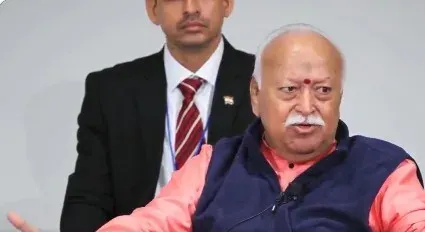
RSS Chief Bhagwat lays out global interfaith strategy at New York summit
Synopsis
RSS Chief Mohan Bhagwat did not just call for religious harmony in New York — he mapped out how to pursue it. His four-part framework at the 'One World, One Humanity' summit — dialogue, simultaneous service, local community models, and patient persistence — signals the RSS is positioning itself as a structured global actor in interfaith cooperation, not merely a domestic cultural organisation.
Key Takeaways
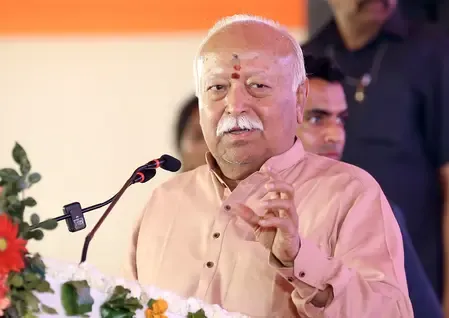
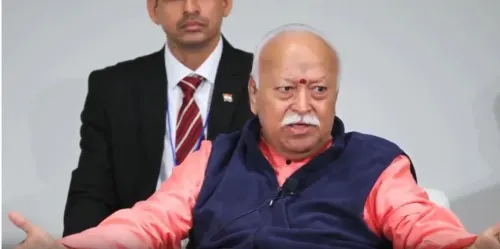
RSS Chief Mohan Bhagwat addressed the 'One World, One Humanity' gathering in New York on 30 August , attended by more than 180 religious leaders from 30 countries .
Bhagwat outlined a four-part global outreach framework: interfaith dialogue, simultaneous service, decentralised community models, and long-term persistence.
He cited the RSS's 1,30,000 service projects as evidence of non-discriminatory humanitarian work, including assistance during an aircraft collision in Haryana where most victims were Muslim.
Bhagwat argued that social consensus must precede political influence: 'If there is public opinion, then no politician will dare to go against it.' He referenced ongoing interfaith dialogue with Muslim and Christian communities in India that began after a Delhi speech in 2018 .
The RSS, founded in Nagpur in 1925 , completed its centenary in 2025 ; Bhagwat has led the organisation since 2009 .
Rashtriya Swayamsevak Sangh (RSS) Chief Mohan Bhagwat on 30 August outlined a structured, long-term global outreach agenda at the 'One World, One Humanity' gathering in New York, calling for interfaith dialogue combined with non-discriminatory service and community-level action — and arguing that social movements must first build public consensus before seeking to shape government policy.
Key Developments
The summit brought together more than 180 religious leaders and participants from 30 countries, with speakers from Christian, Jewish, Muslim, Hindu and other traditions calling for collective action against war, hatred, poverty and religious persecution. Bhagwat positioned the RSS as an active partner in this effort. 'RSS with all its might is always with you because we are on the same page,' he told the gathering.
His address moved well beyond a general appeal for harmony. It set out a four-part framework: begin within society, pair dialogue with service from the outset, build replicable local models, and sustain the effort even when results are slow to materialise.
Bhagwat's Philosophical Argument for Pluralism
Bhagwat grounded his call for religious pluralism in the idea that different traditions describe the same underlying truth through different experiences and perceptions. He drew a distinction between a religion's destination and the rituals used to reach it, arguing that rituals serve spiritual discipline but must not obscure religion's central purpose. 'What for religion is there? It is leading us to truth,' he said.
He compared religious practices to a finger pointing towards a light — a person who fixed attention on the finger would miss the light entirely. 'Diversity is a decoration for our innate unity,' he said. 'It has to be accepted. It has to be respected. It has to be protected.'
Service as Inseparable from Dialogue
A central theme of the address was that interfaith engagement cannot remain confined to conferences. Bhagwat said dialogue and service must begin simultaneously, not sequentially. He cited the RSS's network of 1,30,000 service projects operating across different scales, all conducted without regard to the religious identity of those being helped.
As an illustration, he referenced the RSS response to a collision involving two aircraft over Haryana, in which most passengers were Muslim. RSS volunteers, he said, assisted without considering religion while recovering bodies, helping the wounded and supporting relatives. 'We never thought at that time that these are Muslims,' Bhagwat said. He linked this approach directly to the organisation's stated distance from electoral politics: 'We could do this because we are not in politics. We do it. We only give. We don't want anything.'
Politics, Public Opinion and Decentralisation
Bhagwat was careful to distinguish between avoiding electoral politics and remaining indifferent to policy. He argued that religious and social organisations must eventually influence governments — including on issues such as preventing wars — but that the effective route runs through society first. 'These things do not happen through politics. Sorry to say, but the fact is, politics has now become a game of self-interest,' he said.
His prescription was to build social consensus, which democratic politics would then be compelled to follow. 'If there is public opinion, then no politician will dare to go against it,' he said. On decentralisation, he urged religious leaders to carry dialogue beyond international forums and senior institutions into provinces, districts and local communities, creating ground-level models of the world they wished to see.
Long-term Engagement and What Comes Next
Bhagwat acknowledged that this approach demands patience. He referred to continuing interfaith dialogue with Muslim and Christian communities in India that he said began following a speech he delivered in Delhi in 2018. 'So we started that dialogue. Mainly with Muslims and Christians of Bharat. And step by step we are going ahead,' he said.
He argued that the harder task was not articulating values of goodness and love — which he said already existed within religious traditions — but converting them into habitual conduct capable of resisting the pull of wealth, influence and superiority. 'We have to instill the practice,' he said. 'If we together start working, we can change the situation of the world. But it will take long time.'
The RSS, founded by K.B. Hedgewar in Nagpur in 1925, completed its centenary in 2025. Bhagwat, a Veterinary Sciences graduate, has served as the organisation's sixth Sarsanghchalak since 2009 and has in recent years expanded his engagement with leaders of different religious communities.
Point of View
Service, decentralisation, persistence — is unusually operational for a speech at a multilateral religious forum, and it signals a deliberate effort to reframe the RSS internationally as a civic actor rather than a Hindu nationalist body. The tension, however, is real: the RSS's domestic critics would argue that its record on minority relations inside India sits uneasily with the pluralism it is now projecting abroad. The reference to 2018 Delhi dialogue is significant — it is the same speech that drew controversy for Bhagwat's remarks on DNA and national identity. Whether international audiences engage with that full context, or accept the New York framing at face value, will shape how this outreach lands.
NationPress
14 Oct 2026
Frequently Asked Questions
What did RSS Chief Mohan Bhagwat say at the New York interfaith summit?
Bhagwat outlined a long-term global outreach strategy built on four pillars: interfaith dialogue, simultaneous service to all communities regardless of religion, creation of local community models, and sustained engagement over time. He told the gathering that the RSS is 'always with you because we are on the same page' in pursuing religious harmony.
What is the 'One World, One Humanity' gathering?
It is an international interfaith summit held in New York that brought together more than 180 religious leaders and participants from 30 countries. Speakers representing Christian, Jewish, Muslim, Hindu and other traditions called for collective action against war, hatred, poverty and religious persecution.
How does Bhagwat distinguish the RSS's role from electoral politics?
Bhagwat argued that the RSS deliberately stays out of electoral politics, which he described as 'a game of self-interest', and instead focuses on building social consensus. He said democratic governments respond to public opinion, making grassroots social work the most effective route to influencing policy — not direct political participation.
What service work did Bhagwat cite to illustrate the RSS approach?
He cited the RSS's network of 1,30,000 service projects and referenced the organisation's response to an aircraft collision in Haryana, where most passengers were Muslim. RSS volunteers assisted without regard to the victims' religion, recovering bodies, helping the wounded and supporting families.
What is the history of the RSS and Mohan Bhagwat's role in it?
The Rashtriya Swayamsevak Sangh was founded by K.B. Hedgewar in Nagpur in 1925 and completed its centenary in 2025. Mohan Bhagwat, a Veterinary Sciences graduate, became its sixth Sarsanghchalak in 2009 and has in recent years led interfaith outreach with representatives of different religious communities in India.