Doval-Wang Yi talks in Beijing: India, China to pursue political settlement of boundary question
Synopsis
India's NSA Ajit Doval and China's Foreign Minister Wang Yi met in Beijing for the 25th round of Special Representatives talks on the boundary question — agreeing to push for a political settlement guided by long-term interests. With the Kailash Manasarovar Yatra resumed and border trade restarted, the diplomatic thaw is gaining tangible shape, even as the core territorial dispute remains unresolved.
Key Takeaways
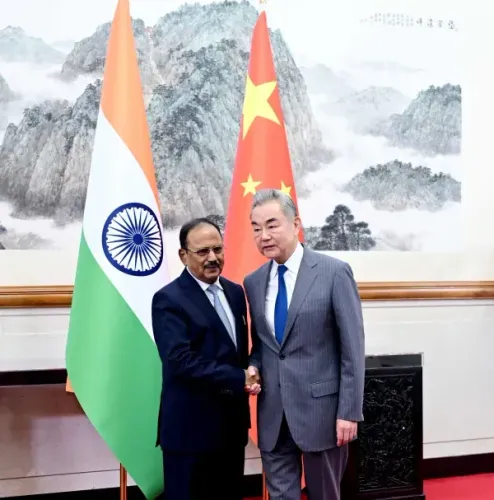
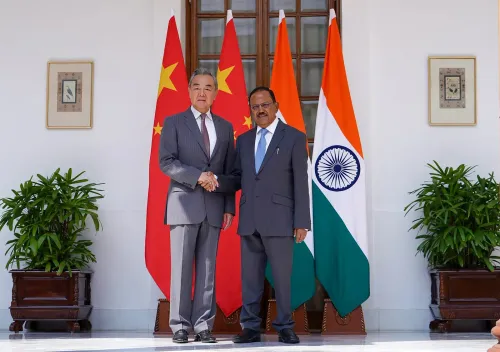
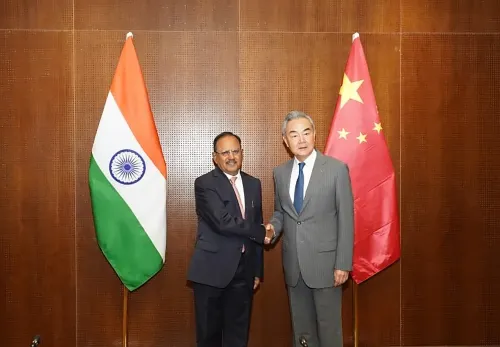
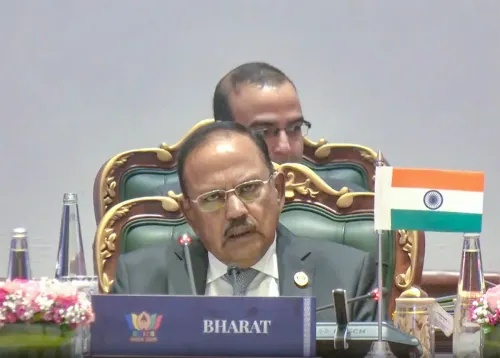
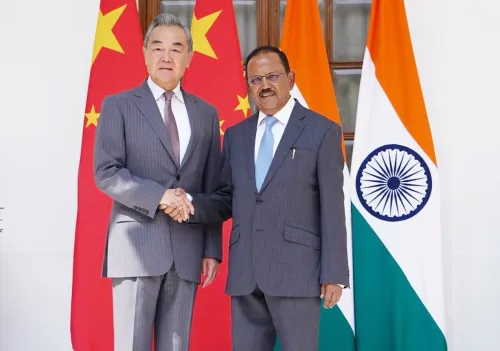
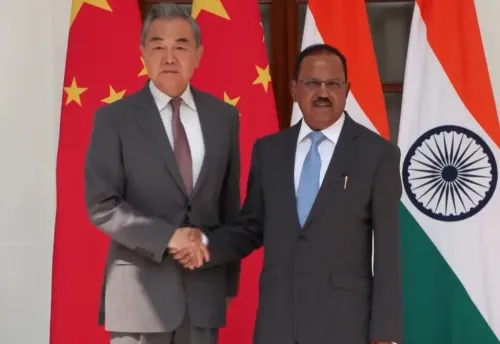
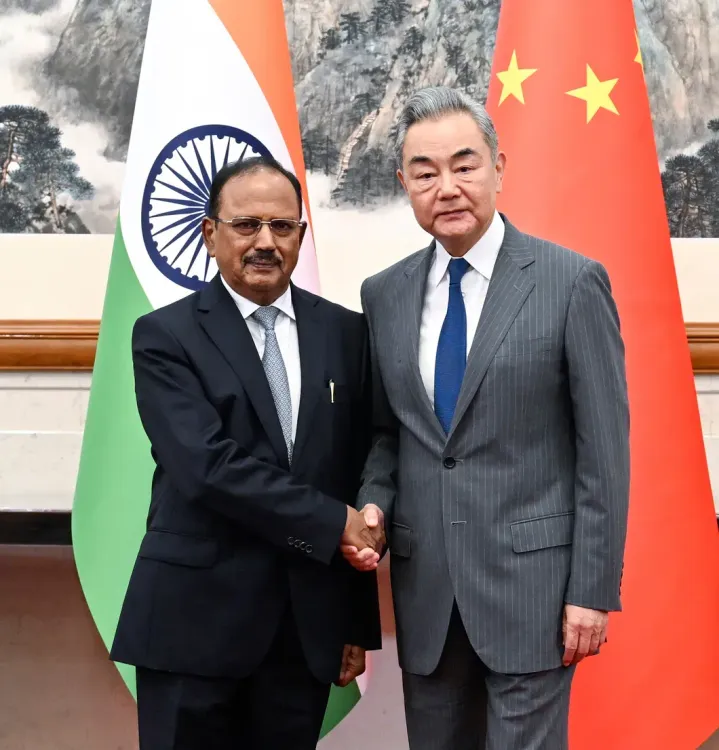
NSA Ajit Doval and Chinese Foreign Minister Wang Yi held the 25th Round of Special Representatives Talks on the India-China Boundary Question in Beijing on 25 August .
Both sides agreed to continue working toward a political settlement of the boundary question in the context of their overall and long-term interests.
Progress in implementing the consensus from the Modi-Xi summits in Kazan (October 2024) and Tianjin (August 2025) was reviewed.
The Kailash Manasarovar Yatra and border trade through three designated passes are cited as active confidence-building measures.
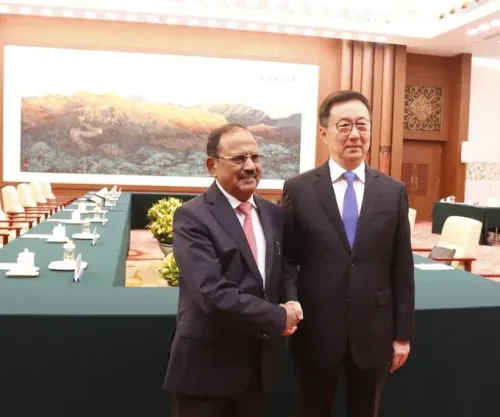
Doval also called on Chinese Vice-President Han Zheng during his two-day Beijing visit.
China described India-China relations as having 'global and strategic significance,' signalling Beijing's intent to sustain the diplomatic momentum.
National Security Advisor Ajit Doval, serving as India's Special Representative on the India-China Boundary Question, met Chinese Foreign Minister Wang Yi in Beijing on Tuesday, 25 August for the 25th Round of Special Representatives Talks on the boundary issue. The two sides agreed to continue working toward a political settlement of the boundary question, guided by the overall and long-term interests of both nations.
Key Developments from the Beijing Talks
The discussions were described as 'comprehensive, in-depth, friendly, and candid' by India's Ministry of External Affairs (MEA). Both sides reviewed progress made in implementing the consensus reached between Prime Minister Narendra Modi and Chinese President Xi Jinping during their summits in Kazan in October 2024 and Tianjin in August 2025.
The two sides also expressed satisfaction at the steady resumption of people-to-people and cross-border exchanges, specifically citing the ongoing Kailash Manasarovar Yatra and border trade through three designated border trading passes.
What India Said
According to the MEA statement issued after the meeting, both Special Representatives held their exchange 'in a constructive and forward-looking spirit' and 'agreed to continue their work in seeking a political settlement of the boundary question in the context of their overall and long-term interests.'
The statement further noted: 'The Indian side highlighted the importance of maintaining peace and tranquility in the India-China border areas for the continued development and progress of the bilateral relationship.'
The two sides also discussed bilateral, regional, and international issues of mutual interest during the course of the meeting.
What China Said
Wang Yi, who also serves as Director of the Office of the Central Foreign Affairs Commission and a Member of the Politburo of the Central Committee of the Communist Party of China, framed the relationship in broader strategic terms. According to China's Ministry of Foreign Affairs, Wang Yi described China and India as 'important neighbours and representatives of major developing countries and emerging economies.'
Wang Yi was quoted as saying: 'The healthy and stable development of China-India relations is in the fundamental interests of both peoples, meets the common aspirations of countries in the Global South, and aligns with the trend of the times. China-India relations have transcended the bilateral scope and possess global and strategic significance.'
He further stated that China is 'willing to work with India to grasp bilateral relations from a strategic and long-term perspective, strengthen communication, enhance understanding, eliminate differences, overcome obstacles, and be good-neighbourly and friendly friends and mutually beneficial partners, achieving a harmonious coexistence between the dragon and the elephant.'
Doval's Other Engagements in Beijing
NSA Doval was on a two-day visit to Beijing at the invitation of Wang Yi. In addition to the formal boundary talks, he called on Chinese Vice-President Han Zheng on Tuesday — a meeting that signals the diplomatic engagement extended beyond technical boundary discussions to the broader bilateral relationship.
Context and What Comes Next
The 25th Round of Special Representatives talks follows a period of gradual diplomatic thaw after the prolonged standoff along the Line of Actual Control (LAC) triggered by the Galwan Valley clash of June 2020. The Modi-Xi meetings in Kazan and Tianjin had already set the tone for a structured re-engagement, and Tuesday's talks represent a continuation of that framework. Notably, the resumption of the Kailash Manasarovar Yatra — suspended for years — is being cited as a concrete confidence-building measure. Whether the two sides can translate diplomatic warmth into a durable boundary settlement remains the central question as talks enter their next phase.
Point of View
Kept alive despite years of LAC tension. Wang Yi's 'dragon and elephant' framing is a well-worn Chinese diplomatic phrase, but its deployment here signals Beijing's interest in managing the relationship rather than letting it drift. India's consistent insistence on peace and tranquility as a prerequisite for broader normalisation is a calibrated position — it keeps the pressure on without closing the door. The real test will come when the political settlement framework moves from agreed language to agreed maps.
NationPress
10 Oct 2026
Frequently Asked Questions
What was decided at the 25th round of India-China Special Representatives talks?
India and China agreed to continue working toward a political settlement of the boundary question, guided by their overall and long-term interests. The talks, held in Beijing on 25 August between NSA Ajit Doval and Chinese Foreign Minister Wang Yi, were described as comprehensive, in-depth, and candid by India's MEA.
What is the India-China Special Representatives mechanism?
The Special Representatives mechanism is a high-level diplomatic channel established to negotiate a political settlement of the India-China boundary dispute. India is represented by the National Security Advisor, currently Ajit Doval, while China's representative is Foreign Minister Wang Yi. Tuesday's meeting was the 25th round of these talks.
What progress has been made in India-China relations since the Galwan clash?
Since the Galwan Valley clash of June 2020, India and China have gradually re-engaged through multiple diplomatic channels. Key milestones include the Modi-Xi summits in Kazan in October 2024 and Tianjin in August 2025, the resumption of the Kailash Manasarovar Yatra, and the restart of border trade through three designated passes.
Who did NSA Doval meet during his Beijing visit?
During his two-day visit to Beijing, NSA Ajit Doval held the formal boundary talks with Chinese Foreign Minister Wang Yi and also called on Chinese Vice-President Han Zheng on Tuesday. The visit was at the invitation of Wang Yi.
What did China's Wang Yi say about India-China relations?
Wang Yi described India and China as 'important neighbours and representatives of major developing countries and emerging economies,' stating that the relationship has 'global and strategic significance.' He said China is willing to 'eliminate differences, overcome obstacles,' and achieve 'harmonious coexistence between the dragon and the elephant.'