Netherlands' Minority Government Officially Takes Office After Extended Coalition Talks
Synopsis
In a historic move, the Netherlands has sworn in its first minority government after extensive coalition discussions. Led by Prime Minister Rob Jetten, this coalition aims to address pressing national issues from housing to climate policy. Discover the implications of this significant political shift.
Key Takeaways
New Dutch minority government sworn in at Huis ten Bosch Palace.
Coalition formed by D66, VVD, and CDA.
Government aims to address housing, climate, and security issues.
66 seats in the House of Representatives but lacks a majority.
Collaboration with other parties is crucial for success.
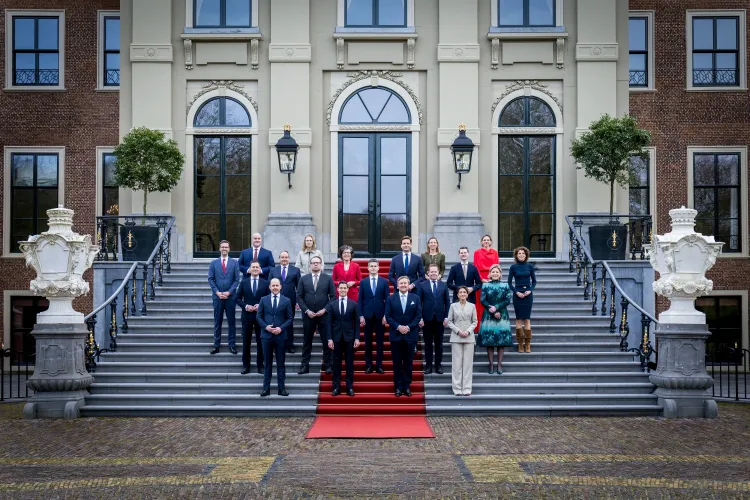
The Hague, Feb 23 (NationPress) A new minority government in the Netherlands was formally inaugurated on Monday at the Huis ten Bosch Palace in The Hague, following over 110 days of coalition negotiations after the October 29 general election last year.
Following the conclusion of the previous administration, 18 ministers and 10 state secretaries took their oaths.
The emerging coalition consists of Democrats 66 (D66), the People's Party for Freedom and Democracy (VVD), and the Christian Democratic Appeal (CDA), with the formation announced on January 30, as reported by Xinhua. Prior to the official swearing-in, Prime Minister Rob Jetten had a preliminary meeting with King Willem-Alexander, symbolizing the handover to the new government.
The inaugural cabinet meeting is set for Monday afternoon, where the government’s initial task will be to outline its policy program based on the coalition agreement.
According to this agreement, the government aims to focus on enhancing the effectiveness of public administration, expediting housing development and energy transitions, pursuing proactive climate strategies, fostering high-tech sectors for economic growth, tightening immigration regulations, reforming social security and healthcare systems, and bolstering national security and international collaboration.
A total of 27 parties participated in the parliamentary elections last October, with 15 securing seats in the House of Representatives. The D66 and the Party for Freedom (PVV) each captured 26 seats, followed by the VVD with 22 and the GreenLeft-Labour alliance (GroenLinks-PvdA) with 20. The CDA and JA21 obtained 18 and 9 seats, respectively.
On January 9, the D66, VVD, and CDA revealed their intention to create a minority cabinet. Forming a government without majority backing is uncommon in Dutch politics. The three parties hold 66 seats in the 150-member House of Representatives, which is 10 seats short of a majority, and 16 seats short of a majority in the Senate.
"The Netherlands does not follow a tradition of minority cabinets. Thus, we are navigating uncharted territory," stated the coalition agreement by the three parties. "The success of this cabinet relies on its ability to cooperate with the House of Representatives and the Senate, other governmental bodies, and civil society organizations."
Point of View
It’s clear that the establishment of a minority government in the Netherlands is a significant development in the political landscape. This coalition, formed without a parliamentary majority, reflects a willingness to engage with diverse political views. The success of this government will largely depend on its ability to collaborate effectively with other political entities and civil society.
NationPress
22 Sept 2026
Frequently Asked Questions
What is a minority government?
A minority government is formed when a political party or coalition does not have an absolute majority of seats in the legislature, requiring cooperation with other parties to pass legislation.
Why is this minority government significant?
This government is significant as it marks a departure from the traditional coalition model in Dutch politics, introducing new dynamics in governance.
What are the priorities of the new government?
The new government aims to improve public administration efficiency, accelerate housing construction, reform social security, and strengthen national security.
Who are the main parties in the coalition?
The coalition consists of Democrats 66 (D66), the People's Party for Freedom and Democracy (VVD), and the Christian Democratic Appeal (CDA).
What challenges does the new government face?
The primary challenge is to effectively govern without a majority, requiring strong collaboration with other political factions and civil society.