White House: FLOTUS Champions Women's Health Executive Order
Synopsis
The White House has announced a new executive order, championed by the First Lady, that creates a White House Women's Health Task Force and establishes a new Women's Health Division within the NIH, targeting research, prevention, diagnosis, and care for girls and women across all life stages.
Key Takeaways
A new executive order signed at the White House targets women's and girls' health across every stage of life.
The order creates a White House Women's Health Task Force to coordinate federal policy.
A dedicated Women's Health Division will be established within the NIH , the primary U.S. federal biomedical research agency.
The NIH Office of Research on Women's Health has existed since 1990 ; the new division represents a fresh, expanded institutional layer.
FLOTUS is publicly championing the initiative, lending White House political visibility to the health agenda.
Full implementation details — staffing, budget, and congressional oversight — are still pending.
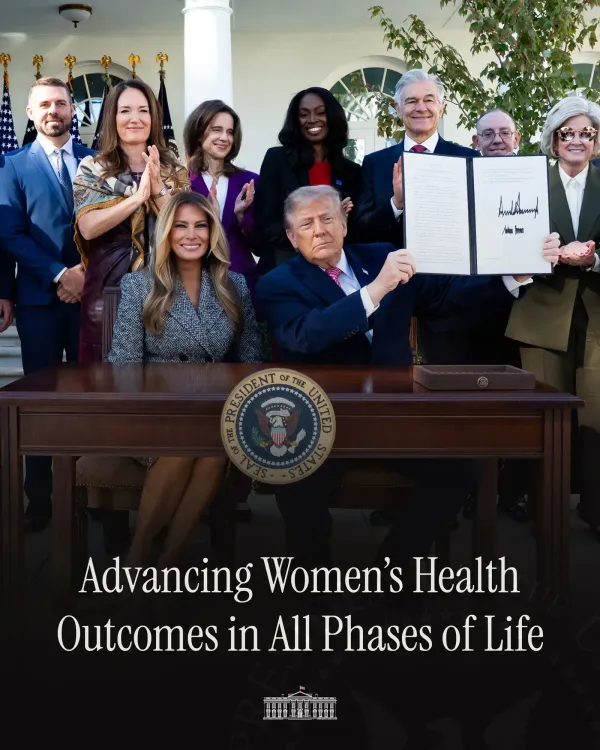
A new executive order signed at the White House is set to reshape how the United States researches, diagnoses, and treats health conditions affecting girls and women — from infancy through old age. The First Lady of the United States (FLOTUS) is championing the initiative, which creates a White House Women's Health Task Force and establishes a dedicated Women's Health Division within the National Institutes of Health (NIH).
What the Executive Order Creates
The order operates on two parallel tracks. The first is a White House Women's Health Task Force — a coordinating body designed to drive policy coherence across federal agencies. The second is a new Women's Health Division inside the NIH, the primary federal engine for biomedical research, which will anchor the scientific mission: strengthening research, prevention, diagnosis, treatment, and care for women at every stage of life.
The White House described the initiative as covering girls and women 'throughout every stage of life' — a signal that the scope runs well beyond reproductive health, encompassing conditions from adolescence through menopause and beyond.
Thirty-Five Years of Institutional History at the NIH
The new division arrives on top of — and distinct from — an existing structure. The NIH Office of Research on Women's Health was established in 1990, following congressional pressure to correct decades of clinical research that had largely enrolled male subjects and generalised findings to women. That office promoted the inclusion of women in clinical trials and seeded dedicated funding streams. The new Women's Health Division appears to expand that mandate with a fresh institutional footprint and, presumably, new resourcing — though full staffing details and budget figures are yet to be disclosed.
A Pattern of Executive Action on Women's Health Gaps
U.S. administrations across party lines have periodically used executive orders and new offices to address gaps in women's health research and care. The recurring tool — a task force here, a dedicated division there — reflects a structural reality: Congress moves slowly, but the executive branch can reorganise federal priorities quickly. The durability of such bodies, however, often depends on subsequent budget requests and congressional buy-in.
For the global health community, an NIH women's health division carries particular weight. The NIH funds research consumed by scientists worldwide, meaning a structural shift in its research priorities has ripple effects far beyond Washington, D.C.
What Comes Next: Implementation and Oversight
The real test will come in the details — how the new NIH division is staffed, what specific research mandates it carries, and whether the administration follows the executive order with a meaningful budget request. Congressional oversight committees will be watching, and advocacy groups focused on conditions historically underfunded in women's health research — from cardiovascular disease to autoimmune disorders — will measure progress against specific funding benchmarks.
For now, the First Lady's public championing of the order sends a clear signal: women's health is a named priority of this administration, backed by institutional architecture designed to outlast a single news cycle.
Point of View
This executive order attempts to bridge the gap between political will and scientific institution — a combination that has historically given women's health initiatives more staying power than either mechanism alone. The First Lady's visible role as champion is a deliberate choice: FLOTUS-led health campaigns carry cross-partisan cultural reach that cabinet secretaries rarely match. The deeper question is whether the new NIH division will be resourced to move beyond symbolic architecture into funded research mandates. Given that the NIH's output shapes global biomedical science, even incremental shifts in its women's health priorities carry consequences well beyond U.S. borders.
NationPress
22 Oct 2026
Frequently Asked Questions
What is the White House Women's Health Task Force?
It is a new coordinating body created by executive order to drive federal policy on women's and girls' health research, prevention, diagnosis, treatment, and care across all life stages.
What is the new NIH Women's Health Division?
It is a new division to be established within the National Institutes of Health — the primary U.S. federal biomedical research agency — focused specifically on women's health research and care.
What role is FLOTUS playing in this initiative?
The First Lady of the United States is publicly championing the executive order, giving it high-profile White House visibility beyond a standard policy announcement.
Does the NIH already have a women's health office?
Yes. The NIH Office of Research on Women's Health was established in 1990 to promote research on conditions affecting women and ensure their inclusion in clinical trials. The new division is a separate, additional structure.
What happens next after the executive order is signed?
Key milestones to watch include the staffing of the new NIH division, any related federal budget requests, and congressional oversight hearings that will determine how robustly the initiative is funded.