How is German Chancellor Tackling the Economic Crisis and Making Recovery a 2026 Goal?
Click to start listening
Synopsis
In a bold declaration, German Chancellor Friedrich Merz has outlined plans to make economic recovery a top priority for 2026, citing the urgent need for legislative action to enhance competitiveness. With a critical economic outlook ahead, how will these strategies reshape Germany's future? Tune in to find out what this means for Europe as a whole.
Key Takeaways
- 2026 is set as a critical year for Germany's economic recovery.
- The government aims to enhance competitiveness through decisive actions.
- Challenges include high energy costs and global demand issues.
- Merz emphasizes the need for technological innovation.
- Europe must strengthen its global presence amidst changing dynamics.
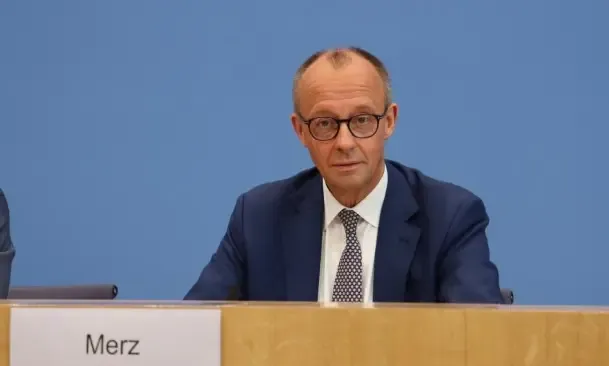
Berlin, Jan 6 (NationPress) German Chancellor Friedrich Merz emphasized that revitalizing economic growth will be the government's top priority in 2026, acknowledging that previous measures have fallen short in enhancing Germany's competitiveness. In a letter to coalition members at the year's start, Merz described the economic situation as "very critical in some sectors," according to a report from the German news agency dpa.
For 2026, he stressed the need for significant political and legislative measures to improve conditions for businesses, asserting that only then could the economy resume its growth trajectory, as reported by Xinhua.
Germany's economy contracted in both 2023 and 2024. Winter forecasts from several top German economic institutes in December 2025 projected a meager growth of just 0.1% in 2025, citing a decline in external demand, particularly a significant drop in exports to the United States.
Experts noted that Germany's recovery has been hindered by high energy costs, weak global demand, and sluggish structural reforms, compounded by US tariff increases in 2025 which have added pressure on exporters.
Since assuming office in May 2025, Merz has committed to rejuvenating Europe's largest economy through extensive public spending and heightened investment in defense and infrastructure. His administration has recognized that recovery will be gradual and has initiated tax cuts and various reforms, although business groups argue that the pace of change is still too slow.
In his New Year's address, the Chancellor asserted the importance of Europe asserting its interests amid a volatile global landscape.
He described the current global environment as an "epochal shift," characterized by geopolitical instability, a resurgence of protectionism, and evolving transatlantic relations.
"Our partnership with the United States, once a steadfast guarantor of our security, is transforming," he stated. "This compels Europeans to defend and promote our interests more vigorously on our own."
Regarding security, Merz highlighted that Germany must enhance its deterrence and defense capabilities to maintain long-term peace.
On the economic front, he pledged that his government, which took shape after the federal elections in February 2025, will prioritize restoring Germany's competitiveness by reducing bureaucratic barriers and promoting technological advancements.
"We are not victims of external circumstances. We are not at the mercy of major powers," he emphasized, asserting that 2026 could be a pivotal year for both Germany and Europe.
"It can be a year where Germany and Europe, with renewed vigor, reconnect with decades of peace, freedom, and prosperity," he declared.
Point of View
It's crucial to recognize the significant implications of Chancellor Merz's statements on Germany's economy. His commitment to prioritizing economic recovery in 2026 reflects not only a response to current challenges but also a strategic vision for the future. The focus on enhancing competitiveness and fostering innovation is essential for Germany to navigate the complexities of a changing global landscape.
NationPress
07/01/2026
Frequently Asked Questions
What is the main priority of the German government for 2026?
Restoring economic growth is the main priority of the German government for 2026, as emphasized by Chancellor Friedrich Merz.
What challenges is Germany's economy currently facing?
Germany's economy is facing challenges such as high energy costs, weak global demand, and slow structural reforms.
How has the U.S. impacted Germany's economy?
The U.S. has impacted Germany's economy through tariff hikes that have added pressure on German exporters.
What measures has Chancellor Merz proposed to revive the economy?
Chancellor Merz has proposed large-scale public spending, tax cuts, and reforms to cut bureaucratic barriers and promote innovation.
What did Merz say about Europe's role in global affairs?
Merz stated that Europe must assert its interests more strongly as global dynamics change.