Piyush Goyal pitches India as world's best data centre hub in Chicago
Synopsis
Commerce Minister Piyush Goyal told Indian-Americans in Chicago that building a data centre in India costs one-fourth to one-fifth of US or European rates, with clean energy available round the clock at 7-8 cents — a direct pitch to redirect global digital infrastructure investment toward India amid geopolitical uncertainty.
Key Takeaways
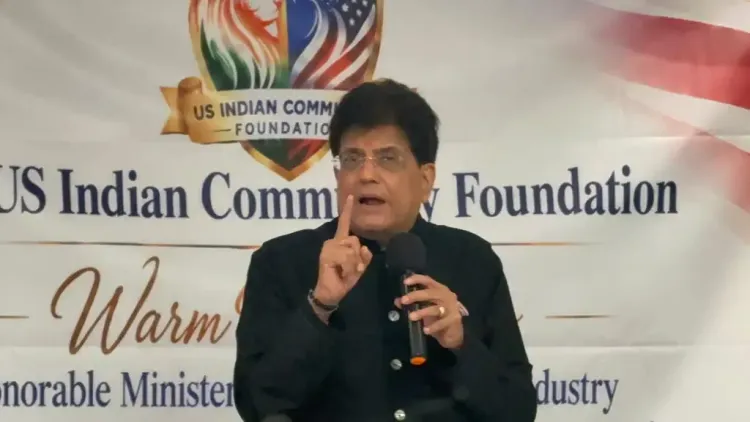
Commerce Minister Piyush Goyal addressed the US Indian Community Foundation in Chicago on 3 October 2026 , pitching India as the world's top data centre destination.
India's national grid stands at 520 gigawatts — the world's second-largest after China — with 60% clean energy capacity; the grid is projected to reach 1,000 GW by 2033 , with 70% clean energy.
Data centre construction costs in India are one-fourth to one-fifth of equivalent costs in the US or Europe.
Data costs in India could be as low as 5-8% of US per-gigabyte rates, according to Goyal.
India graduates approximately 1.4 million STEM students annually, underpinning its technology talent pitch.
Goyal said India plans to bring a large multi-sectoral business delegation to the US region, possibly in the first quarter of next year .
Commerce and Industry Minister Piyush Goyal on 3 October 2026 made a strong pitch for India as the world's premier destination for global data centres, telling Indian-Americans at a community gathering in Chicago that the country offers an unmatched combination of low-cost clean energy, a unified national power grid, cheap data infrastructure, and a deep technology talent pool.
The Core Pitch
Addressing the event organised by the US Indian Community Foundation, Goyal argued that geopolitical uncertainty was reshaping where companies choose to house their data. 'Amongst the trusted world, countries where you feel safe with your data, where you feel safe to invest in the current geopolitical context, India is the world's best location to house data centres,' he said.
The minister pointed out that building data-centre infrastructure in India costs between one-fourth and one-fifth of what it would cost in the United States or Europe. Data costs in India, he added, could be as low as five to eight per cent of what users pay per gigabyte in the US.
India's Grid: Scale and Clean Energy Mix
Goyal underscored a dramatic shift in India's power infrastructure since 2014, when multiple fragmented regional grids operated with uneven supply. Those grids have since been unified into a single national network. 'So today, after China, we have the largest grid in the world,' he said. 'India has a national grid. 520 gigawatts in one connected grid. And in another 6 or 7 years, this will become 1000 gigawatts.'
Clean energy — comprising solar, wind, hydro, and nuclear — already accounts for 60 per cent of the installed capacity of the 520-gigawatt grid. By 2033, when capacity is projected to reach 1,000 gigawatts, Goyal said 70 per cent of installed capacity would be from clean sources.
This scale matters specifically for data centres, which require multiple layers of power redundancy. Goyal said companies can currently secure 80 per cent guaranteed clean energy round the clock at seven to eight US cents per unit, while 100 per cent clean energy is available at roughly 11 to 12 cents. 'Nowhere in the world can you get this level of redundancy and clean energy together at these data points,' he said.
Tech Talent and Investment Appeal
Beyond infrastructure, Goyal highlighted India's human capital advantage, noting that approximately 1.4 million students graduate annually in science, technology, engineering, and mathematics (STEM). He invited Indian-American entrepreneurs and US companies to participate in India's economic expansion through investment, technology transfers, and knowledge-sharing.
'The United States of America has capital strength, technology strength. India has ambition,' Goyal said, adding that the India-US partnership would 'continue to grow, continue to prosper, continue to provide opportunities.'
G20 Trade Meet and Business Engagements
The Chicago community address followed Goyal's participation in the G20 Trade Ministers' Meeting in Milwaukee, where ministers deliberated on global trade challenges, the future of the World Trade Organisation (WTO), and concerns over goods produced through forced labour and state-supported excess production capacity.
During his Chicago visit, Goyal also met American businesses and investors — both through industry groups and in one-on-one sessions with large investors. He indicated that India planned to bring a large, multi-sectoral business delegation to the region, possibly in the first quarter of next year.
With clean energy costs, grid scale, data infrastructure pricing, and talent all cited as competitive advantages, the minister's push signals a deliberate effort to position India as the preferred alternative in a world reconfiguring its digital supply chains.
Point of View
And the clean energy cost numbers — if verifiable by independent benchmarks — are compelling. However, data centre investors also weigh regulatory predictability, data localisation norms, and land acquisition timelines, none of which Goyal addressed. India's Digital Personal Data Protection framework is still being operationalised, and uncertainty there could blunt the infrastructure cost advantage. The one-fourth-to-one-fifth cost claim deserves scrutiny: it likely reflects greenfield land and labour differentials, not the full lifecycle cost including compliance, connectivity, and cooling. A pitch without a policy roadmap risks being dismissed as ministerial salesmanship rather than a fundable investment thesis.
NationPress
3 Oct 2026
Frequently Asked Questions
Why is Piyush Goyal pitching India as a global data centre hub?
Commerce and Industry Minister Piyush Goyal is pitching India as a global data centre hub because the country offers a rare combination of a large unified clean-energy grid, infrastructure costs one-fourth to one-fifth of those in the US or Europe, and data costs at 5-8% of US rates. The pitch is aimed at US companies and Indian-American entrepreneurs looking for geopolitically stable, cost-efficient alternatives for digital infrastructure investment.
What is the size and clean energy mix of India's national power grid?
India's national power grid currently has an installed capacity of 520 gigawatts, making it the world's second-largest after China. Clean energy — solar, wind, hydro, and nuclear — accounts for 60% of that capacity, and Goyal said this is projected to reach 70% when the grid expands to 1,000 gigawatts by 2033.
How do India's data centre costs compare with those in the US?
According to Goyal, building data centre infrastructure in India costs between one-fourth and one-fifth of what it would cost in the United States or Europe. Data costs per gigabyte in India are around 5-8% of US rates, making India one of the most cost-competitive locations globally for digital infrastructure.
What clean energy pricing did Goyal quote for data centres in India?
Goyal said companies can currently secure 80% guaranteed clean energy round the clock in India at 7-8 US cents per unit, while 100% clean energy is available at approximately 11-12 cents. He described this combination of price, redundancy, and clean sourcing as unmatched anywhere in the world.
What other engagements did Piyush Goyal undertake during his US visit?
Before the Chicago community address, Goyal attended the G20 Trade Ministers' Meeting in Milwaukee, where discussions covered global trade challenges, the future of the WTO, and concerns over forced-labour goods and excess state-supported production capacity. In Chicago, he also met US businesses and investors through industry groups and individual meetings, and indicated plans to bring a large Indian business delegation to the region in early next year.