Pakistan's Hangor submarines: China reliance deepens amid engine reliability doubts
Synopsis
Pakistan's $4.8 billion Hangor submarine programme is cementing a near-total reliance on China for advanced naval technology — but the centrepiece vessel may carry an unproven engine. Germany's refusal to export its trusted MTU diesel has forced a switch to China's domestically developed CHD620, which critics say has never been battle-tested in a front-line fleet. For Pakistan's navy, the question isn't just strategic partnership — it's whether the submarines will perform when it matters.
Key Takeaways
Pakistan's Hangor-class submarine programme involves eight vessels under a roughly $4.8 billion China-Pakistan agreement.
Four submarines are being built in China; four will be assembled at Karachi Shipyard and Engineering Works .
Germany has refused export licences for its MTU diesel engines , forcing a switch to China's CHD620 engine.
Critics argue the CHD620 lacks a verified operational track record in front-line submarine fleets.
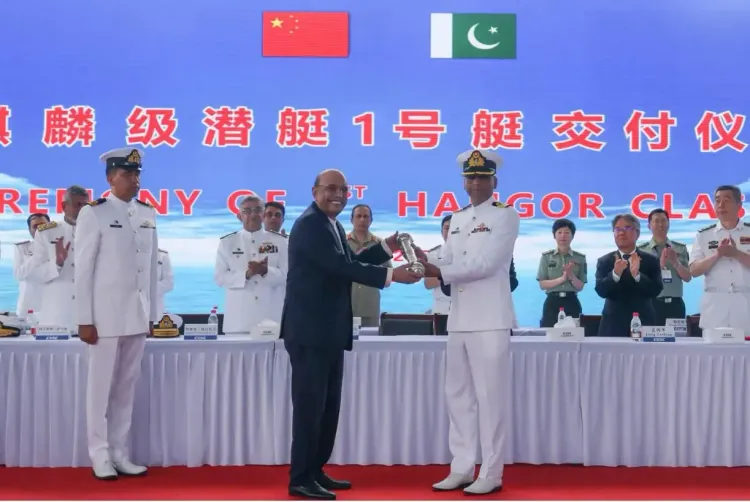
The first Hangor-class submarine was commissioned in 2026 , with China supplying propulsion, electronics, weapons, and spare parts.
Analysts warn the programme raises significant regional security concerns given the fleet's potential uplift to Pakistan's subsurface capabilities.
Pakistan's Hangor-class submarine programme has thrown into sharp relief the country's deepening dependence on China for advanced defence technology, with Beijing supplying critical components spanning propulsion systems, electronics, weapons, and spare parts, according to a report by the Afghan Diaspora Network. The programme, which reached a symbolic milestone in 2026 with the commissioning of Pakistan's first Hangor-class vessel, has simultaneously raised pointed questions about operational reliability and regional security implications.
The Hangor Programme at a Glance
The project is anchored in a roughly $4.8 billion agreement between Pakistan and China covering eight submarines. Of these, four are being constructed entirely in China, while the remaining four are slated for assembly at Karachi Shipyard and Engineering Works in Pakistan. The vessels are based on China's Yuan-class submarine design and are expected to form the backbone of Pakistan's future underwater fleet. When the first boat was commissioned, Pakistani officials publicly described it as 'a major milestone for the country's navy and a symbol of a growing strategic partnership with China,' the report noted.
The Engine Problem: Germany's Refusal and China's Alternative
One of the programme's most consequential challenges involves propulsion. China's own Yuan-class submarines are powered by German-made MTU diesel engines, widely regarded as among the most reliable and acoustically quiet propulsion systems available for conventional submarines. Berlin, however, has refused to grant export licences for these engines for use in Chinese submarine exports — a restriction that has affected other buyers as well. Thailand's proposed purchase of an export variant of the same submarine design encountered an identical setback.
As a consequence, Pakistan's Hangor submarines are believed to be equipped with China's domestically developed CHD620 diesel engine. Beijing has promoted the engine as a credible alternative, but analysts and critics argue that the CHD620 lacks a publicly verified operational track record in front-line submarine fleets. 'Unlike the German MTU system, the CHD620 lacks a publicly known operational track record in front-line submarine fleets. Critics argue that extensive testing cannot fully substitute for years of real-world service at sea,' the Afghan Diaspora Network report stated.
Why Reliability Matters Underwater
The concerns carry operational weight. A submarine's combat effectiveness depends not only on its weapons and sensors but critically on propulsion reliability, noise signature, and maintenance cycles. Any deficiencies in these areas could measurably reduce the Hangor fleet's performance relative to the Yuan-class submarines on which the design is based, according to the report. Notably, stealth — a submarine's primary tactical advantage — is directly tied to how quietly its engines run, making the propulsion question central rather than peripheral.
China as Pakistan's Principal Defence Partner
The Hangor programme is a microcosm of the broader China-Pakistan defence relationship. With Beijing supplying not just hull designs but also electronics, weapons systems, and spare parts, Islamabad's navy is structurally reliant on a single external partner for its most sophisticated platforms. The arrangement, the report observed, reflects the deepening military ties between the two countries, with China having firmly established itself as Pakistan's principal defence partner. This comes amid sustained Western restrictions on arms transfers to Pakistan and declining US military engagement since the Afghanistan drawdown.
Regional Security Implications
Beyond the technical debate, analysts have flagged what an expanding Pakistani submarine fleet could mean for the balance of naval power in the Indian Ocean and the Arabian Sea. Eight modern submarines — even with questions around their engines — would represent a significant uplift for a navy that currently operates a small and ageing underwater fleet. How the Hangor programme ultimately performs in service will shape assessments of both Chinese export defence technology and Pakistan's ability to project subsurface power in the region.
Point of View
Electronics, and spares. The CHD620 engine controversy is not a footnote; it goes to the heart of whether these submarines can deliver stealth and reliability under real operational conditions. Beijing's inability to secure German MTU licences for its own fleet exports is a known constraint, and Pakistan is now absorbing that risk. More broadly, the programme illustrates how China's expanding role as an arms supplier can deepen strategic dependency even as it delivers headline capability — a pattern worth watching across other South Asian and African procurement relationships.
NationPress
21 Nov 2026
Frequently Asked Questions
What is Pakistan's Hangor-class submarine programme?
The Hangor-class submarine programme is an eight-vessel acquisition deal worth roughly $4.8 billion between Pakistan and China, based on China's Yuan-class design. Four boats are being built in China and four are to be assembled at Karachi Shipyard and Engineering Works in Pakistan.
Why are there concerns about the Hangor submarines' engines?
Pakistan's Hangor submarines are believed to use China's domestically developed CHD620 diesel engine after Germany refused to grant export licences for the more proven German MTU diesel engines used in China's own Yuan-class fleet. Critics argue the CHD620 lacks a publicly known operational track record in front-line submarine service.
How does Germany's export refusal affect the programme?
Germany denied export licences for its MTU diesel engines for use in Chinese submarine exports, forcing China to substitute its own CHD620 engine in vessels sold abroad — including to Pakistan. Thailand faced the same obstacle when it sought to purchase a similar export submarine from China.
What does the programme reveal about China-Pakistan defence ties?
The Hangor programme underscores China's role as Pakistan's principal defence partner, supplying not just the submarine hull design but also propulsion systems, electronics, weapons, and spare parts. It reflects a deepening military relationship that has grown as Western arms transfers to Pakistan have remained constrained.
What are the regional security implications of Pakistan's expanding submarine fleet?
Analysts have noted that eight modern submarines would represent a significant capability upgrade for Pakistan's navy in the Indian Ocean and Arabian Sea region. The programme's operational success or failure will shape assessments of Chinese naval export technology and Pakistan's subsurface power projection.