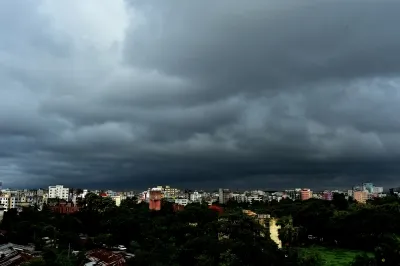
Typhoon Dujuan nears Tokyo coast with 198 kph gusts, heavy rain alert

Synopsis
Typhoon Dujuan — Japan's 25th typhoon of the year — is closing in on the Tokyo coastline with 198 kph gusts, a level 4 landslide alert in Chiba, and up to 350 mm of rain forecast in 24 hours. The timing, smack in the middle of a five-day national holiday, makes this one of the season's most disruptive storms yet.
Key Takeaways
Typhoon Dujuan , the year's 25th typhoon , is approaching Japan's eastern Pacific coast on 21 September 2026 .
As of 10 am local time , the storm was 100 km west-southwest of Hachijo Island , moving north at 25 kph with gusts of 198 kph .
The JMA has issued a level 4 landslide alert for parts of Chiba Prefecture , with road inundation already reported.
Rainfall totals of up to 350 mm (Tokai), 300 mm (Kanto and Izu Islands), and 200 mm (Tohoku) are forecast within 24 hours .
Highway closures and bullet train disruptions are underway; the storm coincides with a five-day national holiday in Japan.
Earlier in August , Typhoon Chan-hom injured seven people after landfall in Ibaraki Prefecture .
Typhoon Dujuan, the year's 25th typhoon, is barreling toward Japan's eastern Pacific coast on Monday, 21 September, with the Japan Meteorological Agency (JMA) issuing warnings of heavy rain, strong winds, flooding, and landslides across multiple regions. The storm poses a direct threat to the densely populated Kanto and Tokai regions, coinciding with a five-day national holiday period.
Current Position and Intensity
As of 10 am local time, Typhoon Dujuan was positioned approximately 100 km west-southwest of Hachijo Island in the Izu Island chain near Tokyo, tracking northward at 25 km per hour. The storm carried a central atmospheric pressure of 960 hectopascals and maximum gusts reaching 198 kph, according to the JMA — placing it firmly in the category of a powerful, large-scale typhoon.
The storm is expected to pass near the Boso Peninsula in Chiba Prefecture, east of Tokyo, from Monday evening through late night.
Rainfall Forecasts and Landslide Alerts
Heavy downpours had already struck the Kanto-Koshin region in eastern Japan and the Tokai region in central Japan by Monday morning. Road inundation was reported across multiple cities in Chiba, and the JMA issued a level 4 landslide alert for parts of the prefecture — one step below the maximum warning level.
Rainfall forecasts for the 24 hours through 6 am Tuesday are significant: up to 350 mm in the Tokai region, 300 mm in the Kanto region and Izu Island chain, and 200 mm in the Tohoku region in northeastern Japan. Such totals raise serious flood and landslide risk, particularly in hilly and coastal zones.
Transport Disruptions and Public Warnings
The typhoon has already triggered partial closures of highway networks. Bullet train services connecting Tokyo and western Japan face potential delays and cancellations from Monday afternoon. Authorities have urged residents to monitor the latest JMA updates and take precautions, including reconsidering travel plans during the holiday period.
The timing is notable — a five-day holiday break typically sees heightened domestic travel across Japan, compounding the risk to commuters and tourists alike.
Earlier August Typhoon Context
This is not Japan's first significant typhoon of the season. In August, Typhoon Chan-hom made landfall in Ibaraki Prefecture in eastern Japan, injuring seven people — two in Iwate Prefecture, four in Ibaraki, and one in Tochigi Prefecture, according to the Fire and Disaster Management Agency. Dujuan arrives as a considerably stronger and more centrally tracked storm, heightening concerns among emergency management officials.
With the storm yet to make its closest approach, conditions are expected to deteriorate through Monday night before gradually easing into Tuesday morning.
Point of View
A five-day national holiday, and already-saturated ground in Kanto and Tokai creates a compounding risk that forecasts alone do not fully convey. Japan's bullet-train network is a critical national artery, and disruptions of this scale have downstream economic effects beyond tourism. More broadly, the season's 25th named typhoon by late September underscores a pattern of intensifying Pacific storm activity that emergency planners cannot treat as routine.
NationPress
21 Sept 2026
Frequently Asked Questions
What is Typhoon Dujuan and where is it headed?
Typhoon Dujuan is the 25th typhoon of the year in Japan, moving northward toward the eastern Pacific coast. As of 21 September, it was located about 100 km west-southwest of Hachijo Island and expected to pass near the Boso Peninsula in Chiba Prefecture, east of Tokyo, from Monday evening.
How strong is Typhoon Dujuan?
Typhoon Dujuan has a central atmospheric pressure of 960 hectopascals and maximum gusts of 198 kph, according to the Japan Meteorological Agency. These figures classify it as a large and powerful typhoon.
What warnings has the Japan Meteorological Agency issued?
The JMA has warned of heavy rain, strong winds, flooding, and landslides across multiple regions. It has also issued a level 4 landslide alert — one step below the maximum — for parts of Chiba Prefecture.
How much rain is forecast from Typhoon Dujuan?
The JMA forecasts up to 350 mm of rain in the Tokai region, 300 mm in the Kanto region and Izu Island chain, and 200 mm in the Tohoku region — all within the 24 hours through 6 am Tuesday.
How is Typhoon Dujuan affecting transportation in Japan?
The typhoon has already forced partial highway closures and is expected to cause delays and cancellations of bullet train services connecting Tokyo and western Japan from Monday afternoon. The disruption is compounded by a five-day national holiday period with elevated travel demand.