How is India Upholding its 'Neighbourhood First' Policy Through Humanitarian Aid to Sri Lanka?
Synopsis
In a show of solidarity, India has launched 'Operation Sagar Bandhu' to deliver critical humanitarian aid to Sri Lanka, following the devastating impacts of Cyclone Ditwah. With substantial supplies sent, the initiative underscores India's commitment to its 'Neighbourhood First' policy.
Key Takeaways
India is providing significant humanitarian aid to Sri Lanka through Operation Sagar Bandhu.
4.5 tonnes of dry rations and 2 tonnes of fresh rations have been delivered.
The initiative reinforces India's commitment to its Neighbourhood First policy.
Prime Minister Modi has expressed condolences for the victims of Cyclone Ditwah.
Severe weather continues to affect daily life and infrastructure in Sri Lanka.
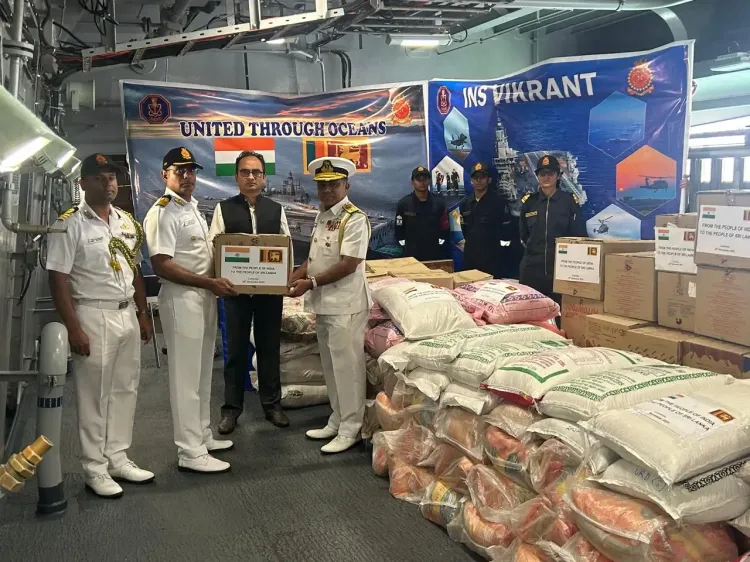
Colombo, Nov 28 (NationPress) The Indian High Commission in Sri Lanka announced on Friday that 'Operation Sagar Bandhu' is currently in progress, as India has dispatched essential Humanitarian Assistance and Disaster Relief (HADR) to Sri Lanka following the devastation caused by Cyclone Ditwah.
The Indian High Commission confirmed that India has delivered 4.5 tonnes of dry rations, 2 tonnes of fresh rations, and various other crucial relief supplies via the Indian Naval Ships (INS Vikrant) and (INS Udaygiri) to support families affected by the cyclone.
"Operation Sagar Bandhu is actively providing urgent HADR assistance to Sri Lanka post-Cyclone Ditwah. India remains committed to supporting Sri Lanka in this difficult time, reaffirming its steadfast dedication to the Neighbourhood First policy," stated the Indian High Commission in Sri Lanka on X.
Earlier, Prime Minister Narendra Modi expressed his condolences to the Sri Lankan people mourning their losses due to Cyclone Ditwah and announced the dispatch of relief materials and HADR support as part of 'Operation Sagar Bandhu'.
"I extend my heartfelt condolences to the families in Sri Lanka who have lost loved ones due to Cyclone Ditwah. I pray for the safety and recovery of all affected. In solidarity with our closest maritime neighbor, India has urgently sent relief and vital HADR support under Operation Sagar Bandhu," PM Modi wrote on X.
"We are prepared to offer further aid as the situation develops. Guided by India’s Neighbourhood First policy and Vision MAHASAGAR, India stands united with Sri Lanka in its time of need," he added.
Reports from Sri Lanka's Disaster Management Centre (DMC) indicate that at least 56 lives have been lost, 14 people injured, and 21 are missing due to the impacts of Cyclone Ditwah.
According to the DMC, around 43,991 individuals from 12,313 families have been affected by the extreme weather, as reported by Sri Lanka's 'Daily Mirror'. Four homes have been completely destroyed, and 666 houses have suffered partial damage due to the storm.
Severe weather persists in Sri Lanka, with heavy rains, rising floodwaters, and landslides disrupting daily life across various regions, as stated in the report.
President Anura Kumara Dissanayake has instructed the Army to assist those impacted by the ongoing adverse weather conditions. Over 20,500 Army personnel have been deployed for rescue operations.
Dissanayake has also ordered the Tourism Authority to ensure essential services for foreign tourists affected by the current emergency situation, according to the Daily Mirror.
More than 65,000 power outages have been reported in Sri Lanka, with approximately 26,000 restored thus far. Airport authorities indicate that 15 inbound flights have been diverted from Bandaranaike International Airport (BIA) since 10:55 PM on Thursday due to unsafe landing conditions resulting from severe weather. These flights were rerouted to Mattala Rajapaksa International Airport (MRIA), Trivandrum, and Cochin.
The India Meteorological Department (IMD) issued a cyclone alert for north Tamil Nadu, Puducherry, and nearby regions of south Andhra Pradesh, stating that Cyclone Ditwah over coastal Sri Lanka and the adjacent southwest Bay of Bengal has moved north-northwest at a speed of 10 kmph. As of 0830 hours IST on November 28, 2025, it is centered about 40 km southwest of Trincomalee.
"It is expected to continue moving north-northwestward across the Sri Lankan coast and into the southwest Bay of Bengal, reaching the coasts of North Tamil Nadu and Puducherry by the early morning of November 30," the IMD warned.
Point of View
The ongoing humanitarian efforts by India reflect a deep commitment to regional solidarity. The prompt response to Cyclone Ditwah highlights the importance of neighborly support during crises. This initiative not only aids those in immediate need but also reinforces the ties that bind nations in times of distress.
NationPress
23 Sept 2026
Frequently Asked Questions
What is Operation Sagar Bandhu?
Operation Sagar Bandhu is an initiative by India to provide urgent humanitarian assistance and disaster relief to Sri Lanka in the aftermath of Cyclone Ditwah.
What assistance has India provided to Sri Lanka?
India has delivered 4.5 tonnes of dry rations, 2 tonnes of fresh rations, and various essential relief items to assist families impacted by Cyclone Ditwah.
How has Cyclone Ditwah affected Sri Lanka?
Cyclone Ditwah has resulted in at least 56 fatalities, numerous injuries, and significant damage to homes, affecting over 43,991 individuals across the country.
What is the Neighbourhood First policy?
The Neighbourhood First policy is India's approach to prioritize friendly relations and cooperation with its neighboring countries, especially during crises.
Is further aid expected from India?
Yes, India has expressed its readiness to provide additional aid and support to Sri Lanka as the situation evolves.