India-Myanmar sign MoUs on 5 Quick Impact Projects under Mekong-Ganga Cooperation
Synopsis
India and Myanmar signed MoUs on five Quick Impact Projects in Naypyitaw, spanning WASH support, boiler operations, road upgrade, sports facilities, and software — the latest instalment in India's US$ 500,000-a-year community-level development push under the Mekong-Ganga Cooperation framework, with over 25 QIPs already sanctioned across Myanmar.
Key Takeaways
India and Myanmar signed MoUs on five QIPs in Naypyitaw on 16 October 2026 under the Mekong-Ganga Cooperation initiative.
Projects cover WASH support, boiler operations, road upgrade, sports facility, and software support .
The MoUs were signed by First Secretary Amit Shreeansh and Myanmar ministry Director Generals, witnessed by Ambassador Abhay Thakur and Union Minister U Aung Kyaw Hoe .
India has committed up to US$ 500,000 per year for QIPs under the MGC framework.
More than 25 QIPs have been sanctioned across Myanmar as of March 2026 , covering renewable energy, agriculture, education, and more.
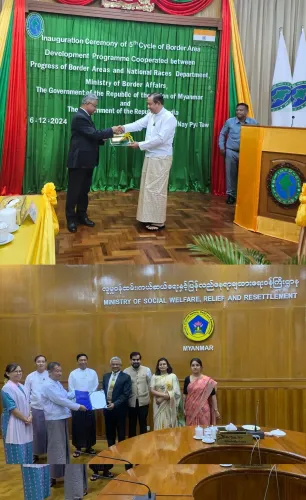
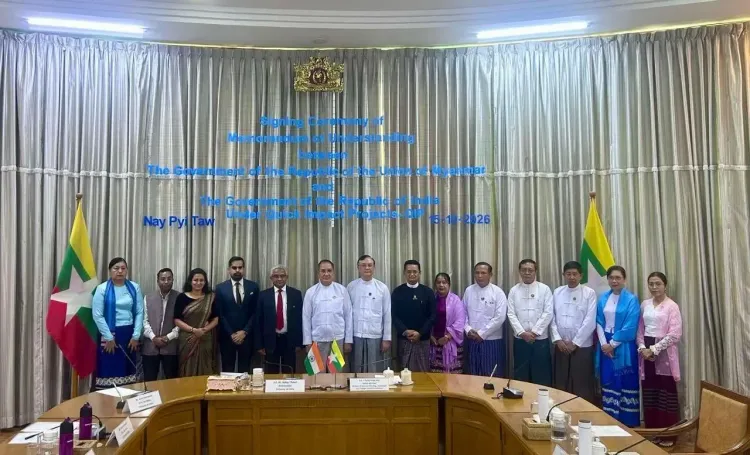
India and Myanmar have signed Memorandums of Understanding (MoUs) on five Quick Impact Projects (QIPs) under the Mekong-Ganga Cooperation (MGC) initiative, covering water, sanitation and hygiene (WASH) support, boiler operations, road upgrade, sports facility, and software support. The signing took place in Naypyitaw on 16 October 2026, marking a fresh stride in India's development cooperation with its eastern neighbour.
Details of the Signing Ceremony
The MoUs were signed by First Secretary at the Indian Embassy Amit Shreeansh and the Director Generals of the relevant Myanmar ministries. India's Ambassador to Myanmar Abhay Thakur and Myanmar's Union Minister for National Planning, Investment and Foreign Economic Relations U Aung Kyaw Hoe were present at the ceremony.
The Embassy of India in Myanmar confirmed the development in a post on X, stating the projects aim at 'supporting local community projects for the benefit of the people in Myanmar.'
What the Five Projects Cover
The five QIPs span a broad range of developmental needs. The WASH support project addresses access to clean water and sanitation infrastructure, while the boiler operations and software support projects target industrial and digital capacity-building. A road upgrade initiative and a sports facility project round out the package, reflecting India's emphasis on both hard and soft infrastructure at the community level.
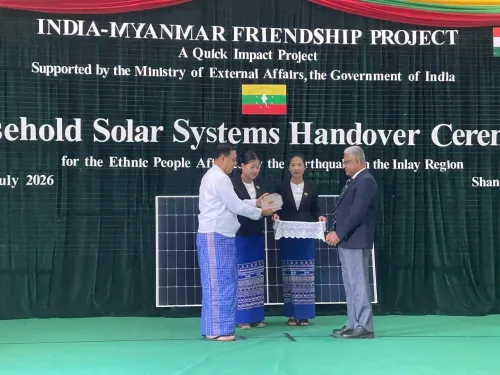
This comes just months after Ambassador Thakur handed over solar systems for 50 households of earthquake-affected ethnic people of Inle in Taunggyi in July — another QIP under the MGC framework.
India's Broader Development Footprint in Myanmar
According to the Ministry of External Affairs (MEA), India's development cooperation with Myanmar spans major connectivity infrastructure, agricultural research, rural development, healthcare, education, IT, and skill development. Development cooperation has long been a cornerstone of India's bilateral engagement with Naypyitaw.
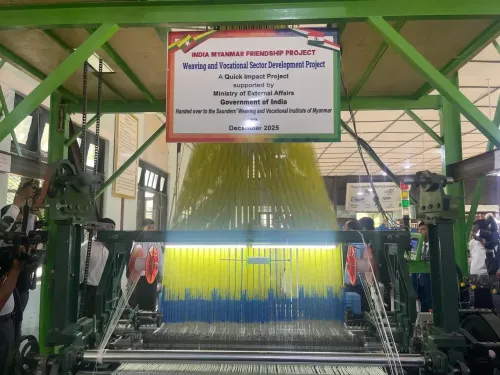
Under the MGC mechanism, the Government of India has committed up to US$ 500,000 per year for QIPs, which are designed to deliver short-gestation, high-visibility outcomes that respond directly to local needs. As of March 2026, more than 25 QIPs have been sanctioned across states and regions throughout Myanmar, covering sectors including renewable energy, civic infrastructure, agriculture, disaster risk reduction, handloom, and cultural restoration, according to the MEA.
Why the MGC Framework Matters
The Mekong-Ganga Cooperation initiative links India with five Southeast Asian nations — Myanmar, Thailand, Cambodia, Laos, and Vietnam — and serves as a diplomatic vehicle for India's Act East Policy. QIPs within this framework are deliberately small and swift, designed to produce visible community benefits faster than large infrastructure projects. Notably, with Myanmar navigating a complex post-coup political environment, India's continued on-ground development engagement signals a pragmatic foreign policy stance of maintaining working bilateral channels.
Point of View
000 annual ceiling is modest by any sovereign benchmark, but the optics of on-ground delivery matter more than the dollar figure in neighbourhood diplomacy. What is worth watching is whether these community-level projects translate into the kind of goodwill that insulates the bilateral relationship against larger geopolitical pressures. With China deepening its own infrastructure footprint in Myanmar, India's QIP model — nimble, community-focused, visible — is as much a soft-power competition as it is aid.
NationPress
16 Oct 2026
Frequently Asked Questions
What are the five Quick Impact Projects signed between India and Myanmar?
The five QIPs cover water, sanitation and hygiene (WASH) support, boiler operations, road upgrade, sports facility, and software support. They were signed in Naypyitaw on 16 October 2026 under the Mekong-Ganga Cooperation initiative.
What is the Mekong-Ganga Cooperation initiative?
The Mekong-Ganga Cooperation (MGC) is a regional framework linking India with five Southeast Asian nations — Myanmar, Thailand, Cambodia, Laos, and Vietnam — to promote tourism, culture, education, and development cooperation. Quick Impact Projects are a key instrument through which India delivers community-level development outcomes under this mechanism.
How much does India spend on Quick Impact Projects in Myanmar each year?
The Government of India has committed up to US$ 500,000 per year for QIPs under the MGC framework. As of March 2026, more than 25 QIPs have been sanctioned across Myanmar in sectors ranging from renewable energy to cultural restoration.
Who signed the MoUs on behalf of India and Myanmar?
The MoUs were signed by First Secretary at the Indian Embassy Amit Shreeansh and the Director Generals of the concerned Myanmar ministries. Ambassador Abhay Thakur and Myanmar's Union Minister U Aung Kyaw Hoe were present at the ceremony in Naypyitaw.
What other QIPs has India delivered in Myanmar recently?
In July 2026, Ambassador Abhay Thakur handed over solar systems for 50 households of earthquake-affected ethnic people of Inle in Taunggyi — another QIP under the MGC initiative. India's development cooperation in Myanmar also extends to agricultural research, rural infrastructure, healthcare, education, IT, and skill development.