India-Canada CEPA Round 5 begins in Ottawa, $70 billion trade target by 2030
Synopsis
India and Canada are in Ottawa this week for their fifth round of CEPA talks — the most consequential yet. With a $70 billion trade target by 2030, 300 Canadian business delegates heading to India next week, and both sides under pressure to close a deal before year-end, this diplomatic-economic reset is moving at a pace few anticipated after years of deep bilateral frost.
Key Takeaways
India and Canada launched CEPA Round 5 in Ottawa on 5 October 2026 , running through 9 October .
Both sides are targeting a deal by end-2026 and aim to double two-way trade to $70 billion annually by 2030 .
Two-way goods and services trade reached $30.4 billion in 2025 ; merchandise trade alone was $13.6 billion .
Priority sectors include energy , critical minerals , aerospace , and artificial intelligence .
A Team Canada Trade Mission with nearly 300 delegates is scheduled for India from 12–17 October .
Canada is pursuing the deal partly to reduce its heavy dependence on the United States for trade.
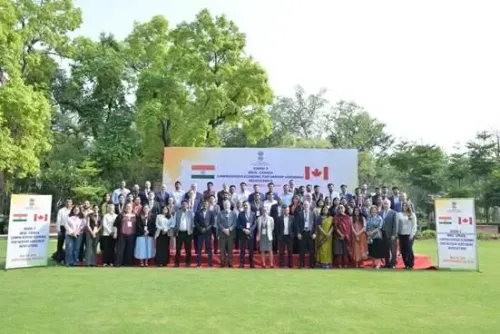
India and Canada launched the fifth round of negotiations for a Comprehensive Economic Partnership Agreement (CEPA) in Ottawa on 5 October 2026, with both sides racing to finalise a deal before the year's end. The week-long talks, running through 9 October, mark a significant milestone in a bilateral economic relationship that has rebounded sharply from a prolonged diplomatic freeze.
What Is on the Table
The Ottawa round covers the full breadth of a comprehensive trade framework, with energy, critical minerals, aerospace, and artificial intelligence identified as priority sectors for deeper cooperation. Canada has set an ambitious goal of doubling two-way trade from $30.4 billion in 2025 to $70 billion annually by 2030.
Two-way merchandise trade alone stood at $13.6 billion in 2025, according to Canadian government figures. Canadian exports to India were valued at $3.9 billion, led by vegetables, mineral fuels and oils, and wood pulp. Merchandise imports from India reached $9.7 billion, with precious stones and metals, machinery, and pharmaceuticals among the principal categories. Services trade added an even larger layer: Canadian service exports were valued at $15.2 billion in 2025, with education-related travel accounting for the largest share.
Ministerial Push Behind the Talks
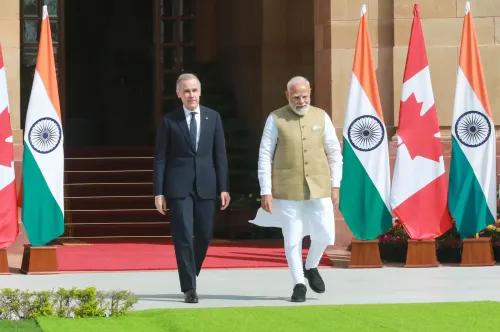
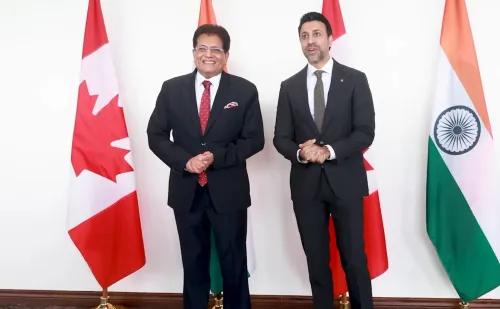
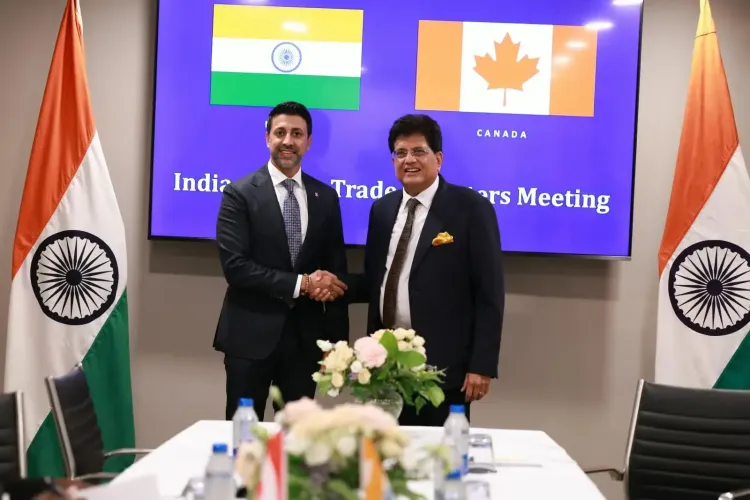
The fifth round follows direct ministerial engagement. Commerce and Industry Minister Piyush Goyal and Canadian International Trade Minister Maninder Sidhu met on the sidelines of the G20 Trade Ministers' Meeting in Milwaukee last week, reviewing progress and aligning on the Ottawa agenda. Global Affairs Canada noted that Sidhu emphasised the importance of reaching a mutually beneficial agreement by the end of 2026.
'My discussions with Minister Goyal this week are driving real progress toward an agreement that will double our two-way trade to $70 billion by 2030,' Sidhu said after meeting Goyal in Mumbai last month. 'India's rapid growth and Canada's advantage in energy, critical minerals, aerospace, AI and more mean enormous potential for our businesses and workers,' he added.
Team Canada Trade Mission to Follow
The Ottawa round will be followed almost immediately by a major commercial push. Sidhu is scheduled to lead a Team Canada Trade Mission to India from 12 to 17 October, expected to bring close to 300 Canadian delegates from businesses across key sectors. The mission is designed to create new commercial opportunities and expand business-to-business ties between the two countries.
Notably, Canada has also positioned itself as a potential long-term supplier to meet India's expanding requirements for energy and critical minerals — a pitch that aligns with India's own strategic diversification away from overdependence on single-source suppliers.
The Broader Strategic Context
This comes amid a wider Canadian effort to reduce its overwhelming dependence on the United States for trade. Ottawa has stated its intention to double exports to non-US markets over the next decade, making India's rapidly growing economy an increasingly important anchor of its diversification strategy. For India, a CEPA with Canada would add another major developed-economy trade pact to its portfolio as it pursues similar agreements with the European Union, the United Kingdom, and others.
Four rounds of CEPA negotiations have already been completed, with the fourth round concluding in New Delhi on 18 September. Canadian officials say negotiators are working to maintain momentum and narrow outstanding gaps, with the shared objective of concluding negotiations before the end of this year. Whether the two sides can bridge remaining differences in the weeks ahead will determine whether the $70 billion target becomes a realistic near-term milestone or a longer-term aspiration.
Point of View
With 300 business delegates converging on India days after the Ottawa round, signals a deliberate political decision to compartmentalise the security dispute and prioritise economic gains. The $70 billion trade target is credible only if critical minerals and energy deals materialise — sectors where Canada has real supply-side advantage but where India has historically moved slowly on import diversification. The deeper question is whether this reset has enough domestic political insulation on both sides to survive the next diplomatic flashpoint.
NationPress
5 Oct 2026
Frequently Asked Questions
What is the India-Canada CEPA and where do negotiations stand?
The Comprehensive Economic Partnership Agreement (CEPA) is a proposed bilateral trade pact covering goods, services, and investment. Five rounds of negotiations have now begun, with the latest round taking place in Ottawa from 5 to 9 October 2026 following four earlier rounds, the most recent of which concluded in New Delhi on 18 September.
What is the trade target India and Canada are aiming for?
Canada has set a goal of doubling two-way trade with India from $30.4 billion in 2025 to $70 billion annually by 2030. Two-way merchandise trade stood at $13.6 billion in 2025, while Canadian service exports to India were valued at $15.2 billion the same year.
Which sectors are central to the India-Canada trade talks?
Energy, critical minerals, aerospace, and artificial intelligence have been identified as priority areas. Canada has also positioned itself as a long-term supplier for India's expanding energy and critical mineral requirements.
What is the Team Canada Trade Mission to India?
Canadian International Trade Minister Maninder Sidhu is scheduled to lead a Team Canada Trade Mission to India from 12 to 17 October 2026, expected to bring close to 300 Canadian business delegates from key sectors. The mission is aimed at expanding commercial ties between the two countries.
Why is Canada prioritising a trade deal with India now?
Canada is actively seeking to diversify its trade beyond its heavy dependence on the United States, and has stated a goal of doubling exports to non-US markets over the next decade. India's rapidly growing economy makes it a key target for Canada's trade diversification strategy.