India at UN slams rapporteur bias on Kashmir burials, terrorism victims
Synopsis
India's UN Mission delivered a pointed rebuttal at the General Assembly's Third Committee, accusing special rapporteur Nazila Ghanea of selective outrage — championing burial rights for terrorists while ignoring victims of terrorism, and scrutinising the Global South over Covid-era practices while staying silent on mass graves in New York City. India also turned the tables on Pakistan, invoking the 1999 Kargil conflict to highlight what it called rank hypocrisy.
Key Takeaways
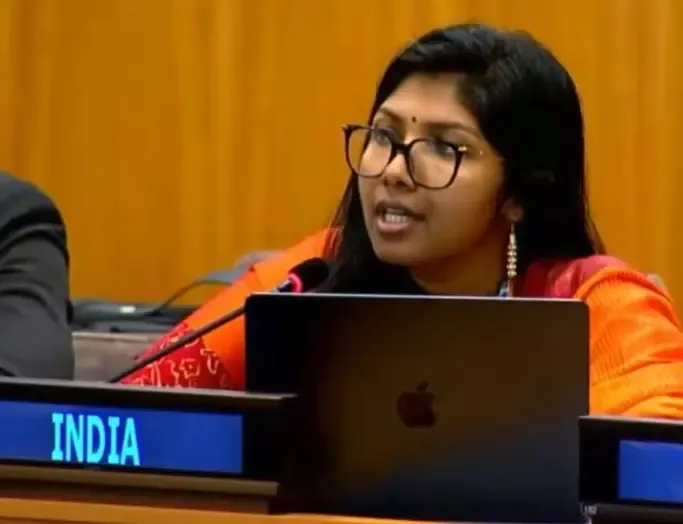
Bhavika Mangalanandan , First Secretary at India's UN Mission , on 23 October challenged rapporteur Nazila Ghanea's report on funeral rights at the UN Third Committee .
The report alleged that bodies of those killed in Kashmir security operations were not returned to families and that burial restrictions were imposed on CAA protest deaths.
India argued the rapporteur showed bias by highlighting Global South practices during Covid-19 while ignoring mass burials in New York City .
India accused the report of failing to extend the same advocacy to victims of terrorism that it gave to those who carried out attacks.
India rebuked Pakistan , recalling that the Indian Army buried Pakistani soldiers with military honours after Kargil 1999 — while Pakistan refused to accept the bodies.
India called on Pakistan to address shrinking minority rights in the territory it illegally occupies rather than lecturing India on religious freedom.
India on Thursday, 23 October delivered a sharp rebuke at the United Nations General Assembly's Third Committee in New York, accusing a UN special rapporteur of bias in reporting on funerals and burials in India while failing to acknowledge the gravity of terrorism and its victims.
India's Core Objection
Bhavika Mangalanandan, First Secretary at India's UN Mission, directly challenged a report by Nazila Ghanea, the special rapporteur on freedom of religion or belief, titled 'Freedom of Religion or Belief and Funeral Rights in Exceptional Circumstances.' Ghanea's report claimed that bodies of persons killed in security operations in Kashmir were not returned to their families and were instead buried in remote areas. It also alleged restrictions on burials of individuals killed during protests against the Citizenship Amendment Act (CAA), citing 'law and order' concerns.
Mangalanandan rejected the framing as politically motivated. 'Deriving political mileage out of people's pain and loss should not be a topic that SRs should base relevance on,' she said. She further challenged the rapporteur's selective sympathy: 'We are surprised that the fervent advocacy for the rights of terrorists who violate the most sacred right of humans, the right to life, does not similarly extend to the victims of terrorism.'
Terrorism and the Right to Life
India's rebuttal centred on the moral asymmetry in the rapporteur's framing. 'A terrorist not only kills innocent people, but damages the psyche of a nation,' Mangalanandan said, pressing the committee to consider the broader human cost of terrorism when evaluating state responses to security threats. The remarks signal India's continued resistance to what it views as selective international scrutiny of its internal security operations.
Global South Bias in Covid Burial Reporting
Mangalanandan also challenged the report's geographic scope, arguing it painted a distorted picture by focusing exclusively on the Global South during the Covid-19 pandemic while ignoring comparable incidents in wealthy nations. 'As per the report, all discrimination and wrong practices during Covid-19 supposedly took place only in the Global South,' she said. She pointed specifically to New York City, where thousands of Covid-19 victims were buried in mass graves on an isolated island — an incident the report did not mention. 'What benefit does the report derive by not mentioning similar tragic situations in the developed world?' she asked.
Sharp Rebuke to Pakistan at Third Committee
Responding to remarks made by Pakistan during the same session, Mangalanandan drew a pointed historical contrast. 'It is deeply ironic that a state that did not even accept the bodies of its own soldiers who were killed in combat in 1999 in Kargil unabashedly speaks with fervour on faith, religious freedom and burials,' she said. She noted that it was the Indian Army that buried a number of Pakistani soldiers 'with military honours and in accordance with Islamic rites.' India also called on Islamabad to address the rights of minorities in Pakistani-administered Kashmir rather than focusing on India. 'A state that cannot ensure the safety of its own minorities has no standing to lecture India,' Mangalanandan said.
About the Rapporteur and the Forum
Nazila Ghanea is a professor of international human rights law at Oxford University. Special rapporteurs are appointed by the UN Human Rights Council, work independently of the UN Secretariat, and are not paid by the organisation. The Third Committee of the General Assembly deals with social, humanitarian, and cultural affairs, making it a regular venue for countries to push back against human rights criticism.
Point of View
Which it views as vehicles for politically motivated scrutiny of the Global South. The Pakistan rebuttal, while pointed, is largely a known diplomatic reflex at multilateral forums. The harder question the Third Committee must now confront is whether rapporteur mandates can survive their credibility gap with large democracies that increasingly refuse to accept selective accountability.
NationPress
23 Oct 2026
Frequently Asked Questions
Why did India criticise the UN special rapporteur at the Third Committee?
India criticised special rapporteur Nazila Ghanea for what it called biased reporting on burials — focusing on Kashmir and CAA protest deaths while ignoring terrorism victims' rights and similar incidents in developed nations during Covid-19. India's First Secretary at the UN Mission said the report derived political mileage from people's pain.
What did the UN rapporteur's report say about India?
Nazila Ghanea's report on 'Freedom of Religion or Belief and Funeral Rights in Exceptional Circumstances' alleged that bodies of persons killed in Kashmir security operations were not returned to families and were buried in remote areas. It also cited restrictions on burials of individuals killed during CAA protests, citing 'law and order' reasons.
How did India respond to Pakistan's remarks at the UN?
India called it 'deeply ironic' that Pakistan, which refused to accept its own soldiers' bodies after the 1999 Kargil conflict, was lecturing others on religious freedom and burials. India noted that the Indian Army buried Pakistani soldiers with military honours in accordance with Islamic rites.
Who is Nazila Ghanea, and how are UN special rapporteurs appointed?
Nazila Ghanea is a professor of international human rights law at Oxford University serving as the UN special rapporteur on freedom of religion or belief. Special rapporteurs are appointed by the UN Human Rights Council, work independently of the UN Secretariat, and are not remunerated by the organisation.
What is the UN General Assembly's Third Committee?
The Third Committee of the UN General Assembly handles social, humanitarian, and cultural affairs, including human rights. It is a key forum where member states debate and respond to reports from special rapporteurs and other human rights mechanisms.