India to reclaim 3 Tamil Nadu antiquities from Australia in cultural exchange
Synopsis
Three Chola-era Tamil Nadu artefacts — a granite Nandi, a bronze Bhadrakali trishula, and a basalt Karttikeya idol — are returning to India from Australian museums after Modi and Albanese struck a reciprocal cultural deal. India, in turn, is voluntarily repatriating an Australian First Nations ancestral remain from Chennai. It is a rare bilateral exchange that reframes repatriation not as a demand, but as a shared act of cultural respect.
Key Takeaways
Australia will voluntarily return three Tamil Nadu antiquities held in the National Gallery of Australia and the Art Gallery of New South Wales .
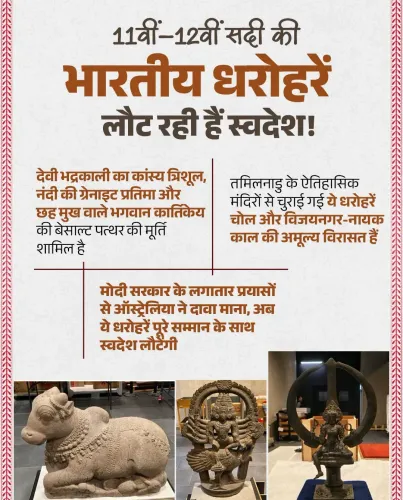
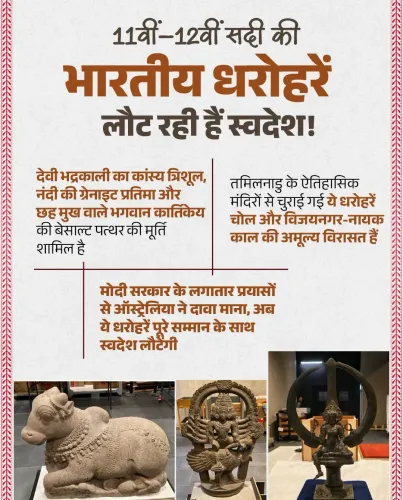
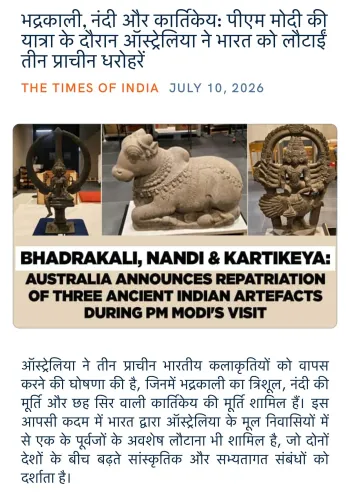
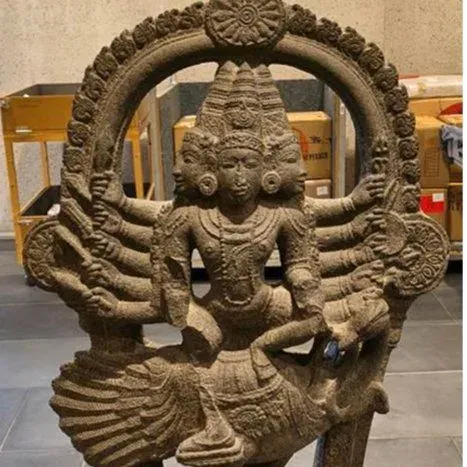
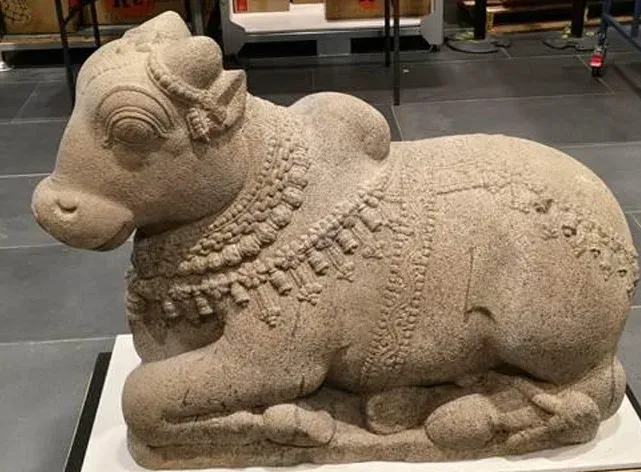
The artefacts include an 11th–12th century granite Nandi, an 11th century bronze Bhadrakali trishula, and a 12th century basalt six-headed Karttikeya — all from Tamil Nadu temples.
Two of the three artefacts originate from the Sri Kasiviswanathaswamy Temple, Kollumangudi, Thiruvarur District ; the third from Naganathsamy Temple, Manambadi, Thanjavur District .
India will reciprocally repatriate an Australian First Nations ancestor held at the Government Museum of Chennai , voluntarily and unconditionally.
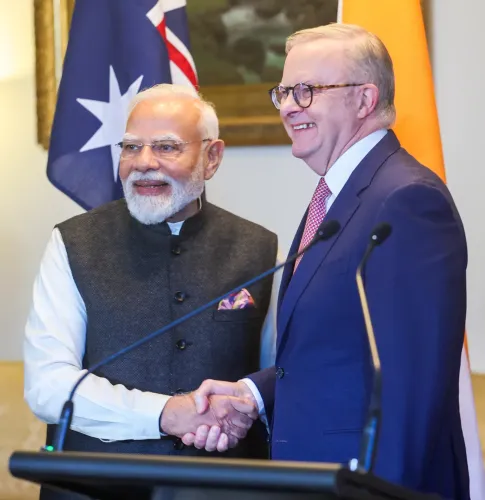
The announcement was made jointly by PM Narendra Modi and Australian PM Anthony Albanese on 9 July in Melbourne.
The exchange deepens the India-Australia Comprehensive Strategic Partnership and expands people-to-people ties.
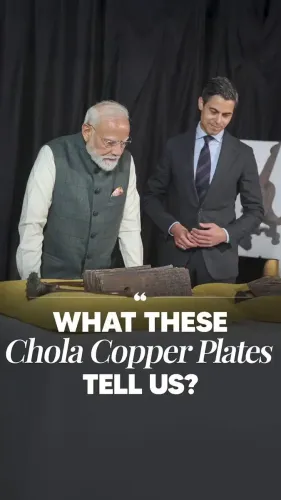
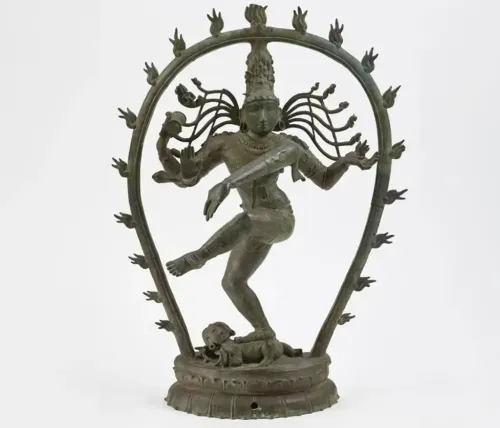
Three ancient Indian antiquities — all tracing their origins to Tamil Nadu temples — are set to return to India after Australian Prime Minister Anthony Albanese announced their voluntary repatriation alongside Prime Minister Narendra Modi on Thursday, 9 July. The artefacts, currently held in Australian museum collections, include a 11th–12th century granite Nandi, an 11th century bronze trident bearing the image of Goddess Bhadrakali, and a 12th century basalt idol of the six-headed Karttikeya — all of exceptional archaeological and religious significance.
The Three Antiquities Being Returned
The sacred bull Nandi — sculpted in the Tamil Shaiva temple tradition with ornamental bells and garlands — originates from the Sri Kasiviswanathaswamy Temple, Kollumangudi Village, Thiruvarur District, Tamil Nadu, dating to the 13th–16th centuries CE. Traditionally positioned facing the sanctum as a symbol of devotion and dharma, the idol was held at the National Gallery of Australia.
The ceremonial trishula (trident) surmounted by an image of Goddess Bhadrakali — a fierce form of Shakti revered in Shaiva-Shakti traditions — is crafted in the South Indian temple ritual metalwork tradition. It also originates from the Sri Kasiviswanathaswamy Temple, Kollumangudi, built between the 13th–16th centuries CE during the late Chola to Vijayanagara/Nayak period. The idol represents protection, the destruction of evil, and divine power.
The six-headed Karttikeya (Shanmukha), carved in the Chola-period sculptural tradition and known for refined proportions and intricate ornamentation, depicts Murugan with 12 arms carrying the vel (spear), often accompanied by a peacock. It originates from the Naganathsamy Temple, Manambadi Village, Thanjavur District, Tamil Nadu — a temple built during the early 11th century CE under Rajendra Chola I.
What Australia and India Said
Addressing the media, Albanese said: 'In the spirit of friendship, Australia will voluntarily return several items of cultural significance to India, previously held in the collections of the National Gallery of Australia and the Art Gallery of New South Wales.' He framed the decision as a deepening of bilateral cultural cooperation and an expansion of people-to-people ties.
Albanese also welcomed India's reciprocal gesture: 'I welcome progress to repatriate the remains of an Australian First Nations ancestor held in the Government Museum of Chennai. The ancestor will be voluntarily and unconditionally repatriated by India to their traditional custodians.'
Australian Minister for the Arts Tony Burke echoed the sentiment, stating: 'The repatriation of ancestors and the voluntary return of items of cultural significance are both examples of the values shared between Australia and India.'
A Reciprocal Cultural Exchange
The announcement is notably bilateral in character. While India receives three antiquities of deep religious heritage, Australia gains the repatriation of a First Nations ancestral remain from the Government Museum of Chennai — an act India is undertaking voluntarily and unconditionally. This reciprocal framework distinguishes the agreement from unilateral repatriation demands that have historically complicated cultural diplomacy between nations.
Notably, the two artefacts from Kollumangudi — the Nandi and the Bhadrakali trishula — both originate from the same Tamil Nadu temple complex, suggesting they may have left India through a common provenance pathway, a detail likely to interest investigators tracking illicit antiquities trafficking routes.
Broader Context: India's Repatriation Push
This repatriation is part of a wider diplomatic effort by India to recover cultural heritage held abroad. In recent years, India has secured the return of hundreds of artefacts from the United States, the United Kingdom, and several European nations. The inclusion of Australian institutions — the National Gallery of Australia and the Art Gallery of New South Wales — marks a significant expansion of that effort into the Oceania region.
Albanese underscored the strength of the bilateral relationship: 'While we are separated by an ocean, we are indeed the closest of friends. Today marks the next year in our partnership, as we are reminded that we need to continue our ongoing work.' The two leaders' joint announcement signals that cultural diplomacy is now a formal pillar of the India-Australia Comprehensive Strategic Partnership.
What Happens Next
No formal handover date has been announced, but the voluntary nature of Australia's commitment suggests the process is unlikely to face legal or institutional hurdles. The artefacts are expected to be formally handed over through diplomatic channels, with their eventual placement — likely back in Tamil Nadu — to be determined by Indian cultural authorities. The return of the Chola-era idols, in particular, may reignite discussions about their original temple homes in Thiruvarur and Thanjavur districts.
Point of View
But what it is giving. By voluntarily returning a First Nations ancestral remain from Chennai, India has reframed the conversation — from a supplicant seeking its stolen heritage to an equal partner in a mutual act of cultural restitution. That framing matters. It gives Australia political cover to move faster on future returns and sets a template that other holding nations — the UK and US chief among them — will now find harder to resist. The Chola-era provenance of all three artefacts also raises uncomfortable questions about how they left India and through which channels they entered Australian public collections — questions that no official statement on either side has yet addressed.
NationPress
8 Oct 2026
Frequently Asked Questions
Which three Indian antiquities is Australia returning to India?
Australia is returning a granite Nandi idol (11th–12th century), a bronze ceremonial trishula bearing the image of Goddess Bhadrakali (11th century), and a basalt six-headed Karttikeya idol (12th century) — all originating from temples in Tamil Nadu. The Nandi and trishula come from Sri Kasiviswanathaswamy Temple, Kollumangudi, Thiruvarur District, while the Karttikeya idol originates from Naganathsamy Temple, Manambadi, Thanjavur District.
Why is India also repatriating something to Australia?
India is voluntarily and unconditionally returning the remains of an Australian First Nations ancestor currently held at the Government Museum of Chennai to their traditional custodians. The reciprocal exchange was announced jointly by PM Modi and Australian PM Albanese on 9 July, framing the agreement as a mutual act of cultural respect rather than a one-sided demand.
Where were the Indian artefacts held in Australia?
The three antiquities were held in the collections of the National Gallery of Australia and the Art Gallery of New South Wales, according to Australian PM Anthony Albanese's statement.
What is the historical significance of the artefacts being returned?
All three artefacts are from the Chola and post-Chola periods of South Indian temple art. The Nandi and Bhadrakali trishula date to the 13th–16th centuries CE, associated with the late Chola to Vijayanagara/Nayak period. The Karttikeya idol is from the early 11th century CE, carved during the reign of Rajendra Chola I — one of the most celebrated rulers of the Chola Empire.
How does this fit into India's broader effort to recover cultural heritage?
India has been actively pursuing the repatriation of artefacts from countries including the United States, the United Kingdom, and several European nations. The agreement with Australia marks a significant expansion of that effort into the Oceania region, and is notable for being framed as a bilateral cultural exchange rather than a unilateral demand.