India named key focus in Trump's new US public diplomacy push
Synopsis
The Trump administration's public diplomacy playbook is going digital — and India is in the frame. USAGM nominee Sarah Rogers told the Senate Foreign Relations Committee that Asia is a 'huge focus,' singling out India and Japan as key social media targets. With podcasts, short-form video, and diaspora group chats on the agenda, Washington is rewriting how it competes with China in the information domain.
Key Takeaways
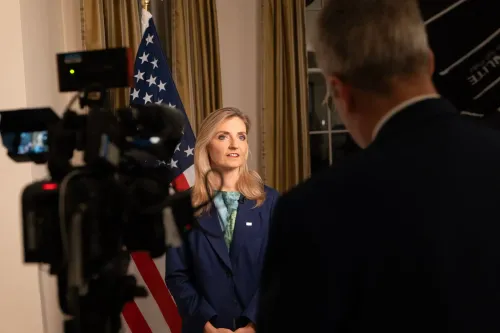
Sarah Rogers , President Trump's USAGM nominee, told the Senate Foreign Relations Committee on 31 July that Asia is a principal focus of US public diplomacy.
India and Japan were specifically cited as social media outreach priorities, described as countries 'where Twitter is most popular.' Rogers pledged to expand USAGM into short-form video , podcasts , and diaspora group chats if confirmed.
Strategic priorities named include Asia , the Middle East , Iran , Afghanistan , and Cuba .
The shift is framed as a direct counter to China's growing international information campaigns.
India has been identified as a priority target in the Trump administration's evolving public diplomacy strategy, as Washington recalibrates its international communications approach with a sharper focus on Asia. The disclosure came on 31 July when a senior US official outlined the administration's vision before a congressional panel.
What the Nominee Said
Sarah Rogers, President Donald Trump's nominee to lead the US Agency for Global Media (USAGM), told the Senate Foreign Relations Committee that Asia would be one of the agency's principal areas of focus. The agency oversees Voice of America, Radio Free Europe/Radio Liberty, Radio Free Asia, and other US-funded international broadcasters.
'Asia, huge focus,' Rogers told lawmakers, framing the shift as a direct response to what she described as growing information campaigns by China and other authoritarian governments.
India and Japan in the Digital Crosshairs
Rogers noted that her pre-confirmation public diplomacy engagement had leaned heavily on social media, specifically citing India and Japan. 'I've also tweeted a lot of content about Japan and some about India,' she said, adding that these are among the countries 'where Twitter is most popular.'
The remarks signal a deliberate effort to reach audiences in democracies where open social media ecosystems allow US messaging to circulate freely — a contrast to the restricted information environments in China, Iran, or Cuba.
Modernising US International Broadcasting
Rogers argued that USAGM must evolve beyond traditional radio and television to match contemporary media habits. If confirmed, she said the agency would expand into 'short-form video, diaspora group chats, podcasts and other timely forms of engagement,' while retaining conventional broadcasting where it remains effective.
She also outlined a stabilisation agenda: 'My first priority will be to stabilise the agency, strengthen its leadership, modernise its operations, and restore research capacity so we can actually measure reach and viewership.'
Broader Context: The US-China Information Contest
The testimony comes as the United States intensifies its competition with China across trade, technology, defence — and now, the information domain. Identifying Asia, the Middle East, Iran, Afghanistan, and Cuba as strategic priorities, Rogers framed USAGM's mission as providing access to independent information in markets where state-controlled narratives dominate.
Notably, India's inclusion alongside these regions reflects a different logic — not restricted access, but scale and social media penetration, suggesting Washington sees India as a platform for influence rather than a target of information rescue.
What Comes Next
Rogers's confirmation by the Senate remains pending. Should she be confirmed, the agency's restructuring — including the digital pivot and expanded Asia focus — would represent one of the most significant overhauls of US international broadcasting in years. India's role in that strategy, however modest in the current framing, is likely to grow as the US-China rivalry intensifies across the Indo-Pacific.
Point of View
Yet for an entirely different reason: social media reach, not information suppression. That distinction matters. Washington is not treating India as a captive audience in need of rescue from state media; it is treating India as a high-value amplification platform in the broader contest with China. The question is whether New Delhi, which has long guarded its strategic autonomy, will be comfortable with that framing — and whether the US information push will complement or complicate the Modi government's own carefully managed media environment.
NationPress
14 Sept 2026
Frequently Asked Questions
Why has India been named in the Trump administration's public diplomacy strategy?
India was cited by USAGM nominee Sarah Rogers as a key social media outreach target, specifically because Twitter — now X — is widely popular there. Rogers indicated that US public diplomacy would focus on countries where social media plays a significant role in public discourse, making India a natural priority alongside Japan.
What is USAGM and what does it oversee?
The US Agency for Global Media (USAGM) is the federal agency that funds and oversees US international broadcasters, including Voice of America, Radio Free Europe/Radio Liberty, and Radio Free Asia. Its mission is to provide independent news and information to audiences in countries where free press access is limited.
What changes is Sarah Rogers proposing for USAGM?
Rogers has proposed modernising USAGM by expanding into short-form video, podcasts, and diaspora group chats, while maintaining traditional radio and television where effective. She also pledged to stabilise the agency's leadership, modernise operations, and restore research capacity to measure audience reach.
How does this relate to US competition with China?
The strategic pivot is explicitly framed as a response to China's growing international information campaigns. The US is seeking to compete with China not only in trade, technology, and defence but also in the information domain, particularly across Asia, the Middle East, Iran, Afghanistan, and Cuba.
Has Sarah Rogers been confirmed as USAGM head?
As of 31 July, Rogers's confirmation by the Senate remains pending. She appeared before the Senate Foreign Relations Committee to outline her vision, but the confirmation vote has not yet taken place.