India reaffirms Cyprus sovereignty commitment as defence delegation visits Nicosia
Synopsis
India's Defence Secretary Rajesh Kumar Singh walked the divided streets of Nicosia to signal more than diplomacy — India's peacekeeping bond with Cyprus stretches back to UNFICYP's founding in 1964. Now, maritime security and defence industrial cooperation are shaping a modern upgrade to one of India's oldest multilateral commitments.
Key Takeaways
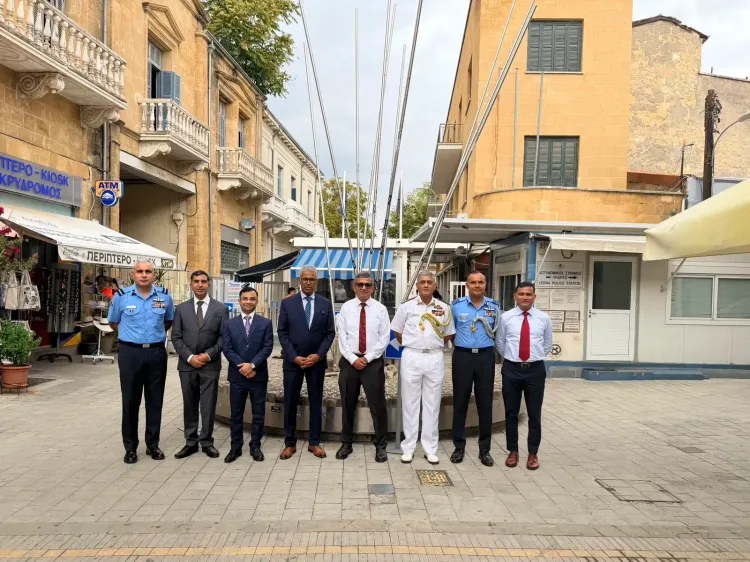
Defence Secretary Rajesh Kumar Singh visited Nicosia, Cyprus on 14 October 2026 , including the Shacolas Tower Observatory and the Ledra Street crossing point.
India reaffirmed its commitment to Cyprus's sovereignty and territorial integrity , citing its peacekeeping role since the founding of UNFICYP in 1964 .
Singh met Cypriot Defence Minister Vasilis Palmas on 13 October 2026 ; maritime security emerged as a key area of cooperation.
Separate talks with Permanent Secretary Stelios Kountouris focused on defence industrial cooperation and technical assistance.
India offered collaboration in coastal and maritime security through capacity building, expert exchanges, and technical assistance.
Defence Secretary Rajesh Kumar Singh led an Indian defence delegation to Nicosia, Cyprus on 14 October 2026, visiting the Shacolas Tower Observatory and walking through the historic city centre along Ledra Street, including the crossing point that marks the island's division. The visit underscored India's enduring commitment to Cyprus's unity, sovereignty, and territorial integrity — a position reinforced by decades of peacekeeping engagement on the island.
On the Ground in a Divided Capital
The delegation, accompanied by India's High Commissioner to Cyprus, Manish, was briefed on the historical and contemporary realities of Nicosia — the world's last divided capital. According to the Indian High Commission in Cyprus, the visit offered a first-hand perspective on the city's heritage and 'the line of division running through its heart.'
'The briefing by guide and tour provided the historical and contemporary realities of the divided capital and the delegation appreciate the pain and suffering of the people of Republic of Cyprus since 1974,' the High Commission said in a post on X. 'For India, Cyprus's unity and sovereignty are enduring commitments, reinforced by a longstanding peacekeeping association in the island by contributing Force Commanders, Indian Peacekeeping officials, both military and police, since inception of UNFICYP.'
Defence Talks with Cyprus Minister
A day earlier, on Tuesday, 13 October 2026, Singh called on Cypriot Defence Minister Vasilis Palmas in Nicosia. Both sides discussed the potential for expanding ongoing defence and defence industrial cooperation, and exchanged views on bilateral, regional, and global issues. According to the Ministry of Defence's Directorate of Public Relations, maritime security cooperation emerged as one of the major areas of common interest between the two nations.
Maritime Security and Industrial Cooperation in Focus
Singh also held a separate meeting with Stelios Kountouris, Permanent Secretary, and officials of the Armament Directorate of Cyprus, with discussions focused on strengthening bilateral defence industrial ties. India expressed its willingness to collaborate with Cyprus in maritime security through capacity building, expert-level exchanges, and technical assistance, leveraging India's expertise in coastal security and maritime cooperation, according to the Ministry of Defence.
This is notable given Cyprus's strategic position in the Eastern Mediterranean — a region of growing geopolitical interest for India, particularly in the context of maritime trade routes, energy security, and India's broader engagement with Europe and the Middle East.
India's UNFICYP Legacy
India's association with Cyprus predates most of its other multilateral engagements. Since the inception of the United Nations Peacekeeping Force in Cyprus (UNFICYP) in 1964, India has contributed Force Commanders, military personnel, and police officers to the mission — one of the longest-running UN peacekeeping operations. This history lends significant weight to India's diplomatic posture on the Cyprus question, setting it apart from nations whose positions are driven more by contemporary strategic calculations than historical solidarity.
What Comes Next
The Singh visit is expected to lay the groundwork for formalised agreements on defence industrial collaboration and maritime security cooperation between India and Cyprus. With India's 'Make in Defence' push gaining momentum and Cyprus seeking to diversify its security partnerships amid regional tensions, both sides appear aligned on deepening ties. Further ministerial-level exchanges and technical working groups are likely to follow in the coming months.
Point of View
But its strategic subtext is harder to miss. The Eastern Mediterranean has become a pressure point — energy pipelines, migration routes, and great-power jostling all converge near Cyprus — and India is quietly positioning itself as a credible security partner for a European Union member-state that faces genuine vulnerability. The UNFICYP legacy gives India moral credibility that most new entrants to the region lack. The open question is whether defence industrial cooperation translates into concrete contracts, or remains in the register of warm bilateral communiqués. India's 'Make in Defence' ambitions need export markets; Cyprus's geographic exposure needs capable partners. The alignment of interests exists — execution is what distinguishes policy from optics.
NationPress
14 Oct 2026
Frequently Asked Questions
What was the purpose of Defence Secretary Rajesh Kumar Singh's visit to Cyprus?
Singh visited Cyprus on an official trip to strengthen bilateral defence and maritime security cooperation. He met Cypriot Defence Minister Vasilis Palmas and Permanent Secretary Stelios Kountouris, with discussions covering defence industrial ties, maritime security, and India's longstanding peacekeeping commitment to Cyprus through UNFICYP.
What is India's historical connection to Cyprus and UNFICYP?
India has been contributing to the United Nations Peacekeeping Force in Cyprus (UNFICYP) since its inception in 1964, providing Force Commanders, military personnel, and police officers. This makes India one of the longest-serving contributors to the mission, underpinning its diplomatic stance in support of Cyprus's sovereignty.
What areas of defence cooperation did India and Cyprus discuss?
The two sides discussed maritime security cooperation, defence industrial collaboration, capacity building, expert-level exchanges, and technical assistance. India specifically offered to leverage its expertise in coastal security to assist Cyprus.
Why is Cyprus significant for India's strategic interests?
Cyprus occupies a key position in the Eastern Mediterranean, a region of growing importance for maritime trade routes, energy security, and geopolitical competition. Deeper ties with Cyprus, an EU member-state, also support India's broader engagement with Europe and the Middle East.
What did the visit to Ledra Street and the Shacolas Tower Observatory signify?
The visit to the Ledra Street crossing point — the dividing line between the Republic of Cyprus and the Turkish-occupied north — was a symbolic gesture of solidarity. It gave the Indian delegation a direct view of the division that has persisted since 1974, reinforcing India's stated commitment to Cyprus's reunification and territorial integrity.