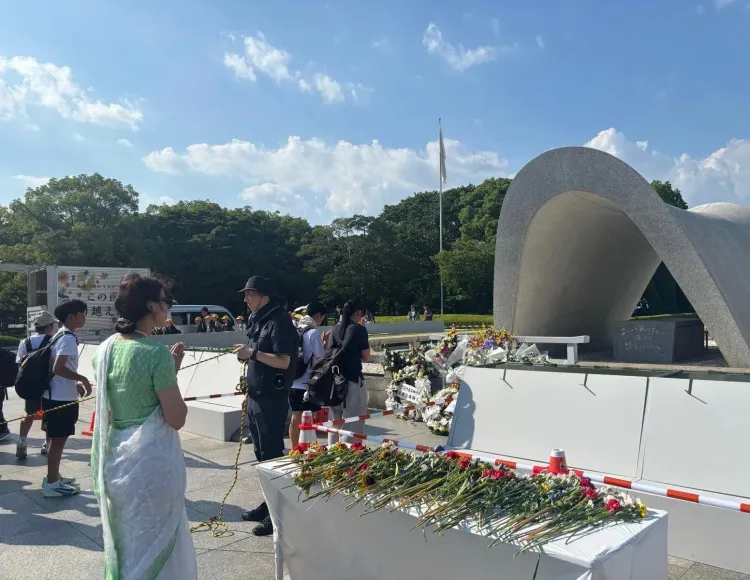
India's envoy lays flowers at Hiroshima Peace Memorial on 81st atomic bombing anniversary
Synopsis
India's Ambassador to Japan, Nagma Mallick, joined officials from 121 nations at Hiroshima's 81st atomic bombing anniversary, laying flowers at the Peace Memorial and a wreath at Gandhi's statue alongside Japanese civic leaders — a gesture that carries diplomatic weight at a moment of heightened global nuclear anxiety.
Key Takeaways
India's Ambassador Nagma Mallick laid flowers at Hiroshima Peace Memorial Park on 6 August , the 81st anniversary of the atomic bombing.
She met Hiroshima Governor Mika Yokota and Mayor Kazumi Matsui at a diplomatic reception.
A wreath was laid at the statue of Mahatma Gandhi alongside Mayor Matsui and senior Hiroshima officials.
Approximately 50,000 people gathered at Peace Memorial Park; representatives of 121 nations and the EU attended.
The 6 August 1945 bombing killed an estimated 140,000 people by year's end; silence was observed at 8:15 am local time .
Hiroshima Mayor Matsui called for nuclear abolition, warning against normalising nuclear weapons as 'tools of intimidation.'
India's Ambassador to Japan, Nagma Mallick, on Thursday, 6 August, laid flowers at the Hiroshima Peace Memorial Park and paid tribute to the victims of the atomic bomb, as Hiroshima marked the 81st anniversary of the US atomic bombing of the city. The visit formed part of a broader diplomatic gathering at which representatives of 121 nations and the European Union participated in the annual memorial ceremony.
Ambassador's Engagements in Hiroshima
Ambassador Mallick met Hiroshima Governor Mika Yokota and Hiroshima Mayor Kazumi Matsui at a reception to which the diplomatic corps in Japan had been invited. She also joined Mayor Matsui, Hiroshima Prefectural Assembly Chairman Takashi Nakamoto, and Hiroshima Japan-India Association President Kazuhisa Matsumoto in laying a wreath at the statue of Mahatma Gandhi — a gesture that underscored the enduring symbolic link between India's independence movement and the global peace cause.
The Indian Embassy in Japan shared the moment on X, stating: 'Ambassador Mallick, together with Hiroshima Mayor Kazumi Matsui, Hiroshima Prefectural Assembly Chairman Takashi Nakamoto, and Hiroshima Japan-India Association President Kazuhisa Matsumoto, laid a wreath at the statue of Bapu (Mahatma Gandhi). We extend our heartfelt gratitude to all members of the Indian community in Japan who participated, and to everyone who supports India.'
The Weight of 6 August 1945
On 6 August 1945, a uranium bomb carried aboard the US bomber Enola Gay was detonated over Hiroshima in the closing stages of the Second World War, killing an estimated 140,000 people by the end of that year. On Thursday, a moment of silence was observed at 8:15 am local time — the exact moment the bomb was dropped — with approximately 50,000 people gathered at Peace Memorial Park to honour the victims.
Hiroshima's Call for Nuclear Abolition
In his Peace Declaration delivered at the ceremony, Mayor Matsui warned: 'Downplaying the inhumanity of nuclear weapons and accepting the use of force to pursue one's own prosperity risk cycles of violent retaliation that could ultimately result in another Hiroshima or Nagasaki.' The city also criticised the use of nuclear weapons as 'tools of intimidation' in military conflicts, and took aim at what it described as 'imperious actions by major powers' that breach international law, according to reports.
India's Diplomatic Presence and What It Signals
India's participation at Hiroshima carries particular resonance given the country's longstanding commitment to nuclear disarmament in multilateral forums, even as it maintains a credible minimum deterrent under its No First Use doctrine. The wreath-laying at Gandhi's statue — alongside Japanese officials — reinforces the India-Japan partnership, which was elevated to a Special Strategic and Global Partnership in 2014. With nuclear tensions elevated globally, India's visible presence at the ceremony sends a calibrated diplomatic signal. All eyes will now be on whether such ceremonial solidarity translates into concrete positions at upcoming disarmament forums.
Point of View
Not merely ceremonial. The wreath at Gandhi's statue alongside Japanese officials reinforces the India-Japan Special Strategic Partnership at a time when both nations are navigating a more volatile Indo-Pacific. Yet there is a quiet tension: India attends as an advocate for disarmament while retaining its own nuclear arsenal under a No First Use doctrine — a position that draws scrutiny in multilateral forums. As Hiroshima's Peace Declaration grows sharper in its criticism of major-power behaviour, India's ceremonial solidarity will increasingly be tested against its actual votes and positions at the UN and Conference on Disarmament.
NationPress
20 Sept 2026
Frequently Asked Questions
Why did India's Ambassador visit Hiroshima on 6 August?
Ambassador Nagma Mallick visited Hiroshima to attend the 81st anniversary memorial of the 1945 US atomic bombing, laying flowers at the Peace Memorial Park and representing India among diplomatic corps from 121 nations. The visit reflects India's engagement with global nuclear disarmament dialogue.
What happened at Hiroshima on 6 August 1945?
On 6 August 1945, a uranium bomb dropped from the US bomber Enola Gay detonated over Hiroshima, killing an estimated 140,000 people by the end of that year. It was one of only two nuclear weapons ever used in warfare, the second falling on Nagasaki three days later.
What did Hiroshima Mayor Matsui say at the 2025 ceremony?
Mayor Kazumi Matsui warned that 'downplaying the inhumanity of nuclear weapons and accepting the use of force to pursue one's own prosperity risk cycles of violent retaliation that could ultimately result in another Hiroshima or Nagasaki.' He also criticised the use of nuclear weapons as tools of intimidation by major powers.
Who attended the Hiroshima Peace Memorial Ceremony this year?
Approximately 50,000 people gathered at Peace Memorial Park, with representatives from 121 nations and the European Union attending the official ceremony. India's Ambassador Nagma Mallick was among the diplomatic corps present.
What is the significance of the Gandhi statue wreath-laying in Hiroshima?
The wreath-laying at Mahatma Gandhi's statue in Hiroshima by India's Ambassador alongside Japanese civic leaders symbolises the shared commitment of India and Japan to peace and non-violence. It also reinforces the Special Strategic and Global Partnership between the two countries.