COP17 Ulaanbaatar: India showcases green finance model for land restoration

Synopsis
At COP17 in Ulaanbaatar, India did not just make pledges — it brought a working model. From Sovereign Green Bonds to a canopy-density-verified credit programme, Environment Minister Bhupender Yadav showcased a financing architecture that developing nations could replicate, while pressing wealthy countries to match domestic ambition with international funding.
Key Takeaways
Bhupender Yadav represented India at the COP17 UNCCD Ministerial Dialogue in Ulaanbaatar, Mongolia on 24 August .
India's Green Credit Programme issues restoration credits after 5 years of verified land recovery and at least 40% canopy density .
India's Sovereign Green Bonds were presented as a replicable tool to mobilise capital for land and drought resilience.
Yadav stressed that domestic financing models cannot substitute for additional, predictable international finance .
India reaffirmed its commitment to sharing institutional frameworks, safeguards and lessons learned with the global community.
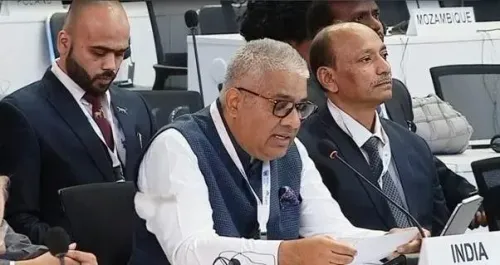
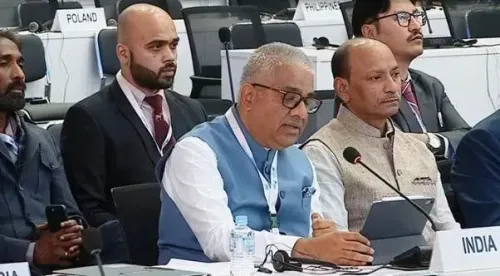
Union Minister for Environment, Forest and Climate Change Bhupender Yadav on Monday, 24 August presented India's diversified financing architecture for land restoration and drought resilience at the 17th Conference of the Parties (COP17) to the United Nations Convention to Combat Desertification (UNCCD), held in Ulaanbaatar, Mongolia. Speaking at the Ministerial Dialogue on 'Innovative Financial Mechanisms for Healthy Land and Drought Resilience', Yadav called for international finance that is adequate, predictable and sustained — not merely aspirational.
India's Blended Finance Framework
According to the Ministry of Environment, Forest and Climate Change, Yadav highlighted India's blended green-finance framework, which channels funding toward climate-change adaptation, sustainable land use, forestry, agriculture, afforestation and biodiversity conservation. He also pointed to Sovereign Green Bonds as a mechanism to mobilise capital for land restoration, drought resilience and sustainable forestry — positioning them as a replicable model for other developing economies.
Green Credit Programme and Compensatory Conservation
A centrepiece of India's presentation was the Green Credit Programme, which enables public and private entities to finance the restoration of degraded forest land. Credits are issued after five years of verified restoration and upon achieving at least 40 per cent canopy density; they may be used once for compensatory afforestation, statutory plantation or corporate social responsibility obligations.
Yadav also outlined India's compensatory conservation regime, under which payments received for forest diversion are channelled toward compensatory afforestation and ecosystem restoration. Corporate funding is integrated through existing environmental regulatory processes, ensuring institutional accountability rather than voluntary pledges.
Whole-of-Government Approach
Underscoring the importance of convergence, Yadav argued that aligning public and private finance — through instruments such as the Green Credit Programme and compensatory afforestation funds — on the same landscape and alongside citizen participation constitutes a genuine Whole-of-Government and Whole-of-Society approach.
'Finance must be continuous, verifiable and connected to local communities,' Yadav said, setting a clear benchmark for how innovative mechanisms should be evaluated.
India's Global Ask
While showcasing domestic achievements, Yadav was careful to draw a distinction between what committed national resources can deliver and what the global community must still provide. He stressed that India's experience cannot substitute for additional, adequate and predictable international finance for restoration and drought resilience — a pointed message to developed nations at a forum where finance gaps remain a persistent fault line.
Concluding his address, the minister reaffirmed India's willingness to share its institutional arrangements, safeguards and lessons learned — including areas requiring course correction. 'Ultimately, innovative finance should be judged not by its design or resources mobilised, but by whether it reaches the land, ecosystems and communities that need it most and delivers lasting restoration and resilience,' Yadav said.
What Comes Next
COP17 in Ulaanbaatar is expected to produce fresh commitments on the Land Degradation Neutrality target framework and drought policy. India's presentation positions the country as both a contributor of models and a claimant of international support — a dual stance that reflects the broader tension between ambition and finance at multilateral climate negotiations.
Point of View
But whether it moves the needle on the global finance gap is another question entirely.
NationPress
9 Oct 2026
Frequently Asked Questions
What did India present at COP17 in Ulaanbaatar?
India presented its diversified financing architecture for land restoration and drought resilience at COP17, held in Ulaanbaatar, Mongolia. Environment Minister Bhupender Yadav highlighted the Green Credit Programme, Sovereign Green Bonds, and India's blended green-finance framework as replicable models for other nations.
What is India's Green Credit Programme?
The Green Credit Programme enables public and private entities to finance the restoration of degraded forest land. Credits are issued after five years of verified restoration and upon achieving at least 40 per cent canopy density, and may be used for compensatory afforestation, statutory plantation or CSR obligations.
Why did India stress the need for international finance at COP17?
While showcasing its domestic financing models, India made clear that national resources alone cannot meet the scale of the land restoration and drought resilience challenge. Yadav called for international finance that is additional, adequate, predictable and sustained — a direct ask directed at developed nations.
What are Sovereign Green Bonds and why did India highlight them?
Sovereign Green Bonds are government-issued debt instruments that raise capital specifically for environmental and climate priorities. India highlighted them at COP17 as a mechanism to fund land restoration, drought resilience and sustainable forestry, and as a model that other developing economies could adopt.
What is the significance of COP17 for land degradation?
COP17 is the 17th session of the Conference of the Parties to the UN Convention to Combat Desertification. It is a key forum for setting global commitments on Land Degradation Neutrality and drought policy, making it a critical platform for countries like India to influence international finance and restoration frameworks.