India-UAE trade hits $101 bn, hailed as BRICS cooperation model
Synopsis
India and the UAE have crossed $100 billion in bilateral trade for the second year running — and a new report says the partnership is now the blueprint for how BRICS nations should work together. With Bharat Mart, IMEC and CEPA already in motion, and a $200 billion target set for 2032, the corridor is fast evolving from a bilateral success story into a geopolitical template.
Key Takeaways
India-UAE bilateral trade hit $101.25 billion in FY26 , the second consecutive year exceeding $100 billion .
The two countries have set a target of $200 billion in trade by 2032 .
A Gulf Today report calls the partnership “an effective model of cooperation within BRICS.” Key drivers include Bharat Mart , the Virtual Trade Corridor , and cooperation under the India-Middle East-Europe Economic Corridor (IMEC) .
The UAE and China together accounted for 88.50% of India’s electronics exports to BRICS nations.
Indian firms registered with Dubai Chamber reached 85,841 by June 2026 , up 15% year-on-year after 7,579 new registrations in H1 2026.
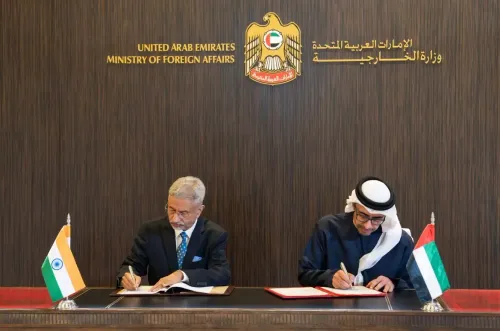
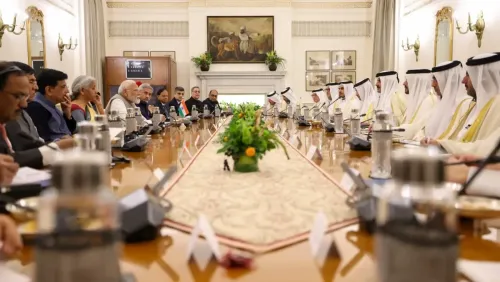
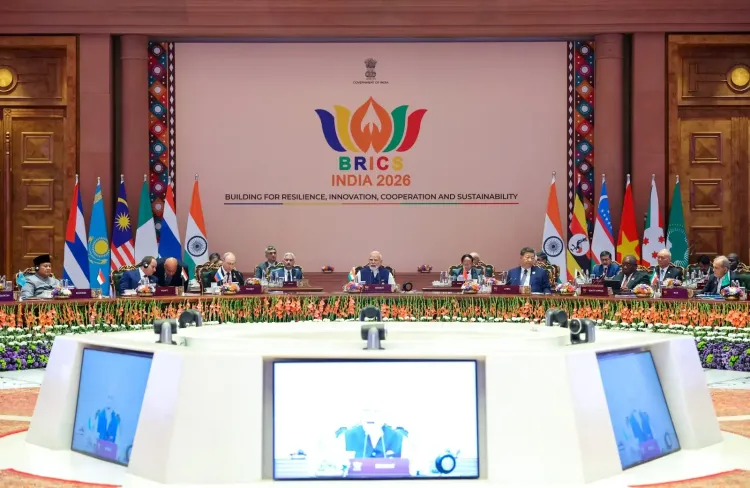
India and the United Arab Emirates (UAE) are deepening a strategic and economic partnership that a new report has described as “an effective model of cooperation within BRICS,” with bilateral trade surpassing $100 billion for the second consecutive year in FY26. The assessment, drawn from a Gulf Today analysis, highlights how the two nations are building integrated logistics corridors, expanding investment flows, and pioneering trade frameworks that could guide broader BRICS economic diplomacy.
Trade Milestone and the $200 Billion Target
Bilateral trade between India and the UAE reached $101.25 billion in FY26, consolidating the two countries’ position as each other’s most significant partners in their respective regions. Both governments have set an ambitious target to double this figure to $200 billion by 2032, a goal that analysts say is achievable given the current trajectory of growth. Notably, this marks the second straight year in which the partnership has crossed the $100 billion threshold — signalling a structural shift rather than a one-off spike.
Key Initiatives Driving Integration
The partnership is being advanced through a suite of targeted initiatives. Bharat Mart, a dedicated platform for Indian goods in the Gulf, and the Virtual Trade Corridor are streamlining cross-border commerce. Cooperation under the India-Middle East-Europe Economic Corridor (IMEC) is adding a geopolitical dimension, linking the two economies to broader Eurasian supply chains. According to the report, these initiatives are “helping strengthen supply chain integration and create new routes for trade and investment flows between the two countries and global markets.”
CEPA: A First-of-Its-Kind Agreement
The UAE-India Comprehensive Economic Partnership Agreement (CEPA), operational since 2022, was described in the report as the first such agreement concluded by the UAE. The pact has expanded the flow of goods, services, and investment, and broadened private-sector opportunities on both sides. Observers note that CEPA has served as a template the UAE has since sought to replicate with other partners — lending India a degree of first-mover advantage in shaping UAE’s economic architecture.
BRICS Footprint and Electronics Exports
Within the BRICS grouping, the UAE and China together accounted for 88.50% of India’s electronics exports to member nations, underscoring the UAE’s outsized role as a conduit for Indian manufacturing into global markets. The report argues that this dynamic positions the UAE-India corridor as a practical illustration of how BRICS membership can translate into tangible trade outcomes rather than remain a diplomatic abstraction.
Indian Business Presence in Dubai Surges
The scale of Indian commercial interest in the UAE is reflected in Dubai Chamber membership figures. The number of Indian companies registered as active members reached 85,841 by the end of June 2026, after 7,579 new Indian firms joined in the first half of the year alone — a year-on-year increase of 15%. The figure cements India’s position as the largest source of foreign business registrations in Dubai, according to reports. This surge also reflects India’s expanding role as a services and manufacturing exporter into the Gulf and beyond.
With the $200 billion trade target firmly on the horizon and IMEC gaining momentum, the India-UAE partnership appears set to deepen further — and its evolution within BRICS could shape how the bloc approaches South-South economic integration in the years ahead.
Point of View
Including resolution of persistent non-tariff barriers that CEPA has not fully addressed. The 88.5% concentration of India’s BRICS electronics exports in just two markets also reveals a dependency risk: the corridor’s success has not yet translated into diversified BRICS trade. The real test of the partnership’s ‘model’ status is whether its logistics and investment frameworks can be replicated with other BRICS members — or whether they remain a bilateral arrangement wearing a multilateral badge.
NationPress
14 Sept 2026
Frequently Asked Questions
What is the current state of India-UAE bilateral trade?
India-UAE bilateral trade reached $101.25 billion in FY26, marking the second consecutive year in which trade between the two countries exceeded $100 billion. Both nations have set a joint target to raise this figure to $200 billion by 2032.
Why is the India-UAE partnership being called a model for BRICS cooperation?
A Gulf Today report argues that the partnership — built on CEPA, integrated logistics corridors like IMEC, and expanding investment flows — demonstrates a practical model of how BRICS nations can deepen economic ties. The UAE and China together account for 88.50% of India’s electronics exports to BRICS members, highlighting the UAE’s pivotal role within the grouping.
What is the India-UAE CEPA and why does it matter?
The UAE-India Comprehensive Economic Partnership Agreement (CEPA), operational since 2022, was the first such agreement concluded by the UAE. It has boosted the flow of goods, services, and investment between the two countries, and expanded private-sector opportunities on both sides, serving as a template for the UAE’s subsequent trade negotiations.
How many Indian companies are registered in Dubai?
By the end of June 2026, the number of Indian companies registered as active members of the Dubai Chamber reached 85,841, after 7,579 new Indian firms joined in the first half of the year — a year-on-year increase of 15%.
What initiatives are driving India-UAE economic integration?
The key initiatives include Bharat Mart (a platform for Indian goods in the Gulf), the Virtual Trade Corridor, and cooperation under the India-Middle East-Europe Economic Corridor (IMEC). These are aimed at strengthening supply chain integration and opening new trade and investment routes between both countries and global markets.