Japan's Ruling Coalition Advances Record Fiscal 2026 Budget Amid Controversies
Synopsis
Japan's lower house has passed a record state budget for fiscal 2026, backed by the ruling coalition's supermajority. This move, criticized for its rapid progression and lack of thorough debate, raises significant concerns among opposition parties about the allocation of public funds.
Key Takeaways
Historic budget : Japan's fiscal 2026 budget surpasses 122.31 trillion yen.
Defense spending : New record of over 9 trillion yen set for defense.
Short deliberation : Only 59 hours allocated for discussions, the least since 2000.
Opposition criticism : Accusations of power politics from the LDP.
Next steps : Budget moves to the House of Councillors for further debate.
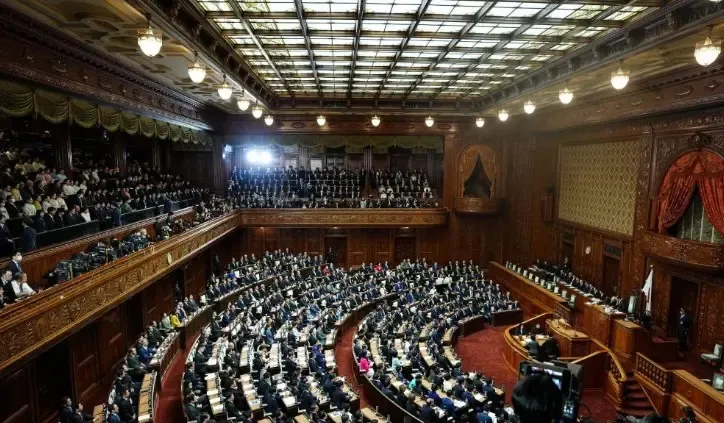
Tokyo, March 14 (NationPress) Japan's lower house has enacted a historic initial state budget for fiscal 2026, propelled by the ruling coalition's overwhelming majority, despite facing backlash for advancing the bill amid significant controversies and notably brief discussions.
The proposed budget totals over 122.31 trillion yen (approximately 769 billion US dollars), which sets a new record, with defense spending also reaching an unprecedented level exceeding 9 trillion yen for the first time. This proposal has incited continuous debate across Japan since its introduction late last year.
Local news outlets have highlighted that the time allocated for the budget bill's deliberation in the House of Representatives was drastically reduced to about 59 hours, marking the shortest duration since 2000.
Opposition parties have condemned the ruling Liberal Democratic Party (LDP) for forcefully advancing a contentious budget by exploiting its parliamentary majority. Junya Ogawa, the opposition Centrist Reform Alliance leader, characterized the LDP's aggressive parliamentary tactics as "highly abnormal" and indicative of Prime Minister Sanae Takaichi's "arrogance."
Yuichiro Tamaki, head of the Democratic Party for the People, emphasized that the fiscal 2026 budget's record scale necessitated comprehensive discussions among elected representatives regarding the allocation of public funds, asserting that the current deliberation process has "serious problems."
Tomoko Tamura, chair of the Japanese Communist Party, criticized the ruling party's strategy as "power politics."
With the budget's approval, the legislative focus shifts to the House of Councillors starting Monday, where the ruling coalition of the LDP and the Japan Innovation Party lacks a majority.
According to Kyodo News, the process of deliberating the national budget should be a crucial opportunity for both the government and opposition parties to scrutinize fiscal expenditures through inquiry and debate, aiming for a more equitable distribution of public funds amidst varied perspectives.
This process also serves as a vital means for the public to comprehend the government's policy trajectory, and it is the government's duty to guarantee thorough and meticulous discussions, the report stated.
Point of View
The swift passage of Japan's fiscal 2026 budget highlights a significant political maneuver by the ruling coalition, raising concerns about accountability and thorough debate. The implications for public trust and governance are profound, necessitating a closer examination of parliamentary processes and the allocation of taxpayer funds.
NationPress
19 Sept 2026
Frequently Asked Questions
What is the total amount of the fiscal 2026 budget in Japan?
The total size of the fiscal 2026 budget exceeds 122.31 trillion yen, which is about 769 billion US dollars.
What notable record was set in the defense budget for fiscal 2026?
The defense budget for fiscal 2026 reached over 9 trillion yen for the first time, marking a new record.
Why was the deliberation time for the budget considered unusually short?
The deliberation time for the budget bill was significantly reduced to about 59 hours, the shortest since 2000.
What has been the response from opposition parties regarding the budget?
Opposition parties have criticized the ruling LDP for pushing the budget through without adequate debate, describing the process as highly abnormal.
What is the next step for the budget after passing the lower house?
Following approval in the lower house, the budget will be debated in the House of Councillors starting Monday, where the ruling coalition does not hold a majority.