What Did Japanese Defence Minister and US Counterpart Discuss Regarding China's Radar Incident?
Click to start listening
Synopsis
Tensions rise as Japanese Defence Minister Shinjiro Koizumi and US counterpart Pete Hegseth discuss a radar lock-on incident and joint patrols by Chinese and Russian bombers. Their telephonic conversation emphasizes the need for ongoing communication to mitigate regional conflicts and highlights Japan's readiness to respond effectively.
Key Takeaways
- Japan and the US are enhancing their defense collaboration.
- Recent tensions stem from a radar lock-on incident involving Chinese jets.
- China's military activities are a concern for regional stability.
- Japan is committed to a calm but firm response.
- The US-Japan Alliance plays a critical role in regional security.
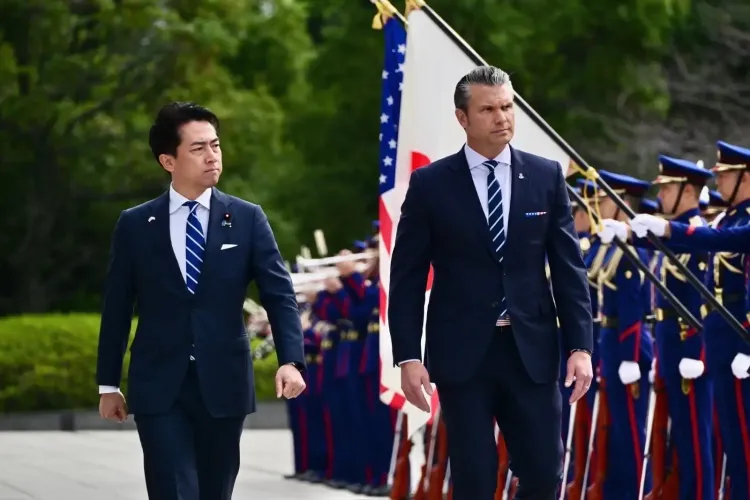
Tokyo, Dec 12 (NationPress) Japanese Defence Minister Shinjiro Koizumi revealed on Friday that he and his US counterpart, Pete Hegseth, engaged in a phone conversation where they expressed their concerns regarding escalating tensions in the region. This follows a recent radar lock-on incident involving Japanese and Chinese fighter jets, as well as a joint patrol of Chinese and Russian bombers close to Japan, according to local media reports.
The discussion lasted approximately 40 minutes, during which both ministers consented to maintain ongoing communication to de-escalate the situation, as reported by Japan’s Kyodo News.
During their call, Hegseth and Koizumi also addressed a joint patrol executed by two Chinese and two Russian bombers over the East China Sea and the Pacific near Japan's Shikoku Island.
In comments to the press, Koizumi emphasized their mutual acknowledgment that such actions exacerbate regional tensions.
He reaffirmed Japan's commitment to respond to these incidents in a calm yet resolute manner, while consistently conducting surveillance operations in the waters and airspace surrounding the nation.
Koizumi further criticized China for failing to provide essential information to Japan, including prior notifications for air missions or navigational warnings, specifically regarding areas designated for Chinese military flight training. He called the radar lock-on incident 'dangerous' and deemed it an unnecessary action that 'exceeded what is required for safe aircraft operations.'
The US Department of War stated: 'Secretary of War Pete Hegseth spoke to his Japanese counterpart, Defence Minister Shinjiro Koizumi, today.' The leaders discussed Japan's initiatives to boost its defense budget and enhance its military capabilities, China's military maneuvers, and the significance of realistic training and exercises throughout Japan, particularly in the Southwest Islands. They reiterated the value of the US-Japan Alliance and their commitment to deterring aggression in the Asia-Pacific.
On the afternoon of December 7, Japan's Vice-Minister for Foreign Affairs Takehiro Funakoshi summoned the Chinese Ambassador to Japan, Wu Jianghao, to the Ministry of Foreign Affairs.
According to the Japanese Ministry of Foreign Affairs, the incident in question occurred on December 6, over international waters southeast of Okinawa Island, when a J-15 fighter jet from the Chinese Navy's aircraft carrier Liaoning intermittently illuminated a F-15 fighter jet from the Japan Air Self-Defence Force that was monitoring airspace violations.
'It is extremely regrettable that such a perilous act transpired, and (Takehiro Funakoshi) lodged a strong protest, demanding that it not recur,' stated the announcement following their meeting.
In response, the Chinese government dismissed Tokyo's remarks as 'irresponsible hype' and 'political manipulation.'
'We wish to reiterate that the facts are quite evident: China's exercises and training activities in the pertinent sea and air regions comply with international law and practices, and the operations are professional and above reproach. We strongly urge Japan to halt its hazardous actions that disrupt China's normal exercises and training and to cease all irresponsible hype and political manipulation,' stated Chinese Foreign Ministry spokesperson Guo Jiakun during a media briefing in Beijing on Monday.
Point of View
It's pivotal to note that Japan and the US are maintaining a united front against rising military assertiveness from China and Russia. The dialogue between their defence ministers reflects a commitment to peace and stability in the Asia-Pacific, emphasizing the importance of collaboration in addressing security challenges.
NationPress
13/12/2025
Frequently Asked Questions
What prompted the discussion between the Japanese Defence Minister and his US counterpart?
The discussion was prompted by rising tensions following a radar lock-on incident involving Japanese and Chinese fighter jets and joint patrols by Chinese and Russian bombers near Japan.
What was Japan's response to the radar lock-on incident?
Japan's Defence Minister expressed the nation's readiness to respond in a calm yet resolute manner, while also increasing surveillance activities in surrounding airspace and seas.
How did China respond to Japan's concerns?
China dismissed Japan's comments as 'irresponsible hype' and reiterated that its military activities are in compliance with international law.
What is the significance of the US-Japan Alliance in this context?
The US-Japan Alliance is crucial for deterring aggression in the Asia-Pacific region, as emphasized by both ministers during their conversation.
What actions did Japan take following the radar incident?
Japan's Vice-Minister for Foreign Affairs summoned the Chinese Ambassador to lodge a strong protest regarding the dangerous act.