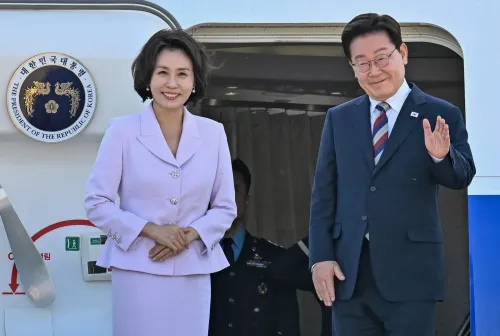
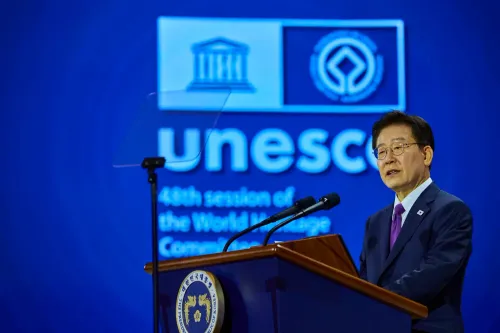
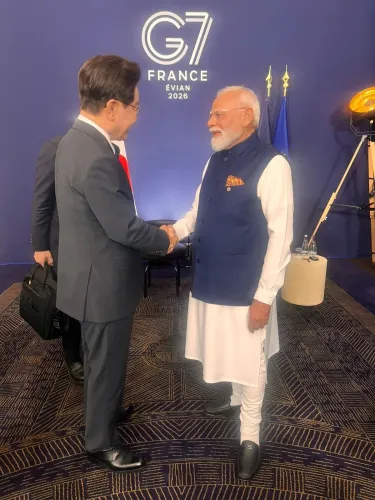
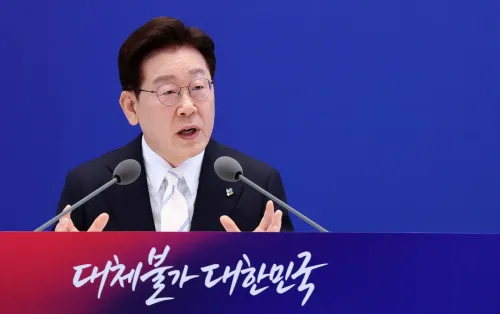
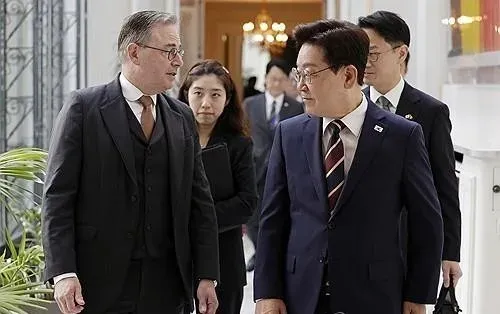
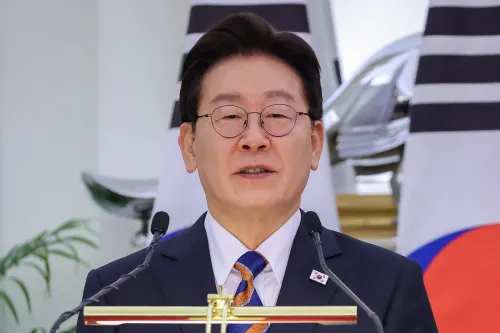
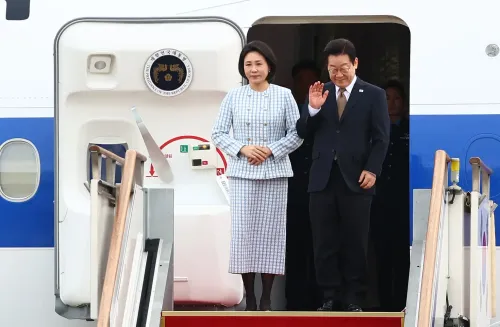
South Korea's Lee Jae Myung departs Italy for G7 summit in Evian-les-Bains
Synopsis
South Korean President Lee Jae Myung's European tour is punching above its diplomatic weight — a special strategic partnership with Italy, a papal invitation for World Youth Day 2027, and a second straight G7 appearance all in one week. For a presidency still in its first year, it is an unusually assertive multilateral debut.
Key Takeaways
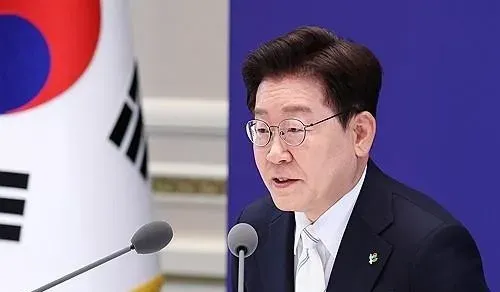
President Lee Jae Myung departed Italy on 16 June for the G7 summit in Evian-les-Bains, France .
South Korea and Italy agreed to elevate bilateral ties to a special strategic partnership , with cooperation in semiconductors and AI .
Lee met Pope Leo XIV at the Vatican and formally invited him to visit South Korea for World Youth Day 2027 .
The Vatican reaffirmed support for peace efforts on the Korean Peninsula ; inter-Korean dialogue was also discussed.
This is the second consecutive year South Korea has been invited to the G7 as a partner country.
South Korean President Lee Jae Myung departed Italy on Tuesday, 16 June, flying out of Leonardo da Vinci International Airport en route to Geneva, from where he will travel overland to Evian-les-Bains, France, to attend the Group of Seven (G7) summit. The departure marks the conclusion of his Italian leg and the final stretch of a week-long European tour — his first since assuming the presidency.
Key Developments on the European Tour
Lee has been in Europe since the previous Tuesday, visiting Belgium first before arriving in Italy as the second stop. In Rome, he held separate bilateral talks with Italian President Sergio Mattarella and Prime Minister Giorgia Meloni, with both sides agreeing to elevate ties to a special strategic partnership. The two governments also agreed to explore cooperation in semiconductors, artificial intelligence (AI), and other strategic sectors.
Lee's Meeting with Pope Leo XIV
A significant diplomatic moment came when President Lee met Pope Leo XIV at the Vatican. During the meeting, Lee briefed the Pope on South Korea's peace-building initiative on the Korean Peninsula, and the Vatican reaffirmed its unwavering support for facilitating peace there. Notably, Lee formally invited Pope Leo XIV to visit South Korea in 2027, on the occasion of the country's hosting of World Youth Day 2027.
National security adviser Wi Sung-lac confirmed the invitation at a press briefing, stating that the two leaders agreed to cooperate closely to ensure a successful hosting of the event. A separate senior South Korean official indicated the meeting also covered inter-Korean issues, with both sides sharing the view that cross-border dialogue and cooperation should be pursued despite prevailing political difficulties. This comes amid a long-standing Vatican interest in the Korean Peninsula — the late Pope Francis had repeatedly expressed willingness to visit North Korea.
South Korea at the G7: Second Consecutive Invitation
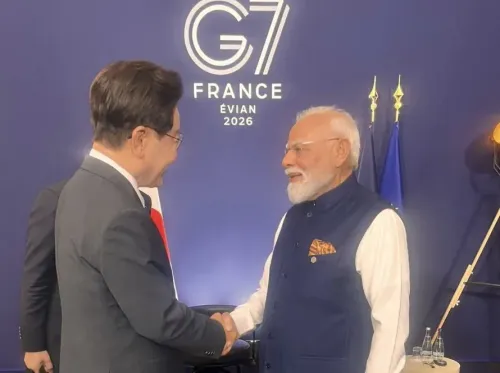
In Evian-les-Bains, Lee is scheduled to attend the G7 summit on Tuesday and Wednesday as the leader of an invited partner country. This marks the second consecutive year South Korea has received a G7 invitation, underlining Seoul's growing role in multilateral diplomacy and its strategic importance to the G7 bloc on issues ranging from technology supply chains to regional security.
What This Visit Signals
The European tour — spanning Belgium, Italy, the Vatican, and now France — reflects a deliberate effort by the Lee administration to deepen South Korea's diplomatic footprint beyond its immediate neighbourhood. The agreements on semiconductors and AI with Italy, combined with the Vatican outreach on Korean Peninsula peace, suggest a multi-track foreign policy approach that blends economic statecraft with security diplomacy. All eyes now turn to what emerges from Lee's G7 engagements in Evian.
Point of View
Korean Peninsula peace through the Vatican, and G7 visibility as a hedge against regional isolation. What is striking is the pace: all of this in a single week, in the first year of his presidency. The papal invitation for 2027 is the most politically loaded moment — the late Pope Francis's stated willingness to visit North Korea was never acted upon, and whether Pope Leo XIV's engagement translates into any tangible inter-Korean movement remains the real question no bilateral communiqué can answer.
NationPress
24 Sept 2026
Frequently Asked Questions
Why did South Korean President Lee Jae Myung visit Europe?
President Lee Jae Myung travelled to Europe — covering Belgium, Italy, the Vatican, and France — to expand South Korea's diplomatic outreach to the region. It was his first visit to Europe since taking office approximately one year ago.
What did South Korea and Italy agree on during Lee's visit?
South Korea and Italy agreed to elevate their bilateral relationship to a special strategic partnership and to explore cooperation in semiconductors, artificial intelligence, and other strategic sectors. Lee held separate talks with Italian President Sergio Mattarella and Prime Minister Giorgia Meloni.
What was discussed between President Lee and Pope Leo XIV?
President Lee briefed Pope Leo XIV on South Korea's peace-building initiative on the Korean Peninsula, and the Vatican reaffirmed its support for facilitating peace there. Lee also formally invited the Pope to visit South Korea for World Youth Day 2027, with both sides agreeing to cooperate on ensuring a successful event.
What is South Korea's role at the G7 summit in Evian-les-Bains?
South Korea is attending the G7 summit as an invited partner country, not a full member. This is the second consecutive year Seoul has received such an invitation, reflecting its growing importance in multilateral forums on technology and regional security.
What is World Youth Day 2027 and why does the papal invitation matter?
World Youth Day 2027 is a major global Catholic gathering that South Korea will host in 2027. President Lee's invitation to Pope Leo XIV to attend is diplomatically significant because it builds on the Vatican's longstanding interest in the Korean Peninsula — the late Pope Francis had expressed willingness to visit North Korea — potentially lending the Holy See's soft power to inter-Korean peace efforts.