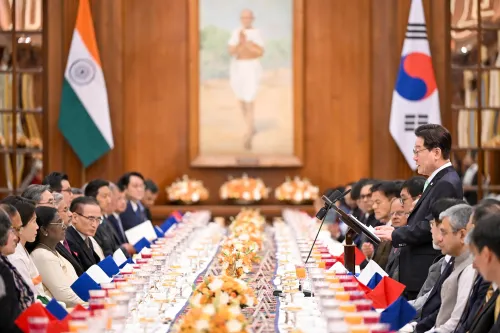
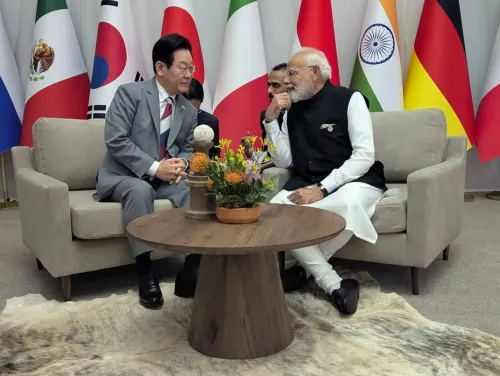
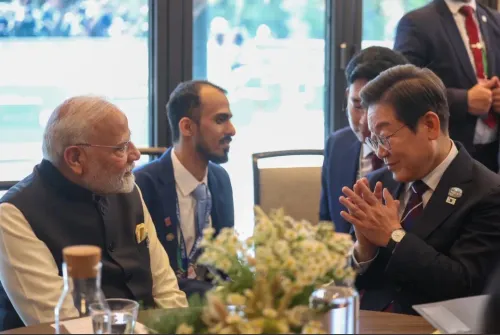
PM Modi Meets South Korea's President Lee at G7 in Evian
Synopsis
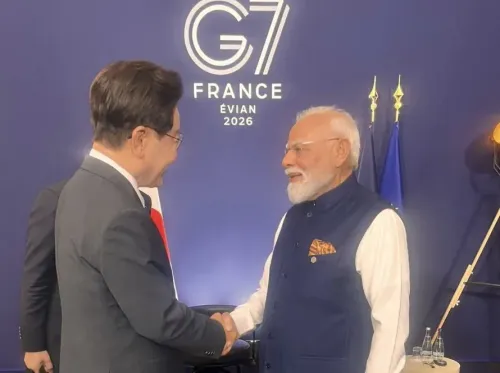
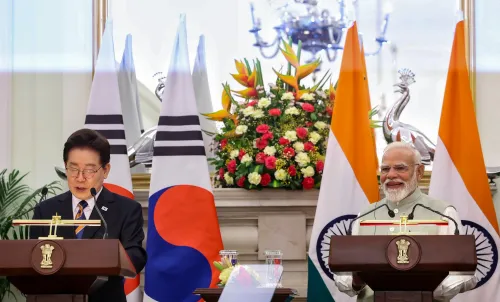
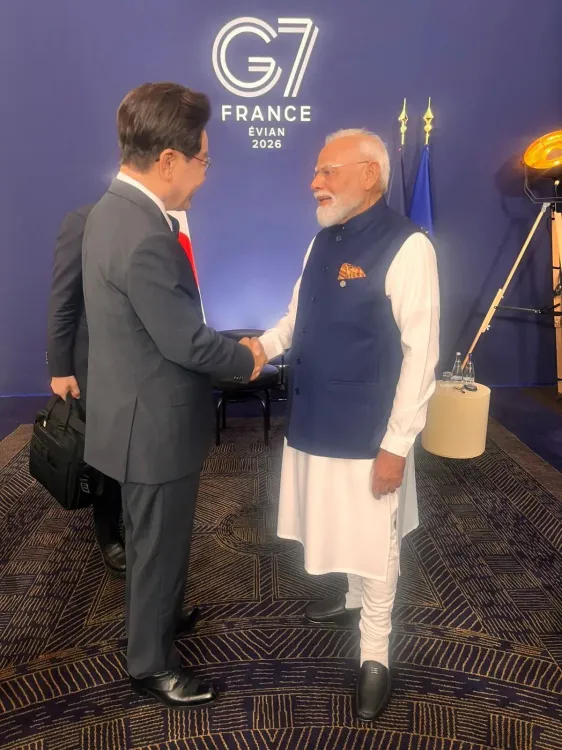
Prime Minister Narendra Modi met South Korean President Lee Jae-myung on the sidelines of the G7 summit in Evian on June 17, 2026, their second high-level meeting in two months, with both leaders highlighting deepening cooperation in trade and future advanced sectors.
Key Takeaways
Prime Minister Narendra Modi held a bilateral meeting with South Korean President Lee Jae-myung at the G7 summit in Evian on June 17, 2026 .
Modi described the conversation as 'very meaningful' and noted it came just two months after President Lee's visit to India.
Both leaders highlighted cooperation spanning trade, commerce, and future advanced sectors such as semiconductors and digital infrastructure.
India and South Korea have maintained structured economic ties since the CEPA signed in 2010 , with annual summit-level engagement.
The meeting reflects Modi's consistent use of multilateral platforms like the G7 to advance targeted bilateral outcomes under India's Act East Policy .
Follow-up announcements on semiconductor, EV, and clean energy supply-chain pacts are being closely watched.
Prime Minister Narendra Modi held a bilateral meeting with South Korean President Lee Jae-myung on the sidelines of the G7 summit in Evian on Wednesday, June 17, 2026, describing the conversation as 'very meaningful.' The meeting follows a visit by President Lee to India just two months prior, underscoring the momentum in ties between the two nations.
Writing in Korean on X, Prime Minister Modi said: '에비앙에서 이재명 대한민국 대통령과 매우 뜻깊은 대화를 나누었습니다' — 'I had a very meaningful conversation with President Lee Jae-myung of the Republic of Korea in Evian.' He noted that the two countries are cooperating closely 'not only in trade and commerce, but also across various future advanced sectors.'
Context
The Evian meeting is the second high-level engagement between the two leaders within a short span. President Lee Jae-myung, leader of South Korea's Democratic Party of Korea, had visited India approximately two months before this G7 encounter, signalling that bilateral consultations are being held at an accelerated pace. Prime Minister Modi's decision to post in Korean reflects a deliberate diplomatic outreach to the South Korean public and government.
Policy Backdrop
India and South Korea have maintained a structured economic relationship since the Comprehensive Economic Partnership Agreement (CEPA) signed in 2010, which expanded bilateral trade and investment frameworks. Annual summit-level meetings since then have deepened cooperation in defence, information technology, and infrastructure. Under India's Act East Policy, South Korea is identified as a priority partner, and the two countries have increasingly aligned on diversifying supply chains in sectors such as semiconductors, electric vehicles, and green hydrogen.
Modi has consistently used multilateral platforms like the G7 — where India participates as an invited partner economy — to secure targeted bilateral outcomes. The Evian sideline meeting fits squarely within this established pattern of converting multilateral presence into concrete bilateral engagement.
Stakeholders and Impact
Technology companies and trade investors in both countries are the primary stakeholders watching this engagement. South Korean conglomerates with manufacturing and R&D interests in India, as well as Indian IT and infrastructure firms with a presence in South Korea, stand to benefit from any follow-on agreements. The reference to 'future advanced sectors' in Modi's post points toward areas such as semiconductor supply chains, digital infrastructure, and clean energy — all of which have featured in recent India-South Korea discussions.
The broader strategic community will also note that closer India-Korea ties contribute to the reshaping of Indo-Pacific supply chains, a goal shared by several G7 member states.
What's Next
Observers will watch for follow-up announcements on specific pacts in semiconductor manufacturing, electric vehicle (EV) battery supply chains, or digital infrastructure cooperation. An upcoming India-Korea foreign ministers' meeting could formalise outcomes from the Evian conversation. The frequency of leader-level contact — two meetings within two months — suggests both sides are working toward a substantive joint deliverable in the near term.
Point of View
Now at the G7 in Evian — signal that the India-South Korea relationship is being elevated beyond routine diplomatic cadence. For New Delhi, Seoul represents a critical node in its strategy to diversify technology and supply-chain partnerships beyond traditional Western allies, particularly in semiconductors and clean energy. The use of Korean-language social media outreach by the Prime Minister's office is itself a soft-power signal, mirroring similar moves with Japanese and German audiences in the past. If concrete sectoral agreements follow, this meeting could mark a step-change in the bilateral relationship's strategic depth.
NationPress
19 Sept 2026
Frequently Asked Questions
Where did PM Modi meet South Korean President Lee Jae-myung in June 2026?
PM Modi met President Lee Jae-myung on the sidelines of the G7 summit in Evian on June 17, 2026, describing the conversation as 'very meaningful.'
What is the current state of India-South Korea relations?
India and South Korea have maintained close ties since signing a Comprehensive Economic Partnership Agreement (CEPA) in 2010, with annual leader-level summits covering defence, IT, infrastructure, and emerging technology sectors.
What sectors are India and South Korea cooperating on?
The two countries are cooperating on trade and commerce as well as future advanced sectors including semiconductors, electric vehicles, green hydrogen, and digital infrastructure.
Why does PM Modi attend G7 summits if India is not a G7 member?
India is regularly invited as a partner economy to G7 summits, and Prime Minister Modi uses these multilateral platforms to hold targeted bilateral meetings with world leaders on the sidelines.
What is India's Act East Policy and how does South Korea fit into it?
India's Act East Policy prioritises deeper economic and strategic engagement with East and Southeast Asian nations. South Korea is identified as a priority partner under this policy, particularly for technology and supply-chain cooperation.