Modi gifts Thewa cufflinks, Kashmiri carpet and Ayurvedic texts to Slovak leaders
Synopsis
Modi's gift list for Slovak leaders was no diplomatic afterthought — each item was a precisely chosen ambassador of a specific Indian region, craft, or knowledge tradition. From Rajasthan's Thewa gold-on-glass cufflinks to Bihar's Chhath Puja sweet and two-millennia-old Ayurvedic surgery texts, the selections collectively mapped India's civilisational range across a single state visit.
Key Takeaways
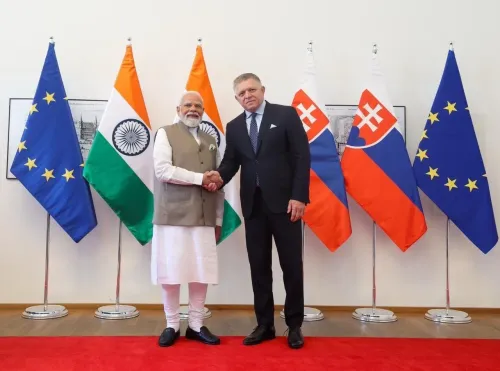
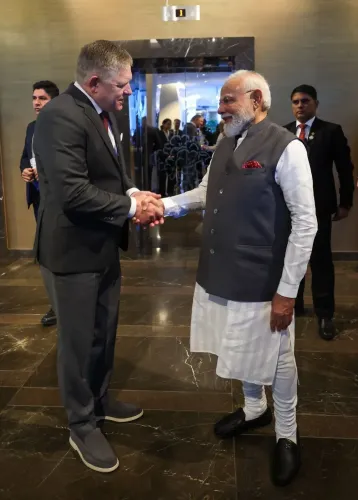
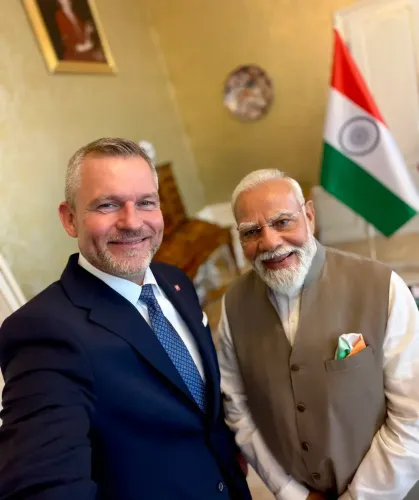
PM Modi visited Bratislava, Slovakia on 19 June in what is being described as a historic bilateral engagement.
Slovak President Peter Pellegrini received Thewa cufflinks (Pratapgarh, Rajasthan), a Himroo silk tie (Chhatrapati Sambhajinagar), and a brass Dokra antelope set from tribal artisan traditions of Chhattisgarh, Odisha, Jharkhand, and West Bengal.
Slovak PM Robert Fico was gifted a hand-knotted Kashmiri silk carpet from the Srinagar region.
National Council Speaker Richard Rasi received the festive sweet Thekua and copies of the Sushruta Samhita and Charaka Samhita — foundational Ayurvedic medical texts.
Several gifts carry GI status and feature in India's One District One Product (ODOP) initiative, underlining their artisanal and economic significance.
Prime Minister Narendra Modi presented an array of traditional Indian artefacts, ancient Ayurvedic manuscripts, and regional delicacies to Slovak leaders during his historic visit to Bratislava on 19 June, using carefully chosen gifts to spotlight India's cultural depth and centuries-old craft traditions.
Gifts for Slovak President Peter Pellegrini
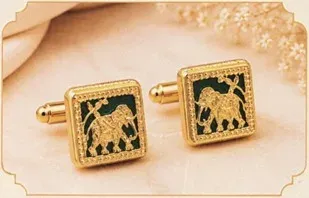
Slovak President Peter Pellegrini received a set that included handcrafted Thewa motif cufflinks, a Himroo silk tie, a matching pocket square, and a brass Dokra antelope set. Each item was selected to represent a distinct regional craft tradition from across India.
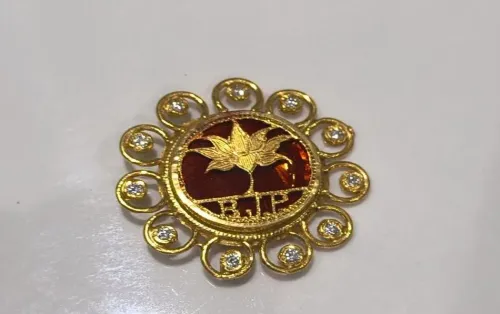
The Thewa cufflinks originate from Pratapgarh, Rajasthan, and are made using the rare Thewa technique — finely engraved gold sheets fused onto coloured glass to produce intricate designs drawn from nature and symbolism. The craft, preserved across generations by artisan families, carries Geographical Indication (GI) status and is part of the government's One District One Product (ODOP) initiative.
The Himroo silk tie and pocket square represent the weaving heritage of Aurangabad — now officially Chhatrapati Sambhajinagar. Crafted from a silk-cotton blend, Himroo is distinguished by its reversible weave, soft texture, and subtle sheen, with floral and paisley patterns woven directly into the fabric. Originating under Deccan court patronage, it too holds GI status and features in the ODOP scheme for its home district.
The brass Dokra antelope set draws on India's ancient lost-wax casting tradition, practised for centuries by tribal artisans across Chhattisgarh, Odisha, Jharkhand, and West Bengal. The antelope figures carry symbolic resonance — their themes of gentleness, agility, and harmony with nature were chosen to echo the Tatra chamois of Slovakia, drawing a cultural parallel between both nations' bonds with their natural environments.
A Kashmiri Silk Carpet for Prime Minister Robert Fico
Slovak Prime Minister Robert Fico was presented with a hand-knotted Kashmiri silk carpet from the Srinagar region of the Kashmir Valley. Woven from high-quality natural silk, these carpets are known for intricate floral, paisley, vine, and medallion designs. Each piece requires months or even years to complete owing to its high knot density, making every carpet a unique work of art valued globally as both a luxury furnishing and a cultural artefact.
Ancient Ayurvedic Texts and Festive Delicacy for Speaker Richard Rasi
Richard Rasi, Speaker of Slovakia's National Council, received a more scholarly selection: the traditional sweet Thekua alongside printed editions of the Sushruta Samhita and the Charaka Samhita — two foundational texts of ancient Indian medicine.
Thekua, a festive snack from Bihar and Jharkhand made with wheat flour, jaggery or sugar, fennel seeds, and ghee, is most closely associated with Chhath Puja. Its long shelf life and simple ingredients make it a durable symbol of regional culinary heritage.
The Sushruta Samhita, attributed to the physician Sushruta, is regarded as one of the earliest comprehensive works on surgery, detailing advanced surgical techniques, anatomy, and pioneering reconstructive procedures including rhinoplasty. The Charaka Samhita, attributed to Acharya Charaka, offers a systematic framework of health, disease, and human physiology developed over two millennia ago. Together, the texts represent India's early contributions to global medical science.
Diplomatic Significance
The choice of gifts — spanning craft traditions from Rajasthan, Maharashtra, Chhattisgarh, Odisha, Kashmir, Bihar, and Jharkhand — reflects a deliberate effort to present India's geographic and cultural breadth on a European diplomatic stage. This visit is being described as historic, marking a significant moment in India-Slovakia bilateral relations. The symbolic alignment of the Dokra antelope with Slovakia's Tatra chamois suggests a level of cultural research that goes beyond standard diplomatic protocol.
Point of View
Not a last-minute protocol list. What is less clear is whether these exchanges translate into substantive trade or strategic outcomes for India in Central Europe, a region where China has invested heavily in influence. The optics are strong; the follow-through will matter more.
NationPress
22 Sept 2026
Frequently Asked Questions
What did PM Modi gift to Slovak President Peter Pellegrini?
PM Modi gifted Slovak President Peter Pellegrini handcrafted Thewa motif cufflinks from Pratapgarh, a Himroo silk tie and pocket square from Chhatrapati Sambhajinagar, and a brass Dokra antelope set representing tribal metal-casting traditions from Chhattisgarh, Odisha, Jharkhand, and West Bengal.
What is the Thewa technique used in the cufflinks gifted by Modi?
The Thewa technique is a centuries-old jewellery craft from Pratapgarh, Rajasthan, involving finely engraved gold sheets fused onto coloured glass to create intricate designs. It carries Geographical Indication (GI) status and is part of India's One District One Product (ODOP) initiative.
What did PM Modi gift to Slovak Prime Minister Robert Fico?
PM Modi presented Slovak Prime Minister Robert Fico with a hand-knotted Kashmiri silk carpet from the Srinagar region of the Kashmir Valley. These carpets are crafted from natural silk and can take months or years to complete due to their high knot density.
What were the Ayurvedic texts gifted to Slovakia's National Council Speaker?
National Council Speaker Richard Rasi received copies of the Sushruta Samhita and the Charaka Samhita. The Sushruta Samhita is one of the earliest works on surgery, while the Charaka Samhita is a foundational text on internal medicine and human physiology, both dating back over two millennia.
Why is PM Modi's Slovakia visit considered historic?
The visit to Bratislava on 19 June is described as historic in the context of India-Slovakia bilateral relations, representing a high-level diplomatic engagement between the two nations. The carefully curated gifts — spanning crafts from multiple Indian states and ancient medical knowledge — underscored India's intent to deepen cultural and diplomatic ties with Central Europe.