Modi at G7: Human-centric AI and global cooperation India's core demand
Synopsis
At the G7 in Evian, Modi didn't just join the global AI conversation — he tried to reshape its terms. By tabling a four-point framework, invoking Pope Leo XIV, and centering child safety and Global South equity, India is positioning itself as the moral architect of international AI governance, not merely a rule-taker.
Key Takeaways
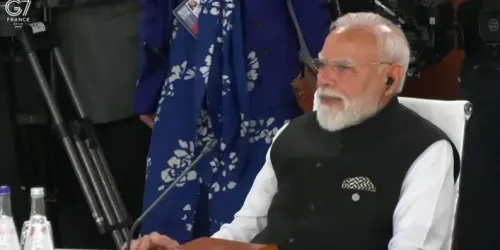
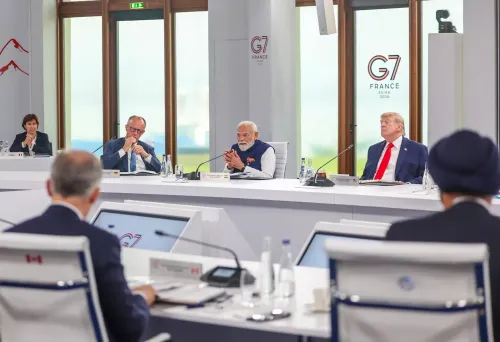
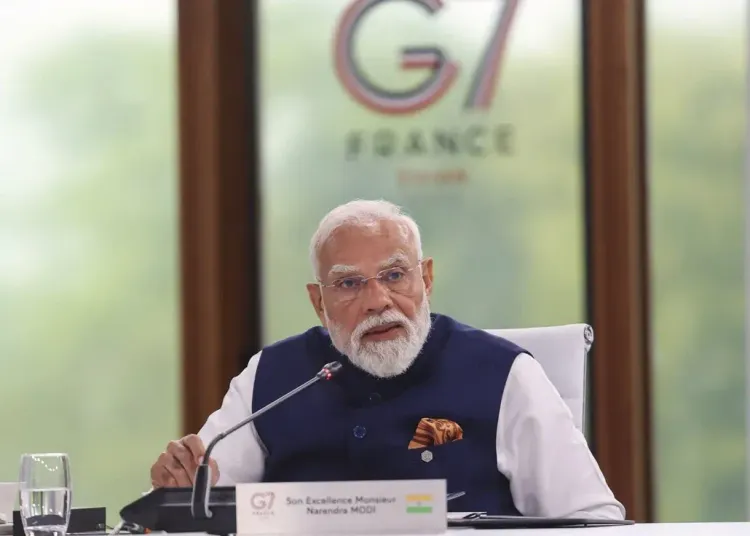
PM Narendra Modi addressed the G7 Summit in Evian on 18 June , outlining India's vision for safe, inclusive, and human-centric AI.
India's MANAV Vision — covering Moral and Ethical Systems, Accountable Governance, National Sovereignty, Accessible and Inclusive, Valid and Legitimate — guides all national AI efforts.
Modi cited Pope Leo XIV's recent letter on AI as convergent with India's framework, both placing human dignity at the centre of technology.
He warned that without safeguards, AI can expose children to misinformation, deepfakes, and exploitation , and called for the digital space to be a safe learning environment.
Modi proposed four measures: safe-by-design AI, common global standards and regulatory sandboxes, cooperation against deepfakes, and equitable AI access for the Global South .
He called for all democratic nations to access frontier AI models to protect critical information infrastructure against growing cyber threats.
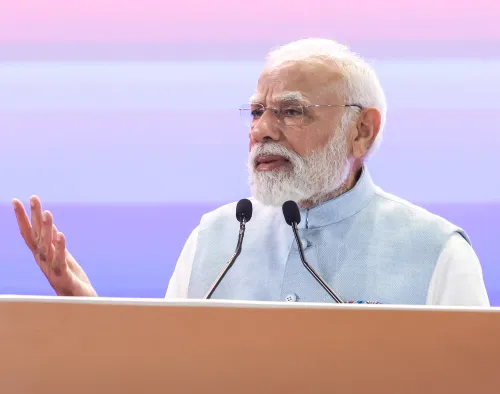
Prime Minister Narendra Modi on Wednesday, 18 June laid out India's vision for artificial intelligence at the G7 Summit in Evian, calling for a safe, inclusive, and human-centric approach to AI development and urging democratic nations to unite on common standards, child safety, and equitable access for the Global South.
India's MANAV Vision at the Centre
Addressing a dedicated session on 'Ensuring a Safe, Rapid and Efficient Rollout of AI', Modi argued that the true benchmark of AI is not the sophistication of machines but how effectively the technology uplifts ordinary people. He pointed to India's AI Impact Summit, held earlier this year, as a concrete expression of this philosophy.
He elaborated on India's MANAV Vision — an acronym standing for Moral and Ethical Systems, Accountable Governance, National Sovereignty, Accessible and Inclusive, Valid and Legitimate — as the guiding framework for all of India's AI policy and deployment efforts. The framework, he said, places human dignity at the core of every technological decision.
Pope Leo XIV's Message and Shared Values
Modi drew a notable parallel between India's policy framework and a recent letter by His Holiness Pope Leo XIV, in which the pontiff emphasised human values, inclusivity, and meaningful human control as the bedrock of responsible AI development. Modi said both the MANAV Vision and the Pope's message converge on one fundamental principle: no matter how advanced technology becomes, the human being must remain at its centre.
Child Safety and the Risks of Ungoverned AI
The Prime Minister devoted significant attention to the risks AI poses to children. While acknowledging that AI can educate children in their own languages, enhance creativity, and personalise learning, he warned that without proper safeguards the same technology can expose minors to misinformation, deepfakes, and exploitation.
Modi stated that the difference between these two outcomes lies not in the technology itself but in values, design, and governance. He called on G7 nations to ensure that the digital space becomes a playground for learning rather than a tool for manipulation.
Cybersecurity, Deepfakes, and Global Access
On cybersecurity, Modi asserted that frontier AI models are opening unprecedented possibilities — but stressed that no country can be fully secure in cyberspace until all countries are secure. He reiterated India's long-held position that cyberspace is a global public good and called for broad, inclusive access to critical AI technologies, particularly for democratic nations seeking to protect their critical information infrastructure.
He also advocated for stronger global cooperation to counter deepfakes, misinformation, and cyber fraud, specifically endorsing technologies such as digital watermarks as practical countermeasures.
Four Proposals for an Integrated AI Framework
Modi put forward four concrete suggestions for the G7 and the broader international community:
First, he called for promoting safe-by-design AI systems, embedding safety as a fundamental design principle from the outset rather than treating it as a regulatory add-on.
Second, he proposed developing common standards, testing frameworks, and regulatory sandboxes for AI deployment, citing civil aviation and maritime transport as sectors where globally harmonised rules have delivered lasting benefits.
Third, he urged strengthened international cooperation to combat deepfakes, misinformation, and cyber fraud, with watermarking technology as one practical tool.
Fourth, he stressed the need to ensure that AI benefits reach all nations of the Global South, so that AI becomes an inclusive force rather than a new axis of global inequality.
Concluding his remarks, Modi reaffirmed that India's AI policy rests on three pillars: expanding human potential, empowering human choice, and protecting human dignity. He said India will continue dialogue and cooperation with all partners on this subject.
Point of View
India is inserting itself as the voice of the Global South and of democratic values simultaneously. The MANAV framework is clever branding, but the harder question is enforcement — India has no binding AI legislation yet. Invoking the Pope adds moral weight, but the G7's actual AI governance architecture will be shaped by Brussels and Washington, not New Delhi. The child-safety and deepfake planks are the most actionable; the Global South equity argument, while compelling, has historically struggled to translate into concrete G7 commitments. India's real leverage will come from its scale of AI deployment at home — if MANAV delivers measurable outcomes domestically, it becomes a credible export.
NationPress
17 Sept 2026
Frequently Asked Questions
What did PM Modi say about AI at the G7 Summit?
PM Modi addressed the G7 Summit in Evian on 18 June, calling for a safe, inclusive, and human-centric approach to AI. He presented India's MANAV Vision as a guiding framework and made four concrete proposals covering safe-by-design systems, common global standards, anti-deepfake cooperation, and equitable AI access for the Global South.
What is India's MANAV Vision for AI?
MANAV stands for Moral and Ethical Systems, Accountable Governance, National Sovereignty, Accessible and Inclusive, and Valid and Legitimate. It is India's overarching policy framework for AI development, placing human dignity and democratic accountability at the centre of all technology decisions.
Why did Modi mention Pope Leo XIV at the G7?
Modi referenced a recent letter by Pope Leo XIV on AI, which emphasised human values, inclusivity, and meaningful human control. Modi argued that the Pope's message and India's MANAV Vision share the same core principle — that human beings must remain central regardless of how advanced technology becomes.
What did Modi say about child safety and AI?
Modi warned that while AI can personalise learning and educate children in their own languages, ungoverned AI can expose minors to misinformation, deepfakes, and exploitation. He called on G7 nations to ensure the digital space is designed as a safe learning environment for children, not a tool for manipulation.
What four proposals did Modi make for global AI governance?
Modi proposed: first, making safety a foundational design principle in all AI systems; second, developing common international standards, testing frameworks, and regulatory sandboxes; third, strengthening global cooperation to counter deepfakes and cyber fraud, including through watermarking technology; and fourth, ensuring AI benefits reach all Global South nations to prevent a new digital divide.