PM Modi at G7: AI must be inclusive, secure and serve public good
Synopsis
At the G7 in Evian, Modi did not just endorse AI — he set conditions for it. With four concrete governance proposals and a pointed call for democratic nations to access AI models for cyber defence, India is staking out a position as the Global South's voice in shaping how the world regulates its most consequential technology.
Key Takeaways
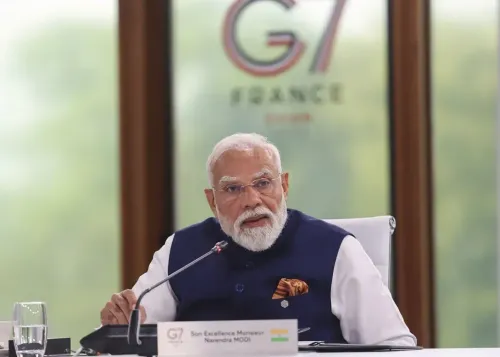
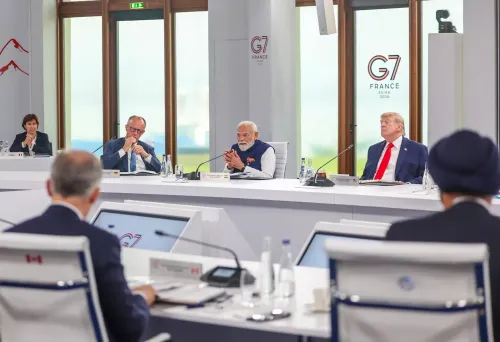
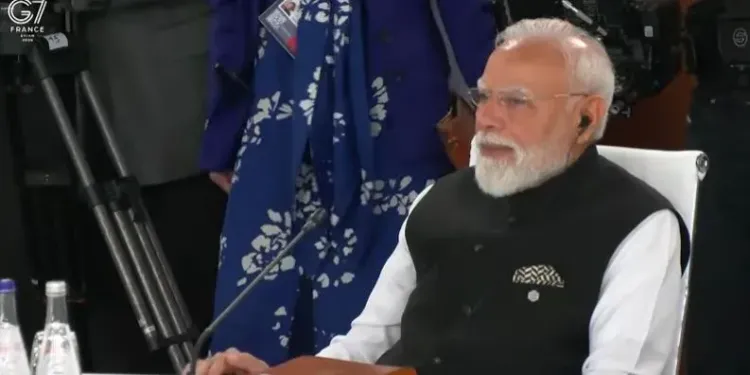
PM Narendra Modi addressed the G7 Summit in Evian, France on 18 June , speaking at the AI outreach session.
Modi articulated India's MANAV (human-centric) vision: AI must be anchored in inclusivity, security, and public good .
He put forward four proposals : safe-by-design AI systems, common standards and testing frameworks, global cooperation against deepfakes and cyber fraud, and equitable AI access for the Global South .
Modi called for all democratic countries to have access to AI models to protect critical information infrastructure against cyber threats.
He rejected a trade-off between safety and speed, calling for an integrated approach that pursues both simultaneously.
India recently hosted the AI Impact Summit , cited by Modi as a practical expression of its human-centric AI philosophy.
Prime Minister Narendra Modi on 18 June addressed the outreach session on 'Ensuring a Safe, Rapid and Efficient Rollout of Artificial Intelligence' at the G7 Summit in Evian, France, calling for a human-centric approach to AI that prioritises inclusivity, security, and public good. The remarks, confirmed by an official statement from the Ministry of External Affairs (MEA), positioned India as a proponent of equitable AI access — particularly for nations in the Global South.
India's Human-Centric Vision for AI
Modi underscored that while AI is a 'transformative force with the potential to redefine the direction of human civilisation', its ultimate value lies not in the power of machines but in how much it empowers ordinary people. He framed this as India's MANAV (human) vision — anchoring AI development in the principles of inclusivity, security, and public good.
In a post on his official X account, Modi wrote: 'The true test of AI is not how powerful our machines become. Its real test lies in how much it empowers ordinary human beings.' He added that this guiding philosophy had shaped India's decision to host the AI Impact Summit recently.
Four Proposals for Global AI Governance
The Prime Minister put forward four concrete suggestions for the international community. First, AI systems should be safe-by-design. Second, AI deployment must be accompanied by common standards, testing frameworks, and regulatory guidelines. Third, there should be effective global cooperation to combat deepfakes, misinformation, and cyber fraud. Fourth, the benefits of AI must reach countries of the Global South to ensure an inclusive global order.
These proposals reflect India's broader push to shape multilateral technology governance from a developing-world perspective — a stance Modi has consistently advanced in forums from the G20 to the United Nations.
Cyberspace as a Global Public Good
Modi also stressed that cyberspace must serve the global public interest, and that access to AI models cannot remain concentrated among a handful of nations. In a second post on X, he wrote: 'India firmly believes that cyberspace has to be one that furthers the global public good. Access to AI technologies must also be broad and inclusive. All democratic countries should have access to such AI models so that they can protect their critical information infrastructure and respond effectively to growing cyber threats.'
The MEA statement noted that Modi emphasised democratic nations must be equipped with AI tools capable of securing critical infrastructure and countering escalating cyber threats — a pointed signal amid global concerns over state-sponsored cyberattacks.
Integrated Approach: Safety, Speed, and Efficiency Together
A key theme of Modi's address was the rejection of trade-offs between safety and speed in AI rollout. He called for an integrated approach where the three imperatives — safety, speed, and efficiency — are pursued simultaneously rather than sequentially. This positions India against regulatory frameworks that treat safety as a brake on innovation, arguing instead that the two can and must coexist.
Modi concluded by stating that 'AI must expand human potential, empower human choice and protect human dignity', and affirmed that India would continue working with international partners to advance these objectives. The statement comes as G7 nations intensify discussions on binding versus voluntary AI governance frameworks.
Point of View
India is making a calculated bid to lead the Global South's negotiating bloc in emerging AI governance forums. The MANAV framing is rhetorically sharp, but the real test is whether India's domestic AI infrastructure — compute, data policy, regulatory capacity — can back the ambition. Notably, the four proposals stop short of calling for binding international rules, leaving India room to manoeuvre between the EU's hard regulatory approach and the US preference for voluntary frameworks. That flexibility is strategic, but it also means India risks being a broker without a binding offer on the table.
NationPress
23 Sept 2026
Frequently Asked Questions
What did PM Modi say about AI at the G7 Summit?
PM Modi addressed the G7 outreach session on AI in Evian on 18 June, calling for a human-centric approach where artificial intelligence is anchored in inclusivity, security, and public good. He proposed four global governance steps and stressed that AI's true measure is how much it empowers ordinary people, not how powerful machines become.
What is India's MANAV vision for AI?
MANAV — meaning 'human' — is India's framework for AI development that places human empowerment at the centre of technology policy. Modi articulated it at the G7 as a counter to purely capability-driven AI narratives, arguing that AI must expand human potential, empower human choice, and protect human dignity.
What four proposals did Modi make for global AI governance?
Modi proposed that AI systems be safe-by-design; that deployment be governed by common standards, testing frameworks, and regulatory guidelines; that nations cooperate to counter deepfakes, misinformation, and cyber fraud; and that AI benefits be extended to Global South countries to ensure an inclusive global order.
Why did Modi stress AI access for democratic countries?
Modi argued that all democratic nations must have access to AI models to protect their critical information infrastructure and respond effectively to growing cyber threats. He framed cyberspace as a global public good, warning against AI access remaining concentrated among a small number of states.
What is the AI Impact Summit that Modi referenced?
The AI Impact Summit is a recent international conference hosted by India, cited by Modi as a practical expression of the country's human-centric AI philosophy. He referenced it at the G7 to underscore India's active role in shaping global AI policy beyond merely participating in multilateral discussions.