Myanmar drug cartels fuel Northeast India's biggest narcotics crisis
Synopsis
Myanmar has overtaken Afghanistan as the world's top opium producer — and India's Northeast is bearing the brunt. With 1,000–1,080 metric tonnes of opium produced annually, billions of yaba tablets flowing in, and a barter-based smuggling system designed to leave no money trail, agencies have quietly abandoned the seizure-only playbook and are now hunting the financiers, hawala operators, and 1,400 mule accounts propping up one of Asia's most sophisticated narcotics networks.
Key Takeaways
Myanmar has replaced Afghanistan as the world's largest illicit opium producer, generating 1,000–1,080 metric tonnes annually.
India's 1,643 km India-Myanmar border remains largely unfenced across Mizoram , Nagaland , Arunachal Pradesh , and Manipur .
The Enforcement Directorate has traced 1,400 mule accounts linked to traders facilitating drug-for-goods barter with Myanmar cartels.
Hawala funds flowing through Champhai, Mizoram originate from Delhi , Kolkata , and Mumbai , routed via illicit money exchanges.
Security agencies have shifted from a seizure-only strategy to a network-centric approach targeting financiers, operators, and supply chains.
Officials say achieving a drug-free India by 2029 is difficult but not impossible with sustained network-disruption operations.
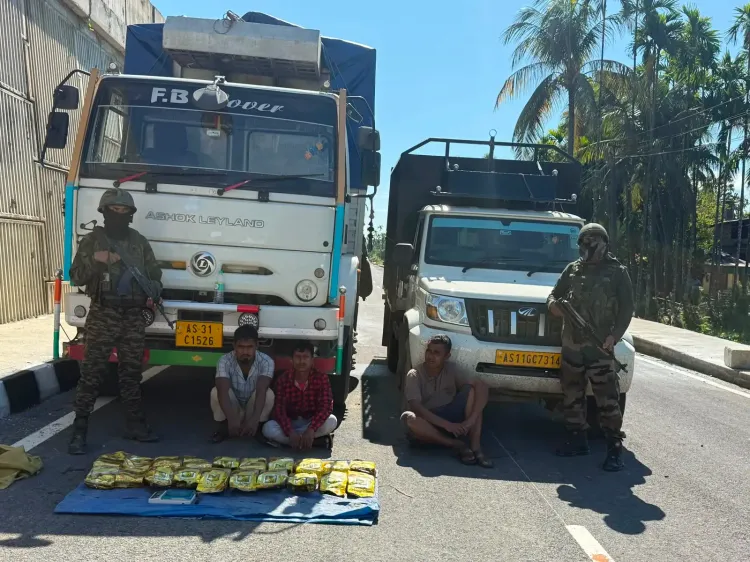
India's northeastern region has emerged as the country's most complex narcotics battleground, with security agencies struggling to dismantle deeply entrenched drug networks supplied primarily from Myanmar — now the world's largest illicit opium producer. Officials acknowledge that achieving a drug-free India by 2029 will be an uphill task, though they maintain it remains achievable.
A Strategic Shift: From Seizures to Network Dismantling
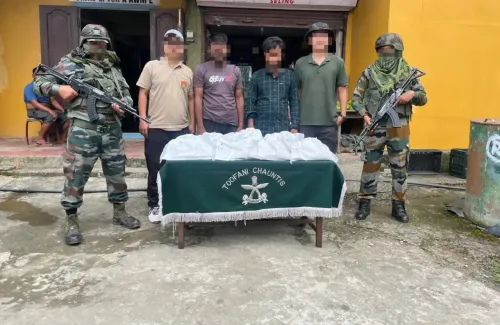
For years, the dominant counter-narcotics approach centred on drug seizures. That strategy, officials now concede, was insufficient. As one official put it: 'All these years, the focus was on seizures. However, this was not sufficient as the cartels kept generating more narcotics. This explains why we have decided to go after the network itself, so that the entire supply chain is shut down.'
Agencies have accordingly pivoted to a network-centric strategy — targeting not just couriers and consignments, but also the financiers, operators, and sourcing infrastructure behind the trade. The scale of operations required to execute this shift, however, is formidable.
Why the Northeast Is Harder Than Punjab or Kashmir
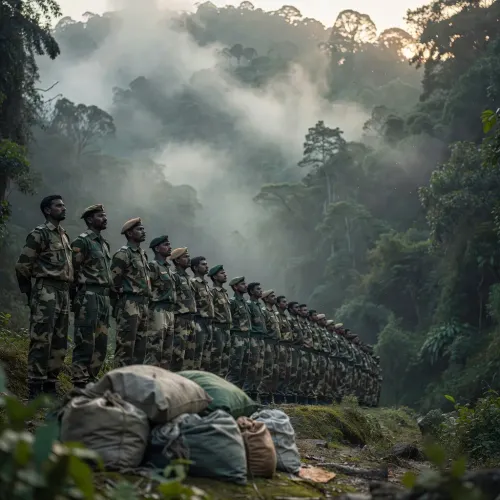
Officials engaged in active operations across the northeastern states describe the challenge as qualitatively different from other drug-affected corridors. The terrain — dense forests and rugged hills — frequently gives cartels an operational advantage over law enforcement. An Intelligence Bureau official noted that both the topography and the sheer scale of smuggling flows compound the difficulty.
The 1,643 km India-Myanmar border is largely unfenced, cutting through forest areas across Mizoram, Nagaland, Arunachal Pradesh, and Manipur. Local communities, including Nagas and Mizos, have historically resisted border fencing, leaving vast stretches porous. Complicating matters further, significant drug volumes are also entering India via the Bangladesh border, reaching Assam, West Bengal, Mizoram, and Tripura.
Myanmar's Drug Production: A Widening Arsenal
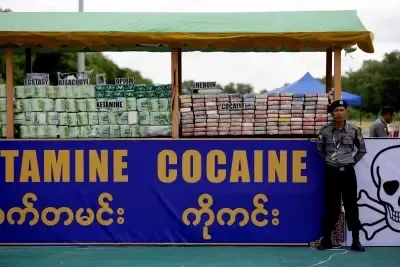
Myanmar had long been notorious for producing and exporting brown sugar, finished heroin, and the synthetic drug methamphetamine. Its displacement of Afghanistan as the world's largest illicit opium producer has dramatically widened the variety of narcotics being pushed into India. Officials estimate that 1,000 to 1,080 metric tonnes of opium are produced in Myanmar annually, alongside billions of yaba tablets, large quantities of crystal methamphetamine, and ketamine.
According to officials, a couple of seizures are inconsequential to these cartels, given their production capacity. If agencies continue relying solely on interdiction, the system risks being overwhelmed by sheer volume.
The Barter Route: How Drugs Cross the Border
The Enforcement Directorate (ED) has mapped a sophisticated cross-border barter mechanism underpinning the trade. Drugs produced in Myanmar are transported across the Tiau River at Zokhawthar — opposite Khawmawi in Myanmar — and enter India through Champhai in Mizoram. From there, consignments move to Aizawl, Vairengte, and Assam, before fanning out to the rest of India.
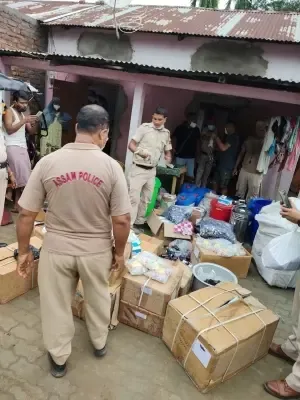
The ED has identified 1,400 mule accounts belonging to traders in India who reportedly assist drug syndicates. These traders procure everyday commodities — petrol, diesel, medicines, edible oil, flour, clothing and footwear — using GST invoices that make transactions appear legitimate. The goods are then exchanged for drugs upon reaching the northeast, in a modern adaptation of an age-old barter system. Hawala money funding these purchases originates from Delhi, Kolkata, and Mumbai, with transactions handled through illicit exchanges in Champhai. Once goods reach Myanmar, they are marketed commercially — eliminating any traceable money trail.
What Comes Next
Officials say that while shutting down the money trail originating in Myanmar and Bangladesh is difficult, tracking and blocking financial flows within India is 'very much a possibility,' according to one ED official. The ED's ongoing probe into hawala networks and mule accounts represents the most advanced front in this effort. The network-centric approach — targeting financiers, logistics operators, and hawala intermediaries simultaneously — is now the stated long-term strategy. Whether agencies can sustain that intensity across four states and a 1,643 km porous border will determine whether the 2029 drug-free India target has any chance of being met.
Point of View
But it exposes just how far behind the curve Indian agencies have been. The barter mechanism — goods exchanged for drugs using legitimate GST invoices — has been operating long enough for cartels to refine it into a near-invisible system. The ED's identification of 1,400 mule accounts is a meaningful breakthrough, but the real test is whether prosecutions follow at scale. Meanwhile, the unfenced 1,643 km border remains the foundational vulnerability: as long as community resistance to fencing persists and terrain advantages favour smugglers, even the best network intelligence will be playing catch-up.
NationPress
2 Nov 2026
Frequently Asked Questions
Why has Northeast India become the centre of India's drug trafficking problem?
Northeast India's porous 1,643 km border with Myanmar — largely unfenced and cutting through dense forests in Mizoram, Nagaland, Arunachal Pradesh, and Manipur — makes it the primary entry point for narcotics smuggled from Myanmar. Myanmar is now the world's largest illicit opium producer, supplying heroin, methamphetamine, yaba tablets, and ketamine into India.
What is the barter system used by Myanmar drug cartels?
Cartels use Indian traders on their payrolls to procure everyday goods — petrol, medicines, edible oil, clothing — using GST invoices that appear legitimate. These goods are transported to the Northeast and exchanged directly for drugs, eliminating a traceable money trail. Hawala networks in Champhai, Mizoram handle financial transfers funded from Delhi, Kolkata, and Mumbai.
What action has the Enforcement Directorate taken against drug networks?
The Enforcement Directorate has identified 1,400 mule accounts belonging to Indian traders who assist drug syndicates through the barter mechanism. The ED is tracing money trails within India, where financial flows remain more trackable than those originating in Myanmar or Bangladesh.
Why are drug cartels difficult to stop despite regular seizures?
Myanmar cartels produce narcotics on an enormous scale — an estimated 1,000 to 1,080 metric tonnes of opium annually — making individual seizures inconsequential to their operations. Officials say agencies are now shifting to a network-centric strategy targeting financiers and supply chain operators rather than just intercepting consignments.
What is India's drug-free 2029 target and how realistic is it?
The drug-free India by 2029 goal is an official government objective, but security agencies acknowledge it is a difficult target given the scale of Myanmar's narcotics production and the porousness of northeastern borders. Officials maintain it is achievable only if the network-centric approach — disrupting entire supply chains rather than seizing individual consignments — is sustained consistently.