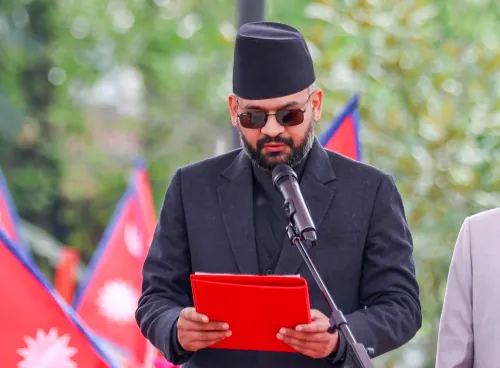
Nepal's PM Balendra Shah Reveals NPR 14.6 Million in Assets
Synopsis
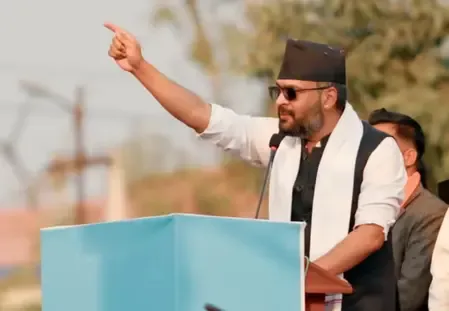
Nepal's Prime Minister Balendra Shah has publicly disclosed his assets, revealing NPR 14.6 million in his bank account. This move highlights a commitment to transparency among government officials, continuing a tradition established since the country's democratic restoration.
Key Takeaways
Balendra Shah has disclosed NPR 14.6 million in assets.
Asset declarations align with the Corruption Prevention Act .
Transparency in governance is a long-standing tradition in Nepal.
Shah names popular platforms as sources of income.
Other Cabinet members have also shared their financial details.
Kathmandu, April 12 (NationPress) The newly appointed Prime Minister of Nepal, Balendra Shah, has disclosed that he possesses NPR 14.6 million in his bank accounts. This information was revealed on Sunday, alongside asset declarations from other members of his Cabinet.
In accordance with the Corruption Prevention Act of 2002, it is mandatory for ministers and senior government officials to submit their asset disclosures to designated authorities within 60 days of taking office.
However, the law does not stipulate that these disclosures must be made public.
Despite this, a tradition of transparency and good governance has led many officials to voluntarily share their asset details.
As per the information released by the Office of the Prime Minister and Council of Ministers, PM Balendra Shah has identified Facebook, YouTube, and Spotify as his income sources.
His asset declaration further indicates that his mother, Dhruvadevi Shah, owns 5 aana of land (approximately 158.98 square meters) in Kathmandu and 1.2 bigha (about 8,286.14 square meters) in the Dhanusha district of southern Madhes Province.
Additionally, his father, Ramnarayan Shah, possesses 9 bigha (approximately 61,112.62 square meters) of land in the Mahottari district.
Moreover, Shah's wife, Sabina Kafle, is reported to own 190 tolas of precious metals, including unspecified amounts of gold and silver.
Other Cabinet members, such as Finance Minister Swarnim Wagle and Home Minister Sudhan Gurung, have also disclosed their asset information.
The practice of publicly announcing property details has been a norm for Prime Ministers and Cabinet Ministers in Nepal since the restoration of democracy in 1990, although some past administrations have neglected this custom.
For example, during the tenure of former Prime Minister KP Sharma Oli starting in July 2024, there was a lack of property disclosures from Cabinet members.
Similarly, a previous government led by Sushila Karki also failed to adhere to this transparency practice.
Point of View
Shah sets a precedent for accountability among government officials. This initiative aligns with the broader expectations for ethical governance, although past administrations have occasionally faltered in this regard.
NationPress
19 Sept 2026
Frequently Asked Questions
What is the current asset declaration of Nepal's Prime Minister Balendra Shah?
Nepal's Prime Minister Balendra Shah has declared NPR 14.6 million in his bank accounts.
What does the Corruption Prevention Act of 2002 require?
The Act mandates that ministers and high-level officials submit their asset details within 60 days of taking office.
Is it mandatory for ministers to publicly disclose their assets?
No, there is no legal requirement for public disclosure, but there is a tradition of transparency.
What sources of income has PM Balendra Shah listed?
He has identified Facebook, YouTube, and Spotify as his sources of income.
Have other Cabinet members disclosed their assets?
Yes, other members of the Cabinet, including Finance and Home Ministers, have also made their property details public.