North Korea downgrades London mission over UK sanctions on Pyongyang camp
Synopsis
North Korea has recalled its ambassador to London and downgraded its diplomatic mission after Britain sanctioned the Songdowon children's camp over suspected links to the forced deportation of Ukrainian children — a move Pyongyang called 'politically provocative.' The same week, Kim Jong-un also replaced his defence minister, signalling a simultaneous reshaping of North Korea's foreign posture and military command.
Key Takeaways
North Korea downgraded its diplomatic mission in London on 1 September , recalling Ambassador Mun Myong-sin .
The move was a direct response to Britain sanctioning Songdowon International Children's Camp in Wonsan over suspected links to forced deportation of Ukrainian children .
The camp, established in 1960 , has reportedly been used to promote regime loyalty; at least two Ukrainian children were reportedly transferred there, according to a Ukrainian online newspaper.
North Korea replaced Defence Minister No Kwang-chol with Kim Song-gi in a reshuffle guided by leader Kim Jong-un .
The reshuffle was decided at the second meeting of the ninth WPK Central Military Commission .
North Korea has downgraded its diplomatic mission in London, announcing the move as a formal protest against Britain's decision to sanction a North Korean children's camp suspected of involvement in the forced deportation of Ukrainian children. Pyongyang's foreign ministry confirmed the decision on Friday, 1 September, describing it as a 'diplomatic response' to what it called a 'politically provocative' act by London.
What the Downgrade Means
Ambassador Mun Myong-sin has been recalled from London and will be reassigned elsewhere. A charge d'affaires will now serve as acting chief of mission at the North Korean diplomatic post in the British capital. The step falls short of a full severance of ties but signals a significant cooling in an already strained bilateral relationship.
The UK Sanctions and the Camp at the Centre
In early May, the British government included Songdowon International Children's Camp — located in the eastern coastal city of Wonsan — in a broader sanctions package that also targeted a range of Russian individuals and entities. London suspects the camp is linked to Russian-led forced deportations and the indoctrination of Ukrainian youths. A Ukrainian online newspaper had reported in December that at least two Ukrainian children were believed to have been abducted by Russian troops in Ukraine and forcibly transferred to the facility.
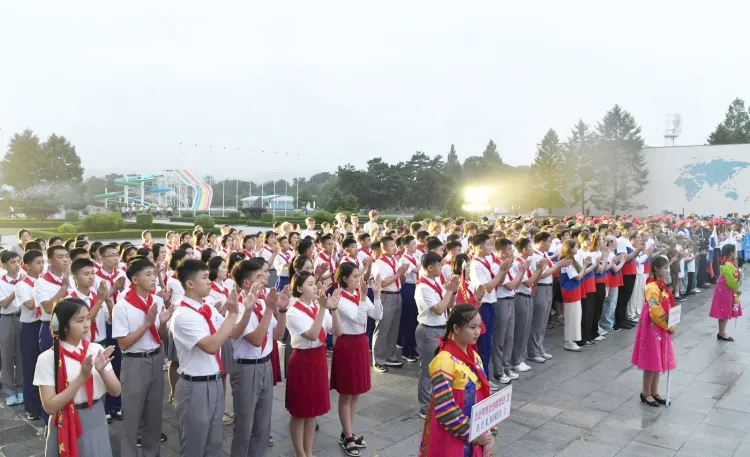
Established in 1960, the Songdowon camp has long been used, according to analysts, to disseminate propaganda and reinforce loyalty to the Pyongyang regime among young people. In July, children from China and Russia participated in the camp — a development widely read as a visible marker of deepening ties among the three countries.
Pyongyang's Rebuttal
North Korea's foreign ministry rejected the British characterisation of the camp, accusing London of 'unreasonably linking our children's camping facility with the groundless issue of forcible migration of Ukrainian children.' Pyongyang further alleged that the sanctions were an attempt to tarnish its international image and undermine its relationship with Russia — a partnership that has grown considerably closer since Russia's full-scale invasion of Ukraine in 2022.
North Korea's Defence Minister Replaced in Military Reshuffle
Separately, state media reported on Sunday that North Korea has replaced its defence minister in a reshuffle of senior military leadership. Kim Song-gi, Director of the General Political Bureau of the Korean People's Army, was appointed as the country's new defence minister, replacing No Kwang-chol, according to the Korean Central News Agency (KCNA). No was removed from the defence portfolio and from the party's central leadership, and was reassigned as first vice-director of the Munitions Industry Department of the Workers' Party of Korea (WPK) Central Committee.
The reshuffle was decided at the second meeting of the ninth WPK Central Military Commission, held the previous day under the guidance of leader Kim Jong-un. The back-to-back developments — a diplomatic downgrade and a military leadership shake-up — paint a picture of a Pyongyang recalibrating both its foreign posture and its internal command structure simultaneously.
Broader Context
This comes amid sustained Western pressure on North Korea over its military cooperation with Russia, including the reported supply of artillery shells and ballistic missiles for use in Ukraine. The London downgrade is the latest in a series of retaliatory diplomatic gestures by Pyongyang against Western nations that have imposed sanctions linked to the Russia-Ukraine conflict. How far the relationship between Britain and North Korea deteriorates will depend in part on whether further sanctions follow.
Point of View
Not just for its own nuclear programme. The simultaneous military reshuffle adds intrigue: replacing a defence minister while managing a foreign-policy flare-up suggests Kim Jong-un is tightening control across both domains. The deeper question is whether Britain's sanctions, layered on top of existing UN restrictions, will meaningfully alter Pyongyang's calculus — or simply accelerate its pivot toward a tighter Moscow-Beijing-Pyongyang axis.
NationPress
17 Oct 2026
Frequently Asked Questions
Why has North Korea downgraded its diplomatic mission in London?
North Korea downgraded its London mission on 1 September in protest against Britain's decision to sanction the Songdowon International Children's Camp, which London suspects is linked to the Russian-led forced deportation and indoctrination of Ukrainian children. Pyongyang called the UK move 'politically provocative' and a bid to damage its international image.
What is the Songdowon International Children's Camp?
Songdowon International Children's Camp is a facility established in 1960 in the eastern coastal city of Wonsan, North Korea. It has long been used, according to analysts, to promote regime loyalty among young people, and a Ukrainian online newspaper reported in December that at least two Ukrainian children were believed to have been forcibly transferred there by Russian troops.
Who is North Korea's new defence minister?
Kim Song-gi, previously Director of the General Political Bureau of the Korean People's Army, was appointed North Korea's new defence minister, replacing No Kwang-chol. The reshuffle was decided at a WPK Central Military Commission meeting guided by leader Kim Jong-un.
What does the diplomatic downgrade mean in practice?
Ambassador Mun Myong-sin has been recalled and will be reassigned, with a charge d'affaires now serving as acting chief of mission in London. It is a step short of a full severance of diplomatic ties but represents a formal downgrading of the bilateral relationship.
How does this relate to North Korea's ties with Russia?
North Korea has characterised the UK sanctions as an attempt to undermine its relationship with Russia, which has grown significantly closer since Russia's full-scale invasion of Ukraine. Western governments have accused Pyongyang of supplying Russia with artillery shells and ballistic missiles, and the Songdowon camp sanction is part of broader Western pressure on that partnership.