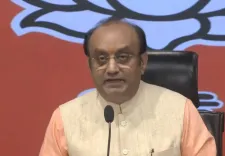
Mandaviya marks 12 years of Modi govt with welfare milestones
Synopsis
On the 12th anniversary of the Modi government, Union Minister Mansukh Mandaviya praised a decade-plus of welfare delivery — from Ujjwala and Ayushman Bharat to Chandrayaan-3 — and called the era a 'mahayagya' for a developed India.
Key Takeaways
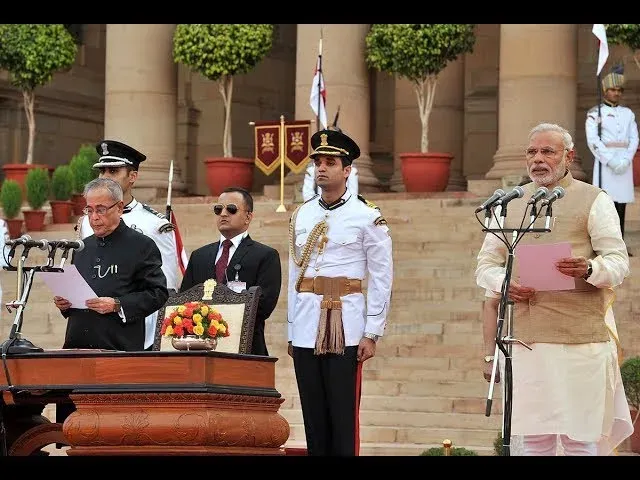
26 May 2026 marks 12 years since Narendra Modi was first sworn in as Prime Minister.
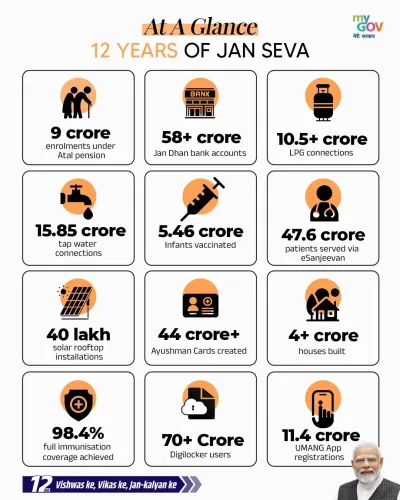
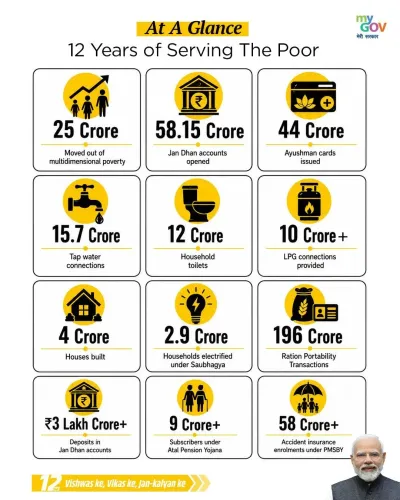
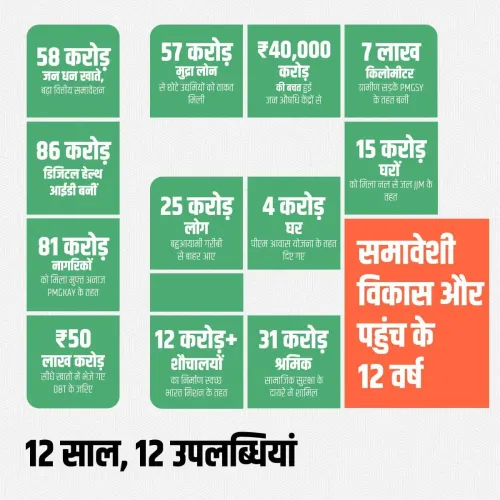
Minister Mandaviya highlighted PM Ujjwala Yojana (launched 1 May 2016 ), Ayushman Bharat (launched September 2018 ), and PM Jan Dhan Yojana (launched 28 August 2014 ) as transformative welfare milestones.
Chandrayaan-3 's soft landing near the Moon's south pole in August 2023 was cited as a symbol of India's global scientific rise.
The post frames India's shift from aid recipient to global capability contributor, referencing pandemic vaccine supply and evacuation of nationals from conflict zones.
Mandaviya described the 12-year period as a 'mahayagya' carried out without interruption under the Viksit Bharat 2047 vision.
Union Labour and Sports Minister Mansukh Mandaviya on Tuesday, 26 May 2026 marked the 12th anniversary of the Narendra Modi-led government, reflecting on a decade-plus of welfare delivery, space achievements, and India's evolving global stature in a heartfelt post on X.
Context
Mandaviya's post, written in Hindi, opens by recalling 26 May 2014 — the day Prime Minister Narendra Modi was first sworn in — as a moment when, in his words, 'sawa sau crore sapnon ne ek naam par bharosa kiya tha' ('one hundred and twenty-five crore dreams placed their trust in one name'). The minister frames the anniversary not as a political milestone but as a covenant of public faith.
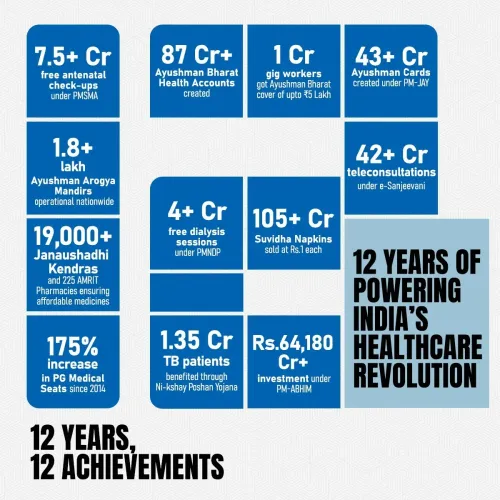
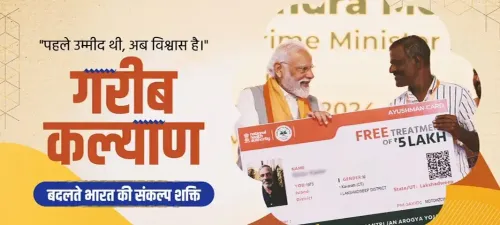
The post draws an arc across three flagship welfare programmes: PM Ujjwala Yojana, which replaced smoky traditional stoves with LPG connections for poor households; Ayushman Bharat, the national health protection scheme offering up to Rs 5 lakh annual coverage to economically weaker families; and PM Jan Dhan Yojana, the financial inclusion drive that opened zero-balance bank accounts for crores of unbanked citizens, particularly women.
Policy Backdrop
PM Jan Dhan Yojana was launched on 28 August 2014, weeks after the government took office, to expand banking access to India's unbanked population. PM Ujjwala Yojana followed on 1 May 2016, targeting below-poverty-line households to provide clean cooking fuel. Ayushman Bharat Pradhan Mantri Jan Arogya Yojana was rolled out in September 2018 as one of the world's largest government-funded health insurance schemes.
Mandaviya also invokes India's space programme, referencing Chandrayaan-3's historic soft landing near the Moon's south pole in August 2023 — the first mission globally to achieve that feat — as emblematic of the country's scientific ambition under the current administration.
Stakeholders and Impact
The beneficiaries cited across the post — women cooking on clean fuel, poor families accessing health cover, unbanked households entering the formal economy, and families receiving subsidised housing — collectively represent hundreds of millions of citizens from below-poverty-line and rural backgrounds. Mandaviya describes these schemes as 'karodon zindagiyon ki dobara shuruat' ('a fresh beginning for crores of lives'), not merely as policy instruments.
Beyond domestic welfare, the minister highlights India's pandemic-era vaccine diplomacy — supplying doses globally — and the evacuation of Indian nationals from conflict zones as evidence of a country that, in his framing, has shifted from 'extending its hand' to 'showing the world the way.' This aligns with the government's broader Viksit Bharat 2047 vision of a fully developed India by the centenary of independence.
What's Next
The Viksit Bharat 2047 agenda sets the long-horizon benchmark against which the current government's remaining targets will be measured, with scheme expansions and budgetary allocations expected to be key indicators in upcoming Union Budgets and parliamentary sessions. Mandaviya closes by calling the 12-year period a 'mahayagya' ('great collective endeavour') — performed without pause or a single day off — dedicated solely to Maa Bharati and the pledge of a developed India.
As the Modi government enters its twelfth year, ministerial posts of this nature signal the ruling party's intent to consolidate its welfare narrative ahead of future electoral cycles, keeping flagship scheme delivery at the centre of its public communication.
Point of View
Space milestones, and foreign-policy moments into a single legitimising arc. By invoking Jan Dhan, Ujjwala, and Ayushman Bharat alongside Chandrayaan-3, the minister signals that the BJP's electoral identity remains anchored in last-mile delivery to the poor, even as it projects a confident global India. The 'mahayagya' framing elevates governance into a quasi-sacred duty, reinforcing Modi's image as a tireless servant-leader rather than a conventional politician. This kind of senior-ministerial amplification on anniversary dates is increasingly a coordinated communication strategy ahead of state elections and the next national cycle.
NationPress
21 Sept 2026
Frequently Asked Questions
When did the Modi government complete 12 years in power?
26 May 2026 marks 12 years since Narendra Modi was first sworn in as Prime Minister of India on 26 May 2014 .
What is PM Ujjwala Yojana and when was it launched?
PM Ujjwala Yojana was launched on 1 May 2016 to provide free LPG connections to women from below-poverty-line households, replacing traditional and often harmful cooking fuels.
What is Ayushman Bharat and who does it cover?
Ayushman Bharat Pradhan Mantri Jan Arogya Yojana , rolled out in September 2018 , offers up to Rs 5 lakh annual health insurance coverage to economically weaker families, making it one of the world's largest government-funded health schemes.
What was the significance of Chandrayaan-3?
Chandrayaan-3 achieved a soft landing near the Moon's south pole in August 2023 , making India the first country in the world to land a spacecraft in that region.
What is Viksit Bharat 2047?
Viksit Bharat 2047 is the Indian government's long-term vision to transform India into a fully developed nation by 2047 , the centenary of independence, through sustained economic growth, social welfare, and infrastructure development.