Mandaviya Marks 12 Years of Modi Govt Welfare Push
Synopsis
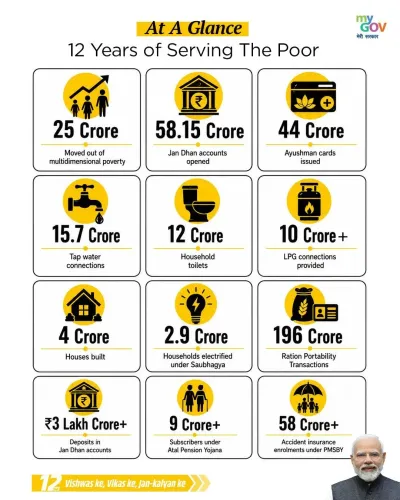
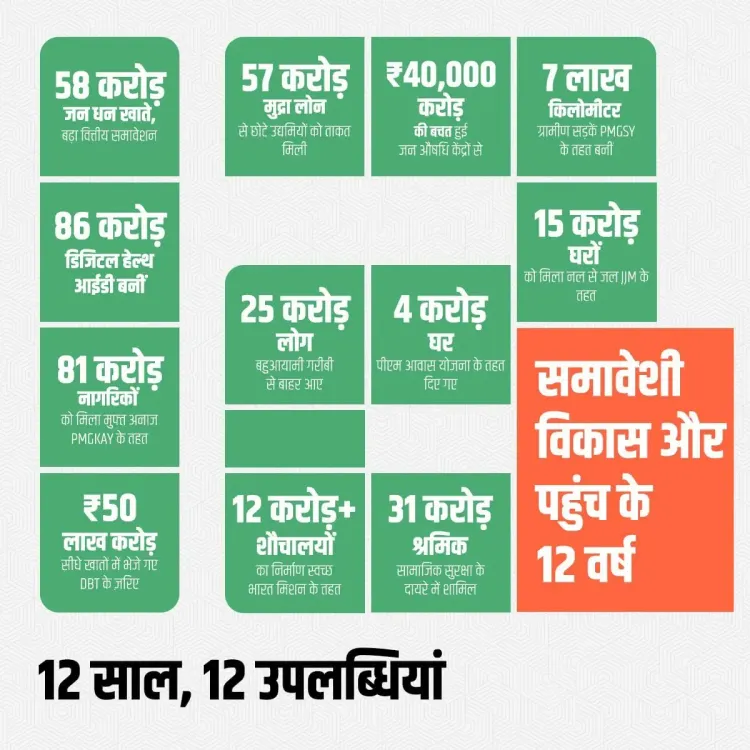
Union Minister Mansukh Mandaviya marked 12 years of the Modi government on June 8, 2026, crediting PM-led welfare campaigns with lifting 25 crore citizens out of poverty and executing some of the world's largest public welfare programmes.
Key Takeaways
Mansukh Mandaviya , Union Minister of Labour and Sports, posted on June 8, 2026 marking 12 years of the Modi government's welfare push.
The post claims 25 crore citizens have been lifted out of poverty under PM Narendra Modi 's leadership.
The Pradhan Mantri Garib Kalyan Anna Yojana (PM-GKAY) , launched in March 2020 , is a flagship scheme cited in the welfare record.
NITI Aayog 's Multidimensional Poverty Index , first published in November 2021 , provides the official statistical framework for poverty-reduction claims.
The post is part of a coordinated BJP campaign under the hashtag #12YearsOfGaribKalyan marking the party's 12th year in power.
The next NITI Aayog MPI release and any PM-GKAY extension announcement are the key policy developments to watch.
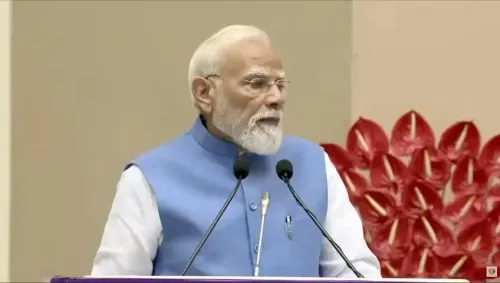
Union Labour and Sports Minister Mansukh Mandaviya on Monday, June 8, 2026, marked 12 years of the Narendra Modi-led government by highlighting what he described as the successful implementation of the world's largest public welfare campaigns, including the lifting of 25 crore citizens out of poverty.
Context
Mandaviya's post, shared under the hashtag #12YearsOfGaribKalyan, celebrated what he called 12 years of 'service, good governance and welfare of the poor' (seva, sushasan aur garib kalyan ke 12 varsh). He credited the leadership of Prime Minister Narendra Modi for steering programmes that he said brought 25 crore Indians out of poverty and executed large-scale welfare initiatives at an unprecedented scale.
The post is part of a coordinated BJP commemoration marking the party's 12th year in power at the Centre, with senior ministers amplifying a common narrative around poverty alleviation and governance delivery.
Policy Backdrop
The welfare architecture being referenced spans over a decade. A landmark intervention was the Pradhan Mantri Garib Kalyan Anna Yojana (PM-GKAY), launched in March 2020 during the COVID-19 pandemic, which provided free foodgrain to hundreds of millions of low-income households and was extended multiple times through 2023-24.
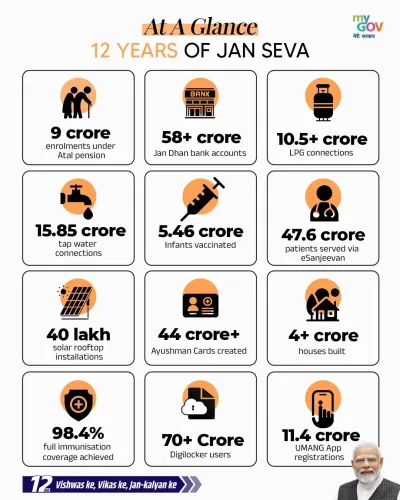
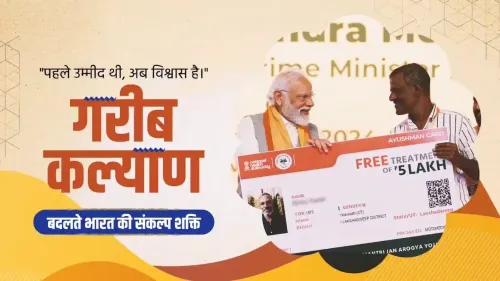
Beyond food security, the government has combined health insurance coverage under Ayushman Bharat, direct benefit transfers, and housing and sanitation schemes to build what it frames as a multi-dimensional welfare net. The NITI Aayog, the government's apex policy body, began publishing a Multidimensional Poverty Index (MPI) from November 2021, tracking improvements across health, education, and living standards to provide an official statistical basis for poverty-reduction claims.
The government has consistently cited MPI data to substantiate assertions about the pace of poverty decline, positioning India's welfare delivery model as a global benchmark.
Stakeholders and Impact
The primary beneficiaries of the programmes being cited are low-income rural and urban households, who have received subsidised or free foodgrain, health cover, and direct cash transfers. Welfare economists and opposition parties have debated the methodology behind poverty-exit figures, with questions around income thresholds and the comprehensiveness of MPI indicators.
For the BJP, the 12-year milestone carries electoral significance, as the party seeks to consolidate its governance record ahead of future state and national electoral cycles. Ministers from across portfolios — including Labour, Health, and Finance — have been amplifying the #12YearsOfGaribKalyan campaign to reach party workers and the broader public simultaneously.
What's Next
The immediate policy watch is the next NITI Aayog MPI release, which will either reinforce or complicate the government's poverty-reduction narrative with fresh data. Equally significant is any announcement from the Finance Ministry on the continuation or redesign of PM-GKAY beyond its current authorised extension.
As the Modi government enters what would be its 13th year in office, the welfare delivery record is expected to remain a central pillar of the ruling party's political messaging — and a key terrain of contestation for the opposition.
Point of View
Signalling that the government wants this figure to anchor public memory of the Modi era. The coordinated hashtag deployment across senior ministers suggests a centralised messaging operation, not an individual statement. For analysts, the more consequential question is whether the next independent MPI release will sustain or revise the scale of poverty exit being claimed.
NationPress
24 Oct 2026
Frequently Asked Questions
How many people has the Modi government lifted out of poverty according to BJP claims?
The BJP and senior ministers including Mansukh Mandaviya claim that 25 crore (250 million) citizens have been lifted out of poverty during the 12 years of the Modi government. This figure is associated with data from the NITI Aayog Multidimensional Poverty Index, though independent verification of the precise number is ongoing.
What is the Pradhan Mantri Garib Kalyan Anna Yojana?
PM Garib Kalyan Anna Yojana (PM-GKAY) is a free foodgrain scheme launched in March 2020 during the COVID-19 pandemic to provide rations to low-income households. It was extended multiple times and covered hundreds of millions of beneficiaries across India.
What is the NITI Aayog Multidimensional Poverty Index?
The NITI Aayog Multidimensional Poverty Index (MPI) is an official government measure first published in November 2021 that tracks poverty across indicators of health, education, and living standards — going beyond income alone to assess the quality of life of Indian households.
What is #12YearsOfGaribKalyan?
#12YearsOfGaribKalyan is a BJP campaign hashtag marking 12 years of the Narendra Modi government at the Centre, used by senior party leaders and ministers on social media in June 2026 to highlight the government's welfare and poverty-alleviation record.
What welfare schemes does the Modi government highlight in its 12-year record?
The Modi government's 12-year welfare record includes PM-GKAY (free foodgrain), Ayushman Bharat (health insurance), direct benefit transfers, and housing and sanitation programmes — collectively framed as the world's largest public welfare campaign.