Gadkari hails 12 years of Modi govt welfare push
Synopsis
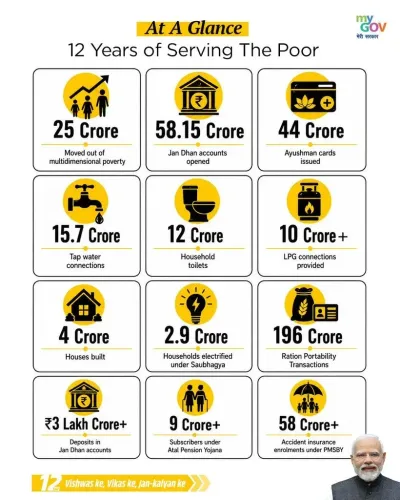
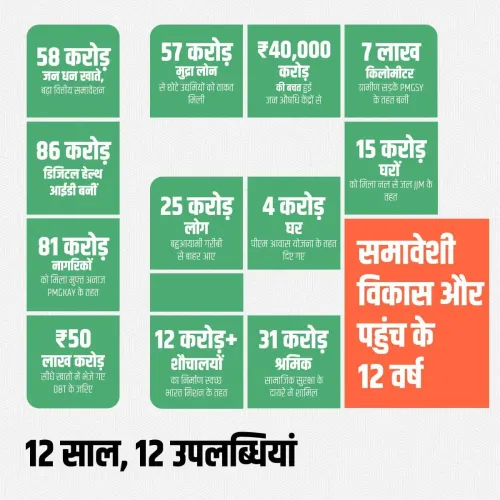
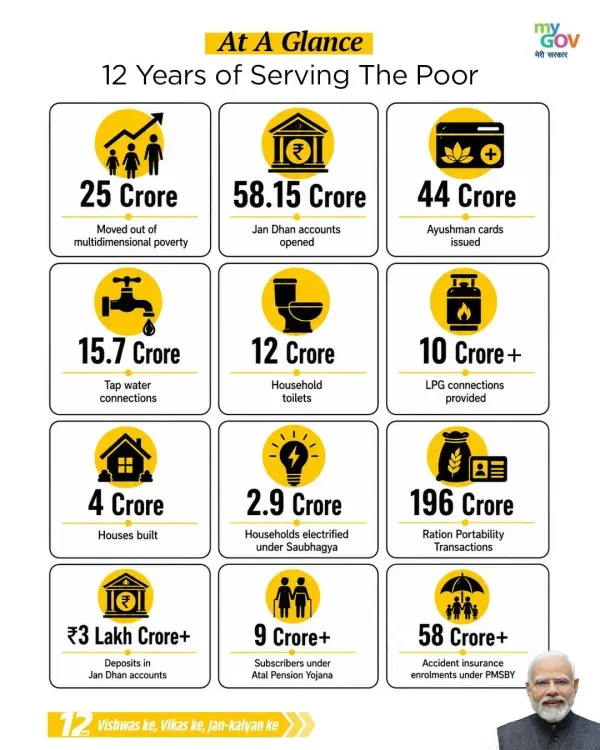
Senior BJP leader and Union Minister Nitin Gadkari on June 8, 2026 marked 12 years of the Modi government's welfare push, highlighting the Antyodaya-driven saturation approach across Jan Dhan, Swachh Bharat, Jal Jeevan Mission, Ayushman Bharat, and Pradhan Mantri Awas Yojana as pillars of last-mile delivery for millions of families.
Key Takeaways
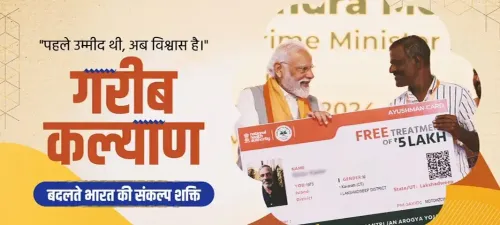
Nitin Gadkari posted on June 8, 2026 marking 12 years of the Modi government's welfare delivery under the hashtag #12YearsOfGaribKalyan .
He cited the Antyodaya principle and a 'saturation approach' — near-universal coverage — as the defining strategy of the welfare push.
Key schemes referenced include Pradhan Mantri Jan Dhan Yojana (financial inclusion, 2014), Swachh Bharat Mission (sanitation, 2014), and Jal Jeevan Mission (tap water, 2019).
Ayushman Bharat (health insurance, 2018) and Pradhan Mantri Awas Yojana (housing, 2015) are highlighted as adding security and asset ownership for low-income families.
Aadhaar-linked direct benefit transfers underpin the architecture, aimed at minimising leakages and reaching last-mile beneficiaries.
NITI Aayog poverty index updates and the next Union Budget will be key markers for independent assessment of scheme outcomes.
Union Road Transport and Highways Minister Nitin Gadkari on Monday, June 8, 2026, lauded the 12-year welfare record of the Narendra Modi government, citing a 'saturation approach' to last-mile delivery across financial inclusion, housing, sanitation, and healthcare as the defining feature of the past decade-plus of governance.
Context
Posting under the hashtag #12YearsOfGaribKalyan (12 Years of Welfare for the Poor), Gadkari said India's welfare landscape has seen a 'transformative shift' driven by the Antyodaya principle — a Gandhian-origin idea that policy must serve the most marginalised first. He credited Prime Minister Narendra Modi's 'visionary leadership' for expanding security and opportunity to 'millions of families.'
The post comes as the BJP marks the anniversary of the Modi government's formation in May 2014, with senior leaders amplifying welfare-delivery milestones across social media platforms.
Policy Backdrop
The schemes referenced in Gadkari's post span the full arc of the Modi government's social infrastructure. Pradhan Mantri Jan Dhan Yojana, launched in August 2014, opened bank accounts for previously unbanked households, enabling direct benefit transfers and reducing leakages. Swachh Bharat Mission, initiated in October 2014, targeted open defecation-free status nationwide through construction of household and community toilets.
Jal Jeevan Mission, announced in 2019, set out to provide piped tap water connections to every rural household — addressing a gap that had persisted for decades. On the housing front, Pradhan Mantri Awas Yojana, started in 2015, has provided pucca (permanent) houses to eligible urban and rural beneficiaries under a 'Housing for All' mandate.
Ayushman Bharat Pradhan Mantri Jan Arogya Yojana, rolled out in 2018, extended health insurance coverage for secondary and tertiary hospital care to vulnerable households, adding a financial-protection layer on top of the physical infrastructure schemes.
Stakeholders and Impact
The primary beneficiaries of this cluster of schemes are low-income families and rural households — groups historically excluded from formal banking, healthcare, and housing systems. The Aadhaar-linked direct transfer architecture underpinning these programmes was designed to minimise intermediary leakages and ensure benefits reach the intended recipient.
The 'saturation model' Gadkari references represents a shift from earlier targeted interventions toward near-universal coverage in basic services. By layering health insurance and property ownership on top of sanitation and banking access, the government's stated aim has been long-term household economic resilience rather than one-off relief.
What's Next
Analysts and policy watchers will look to NITI Aayog's multidimensional poverty index updates and scheme progress dashboards for independent assessments of how far saturation coverage has actually been achieved on the ground. Allocations and outcome reviews in the next Union Budget will also be closely tracked as indicators of whether the welfare push is being sustained and deepened. With the BJP framing the 12-year milestone as a political landmark, welfare delivery is likely to remain a central plank in the party's communication through the next electoral cycle.
Point of View
Deploying the morally resonant Antyodaya framing to position the party as the architect of inclusive growth. The breadth of schemes cited — spanning banking, sanitation, water, housing, and health — reflects a deliberate strategy to present welfare delivery not as isolated programmes but as a systemic transformation. What the post does not address is the gap between scheme rollout and verified ground-level outcomes, a distinction that independent assessments such as the NITI Aayog multidimensional poverty index continue to scrutinise. The 12-year milestone framing signals that welfare delivery will remain the BJP's primary political identity marker in the near term.
NationPress
19 Sept 2026
Frequently Asked Questions
What is #12YearsOfGaribKalyan?
#12YearsOfGaribKalyan (12 Years of Welfare for the Poor) is a hashtag used by BJP leaders to mark the 12th anniversary of the Narendra Modi government, highlighting welfare schemes launched since May 2014.
What is the Antyodaya principle Gadkari mentioned?
Antyodaya is a principle rooted in Gandhian thought that policy should prioritise the most marginalised sections of society first. The Modi government has used it as the philosophical anchor for its last-mile welfare delivery strategy.
What are the main welfare schemes of the Modi government?
Key schemes include Pradhan Mantri Jan Dhan Yojana (financial inclusion), Swachh Bharat Mission (sanitation), Jal Jeevan Mission (rural tap water), Pradhan Mantri Awas Yojana (affordable housing), and Ayushman Bharat (health insurance for poor families).
What is the saturation approach in Indian welfare delivery?
The saturation approach refers to the government's strategy of achieving near-universal coverage of basic services — rather than partial or targeted rollout — so that no eligible household is excluded from schemes like tap water, housing, or bank accounts.
How does Aadhaar help in welfare scheme delivery in India?
Aadhaar-linked direct benefit transfers allow the government to send funds or benefits directly to a beneficiary's bank account, reducing the role of intermediaries and minimising leakages that historically diverted welfare resources away from intended recipients.