Nvidia CEO Jensen Huang's daughter cancels South Korea visit amid spy row
Synopsis
Nvidia CEO Jensen Huang is facing a congressional grilling over alleged ties to a businesswoman reportedly linked to Chinese intelligence — and now his daughter has cancelled a high-profile South Korea trip in circumstances that remain unexplained. With three Republican House committee chairs demanding a closed-door briefing by 18 November, the world's most valuable chip company is navigating a reputational and national security minefield.
Key Takeaways
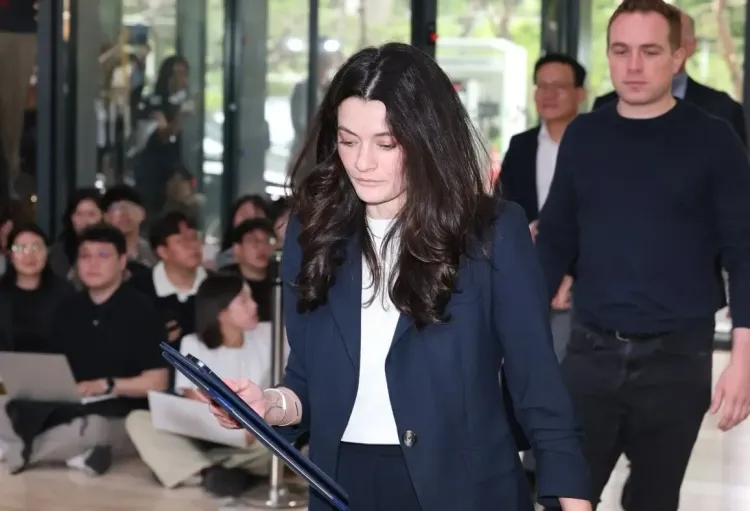
Madison Huang , senior director at Nvidia and daughter of CEO Jensen Huang , has cancelled a planned visit to South Korea on 8 November 2026 .
She was scheduled to attend Nvidia AI Day Seoul 2026 at the COEX centre and meet South Korean government officials.
Sources cited family issues; some observers link the cancellation to reports that a woman close to Jensen Huang allegedly spied for China .
Three Republican House committee chairmen have asked Jensen Huang to attend a closed-door congressional briefing on 18 November .
The inquiry centres on Alice Huang of Singapore-based Megaspeed , who is alleged to have passed information to Beijing .
Nvidia says its CEO's customer meetings involve only routine commercial information and no sensitive trade secrets.
Madison Huang, a senior director at Nvidia Corp. and daughter of Chief Executive Officer Jensen Huang, has abruptly cancelled a planned visit to South Korea, sources said on 8 November 2026. The trip, which would have included attendance at the 'Nvidia AI Day Seoul 2026' event and meetings with South Korean government officials, was called off under circumstances that remain undisclosed.
What Was Planned and What Changed
Madison Huang had been scheduled to arrive in South Korea on Sunday and attend the two-day Nvidia AI Day Seoul 2026 event, set for Monday and Tuesday at the COEX exhibition centre in southern Seoul. She was also expected to hold meetings with South Korean government officials on the sidelines.
Sources cited family issues as the reason for the cancellation but declined to provide further details. Despite her absence, the Nvidia-hosted event is expected to proceed as scheduled, according to sources.
The Espionage Cloud Over Jensen Huang
Some industry observers speculate that the cancellation may have been influenced by foreign news reports claiming that US intelligence officials believe a woman who had a close relationship with Nvidia CEO Jensen Huang was operating as a spy for China. The reports concern Alice Huang, an executive associated with Singapore-based Megaspeed, who is alleged to have passed information to Beijing.
The allegations have drawn the attention of the US Congress. Three Republican House committee chairmen — House Foreign Affairs Committee Chairman Brian Mast, Select Committee on China Chairman John Moolenaar, and House Intelligence Committee Chairman Rick Crawford — have written to Jensen Huang requesting a closed-door briefing on 18 November.
Congressional Letter and Nvidia's Response
The letter, dated 4 November and publicly released on Thursday, asks Jensen Huang to either confirm the 18 November date or propose an alternative by 11 November. The request is not a subpoena but a formal invitation to brief lawmakers. The three chairmen wrote: 'It is vital that Congress determines the extent to which U.S. national security has been placed at risk.'
They sought details of Jensen Huang's interactions with Alice Huang and Nvidia's internal procedures for guarding against espionage by foreign adversaries.
Nvidia defended its chief executive's conduct. In a statement, the company said regional cloud customers received only routine commercial information rather than sensitive trade secrets or material relevant to national security. 'Meetings with customers are part of a CEO's job; Jensen talks with thousands of customer executives every year,' a company spokesperson said. Nvidia added that it was confident US authorities would alert it if any individual were considered a threat to American industry.
Broader Context and What Comes Next
This comes amid intensifying US scrutiny of technology transfers to China, with Nvidia already navigating export restrictions on its advanced AI chips. The congressional inquiry adds a reputational dimension to those regulatory pressures. The Seoul event proceeds regardless, underscoring that business operations continue even as the political and intelligence backdrop grows more complicated.
Whether Jensen Huang accepts the congressional briefing request — and what he discloses — will likely shape the next phase of this story.
Point of View
Which is already fighting export-control battles on its AI chips. A congressional inquiry into the CEO's alleged contacts with a suspected Chinese intelligence asset is a qualitatively different kind of risk: it is personal, political, and very public. Nvidia's defence — that customer meetings are routine — is legally coherent but politically thin at a time when Washington's tolerance for any ambiguity in US-China tech relations is near zero. The company has thrived by staying above the geopolitical fray; that position is now harder to hold.
NationPress
8 Nov 2026
Frequently Asked Questions
Why did Madison Huang cancel her South Korea visit?
Sources cited family issues for the cancellation, without providing specifics. Some industry observers speculate it may have been influenced by reports that US intelligence officials believe a woman with a close relationship to Nvidia CEO Jensen Huang was working as a spy for China, though this has not been confirmed.
Who is Alice Huang and what are the allegations against her?
Alice Huang is an executive associated with Singapore-based Megaspeed who is alleged to have passed information to Beijing. US intelligence reports reportedly link her to Chinese intelligence, and her relationship with Nvidia CEO Jensen Huang has prompted a congressional inquiry.
What has the US Congress asked Nvidia's CEO to do?
Three Republican House committee chairmen — Brian Mast, John Moolenaar, and Rick Crawford — have written to Jensen Huang requesting a closed-door briefing on 18 November 2026. The letter, dated 4 November, asks him to confirm the date or suggest an alternative by 11 November. It is a request, not a subpoena.
How has Nvidia responded to the espionage allegations?
Nvidia has defended Jensen Huang's customer interactions, stating that regional cloud customers received only routine commercial information and no sensitive trade secrets or national-security-relevant material. The company also said it trusts US authorities to flag any individual who poses a threat to American industry.
Will Nvidia AI Day Seoul 2026 still go ahead?
Yes. Despite Madison Huang's cancellation, the Nvidia AI Day Seoul 2026 event at the COEX exhibition centre in southern Seoul is expected to proceed as scheduled on Monday and Tuesday, according to sources.