Oil Market Fluctuations: Navigating Conflict and Diplomacy
Synopsis
Oil prices are in turmoil as investors assess the impact of Middle East tensions alongside hopeful diplomatic developments. With prices hitting $100 briefly before retracting, the market's direction remains unclear.
Key Takeaways
Oil prices are highly volatile due to geopolitical tensions and diplomatic efforts.
Brent crude briefly surpassed $100 before retreating.
High oil prices may negatively impact economic growth.
Market sentiment can shift rapidly based on news developments.
The Strait of Hormuz remains a critical area for oil supply stability.
Washington, March 25 (NationPress) The oil markets experienced significant fluctuations as investors weighed the potential for a prolonged conflict in the Middle East against emerging signs of diplomatic advancements, with prices briefly exceeding $100 before retracting.
Wall Street faced challenges in determining its trajectory. Crude prices increased, bonds experienced a sell-off, and stocks fell as mixed signals emerged from Washington and the region, according to reporting from The Wall Street Journal.
Brent crude for the front month surged by 4.6 percent to reach $104.49 per barrel, while West Texas Intermediate saw an increase of 4.8 percent, climbing to $92.35, as per the Journal's report.
The uptick followed announcements that the Pentagon was moving a combat brigade to the Middle East, even while President Donald Trump indicated that peace negotiations with Iran were making headway.
Investors found themselves navigating uncertain waters, reacting to both escalating risks and diplomatic overtures.
Analysts cautioned that persistently high oil prices could hinder economic growth. “The longer oil prices remain elevated, the more they act like an automatic throttle on the economy,” stated David Lundgren, a portfolio manager and chief market strategist at Little Harbor Advisors.
The volatility was evident across various asset classes. The Nasdaq dropped by 0.8 percent, the S&P 500 dipped by 0.4 percent, and the Dow Jones Industrial Average saw a slight decline, while Treasury yields rose.
Market participants also highlighted the potential for a broader economic shock. An increase in oil prices could lead to “a stagflationary shock to the economy,” remarked Qian Wang of Vanguard.
Simultaneously, traders expressed optimism that prices could escalate further. Bets on Brent crude reaching $110 per barrel were among the most favored, reflecting expectations that supply disruptions might continue.
However, market sentiment shifted later as diplomatic progress became apparent. Oil prices dropped early in trading on “indications of advancement towards resolving the Middle East conflict,” with analysts noting “commitments for peace in the region supported by Pakistan, Qatar, and others,” according to The Wall Street Journal.
Trump reiterated that his administration was in discussions with Iran, referring to an oil and gas-related “gift” from Tehran, as reported by the Journal.
Despite these encouraging signals, economists warned that any relief in energy prices would be gradual. “Prices tend to rise rapidly but fall slowly,” remarked Mark Zandi, chief economist at Moody’s Analytics, as cited by The New York Times.
Even if the conflict resolves swiftly, it may take “six to eight weeks for oil production and shipments to return to normal,” analysts informed the Times, with prices likely stabilizing above pre-conflict levels.
Industry leaders echoed this uncertainty. “We have no clear indication of where prices will head,” stated Mike Sommers of the American Petroleum Institute, according to the Times.
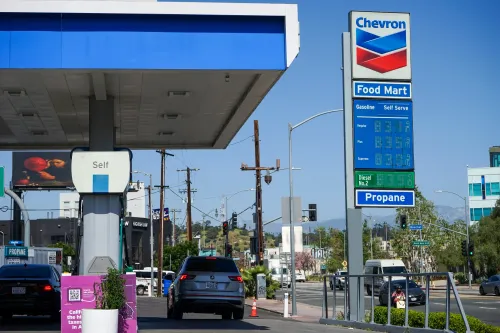
Structural constraints also persist. Gasoline prices remain high near $4 per gallon, and a reduction in crude prices will take time to be reflected in refining and distribution channels, based on a CNN analysis.
The markets continue to be highly sensitive to developments surrounding the Strait of Hormuz, a crucial chokepoint for global oil transportation. Disruptions in this area have amplified price fluctuations and increased geopolitical risks.
Point of View
It is crucial to understand the delicate balance between geopolitical tensions and market responses. While the potential for conflict looms large, the glimmers of diplomatic efforts offer a glimmer of hope for stabilization in oil prices, impacting economies worldwide.
NationPress
24 Sept 2026
Frequently Asked Questions
What caused the recent volatility in oil prices?
The volatility is attributed to investor concerns over a possible prolonged conflict in the Middle East and emerging signs of diplomatic progress.
How high did oil prices reach recently?
Oil prices briefly exceeded $100 before retracting due to mixed signals from the market.
What is the potential economic impact of sustained high oil prices?
Sustained high oil prices could hinder economic growth, acting as a throttle on the economy.
What role do geopolitical tensions play in oil prices?
Geopolitical tensions, particularly in critical regions like the Middle East, can lead to significant price fluctuations and increased volatility in oil markets.
How long might it take for oil prices to stabilize?
Analysts suggest it could take six to eight weeks for oil production and shipments to normalize, potentially stabilizing prices above pre-conflict levels.