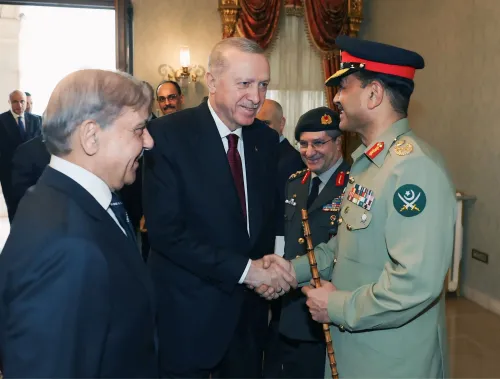
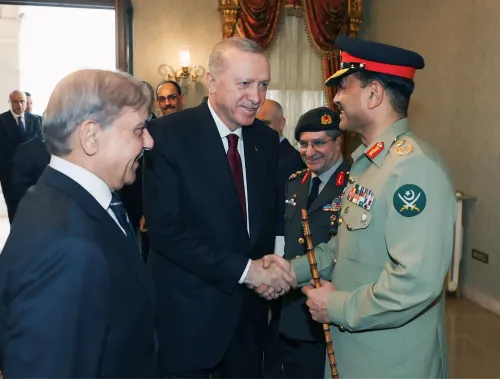
Pakistan Army's Islamisation deepens under Asim Munir's command
Synopsis
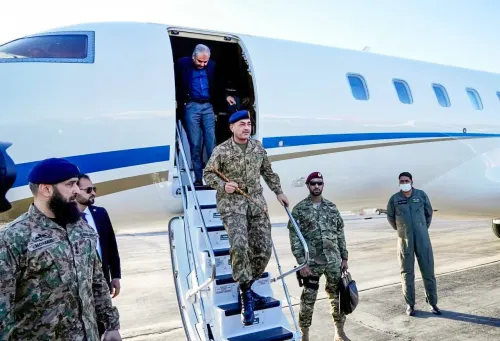
Under General Asim Munir — a Hafiz-e-Quran and son of an Imam — Pakistan's military Islamisation, rooted in the Zia era and deepened through the Afghan jihad, has reached a new consolidation point. From naming missiles after medieval Muslim conquerors to invoking Quranic verse in military operations, the Pakistani Army is increasingly framing national defence as religious duty.
Key Takeaways
The Pakistani Army's ideological Islamisation began under Ayub Khan , accelerated sharply under Zia-ul-Haq , and has consolidated further under General Asim Munir .
Zia-ul-Haq replaced Jinnah's motto with 'Iman, Taqwa, Jihad fi sabilillah' and characterised the Pakistani soldier as part of the 'Jaish al-Islam' (Army of Islam).
Asim Munir , a Hafiz-e-Quran and son of an Imam, appointed COAS in November 2022 , has made religious identity a cornerstone of his public image.
Pakistan named its retaliatory military response to Operation Sindoor as 'Operation Bunyan al-Marsoos', a phrase drawn directly from the Quran .
Pakistani authorities now officially mandate the use of religious terms such as 'Fitna al-Khawarij' for the TTP and 'Fitna al-Hindustan' for Baloch separatist groups in official communications.
The Taliban is widely considered a direct outcome of the ideological indoctrination programmes run by the Pakistani Army during the Soviet-Afghan War .
The Pakistani Armed Forces, born from the partition of British India in 1947, have undergone a profound ideological transformation — from a colonial military institution rooted in secular professionalism to one increasingly defined by Islamic identity. Under General Asim Munir, the current Chief of the Army Staff (COAS), this decades-long trend of Islamisation appears to have consolidated further, with religious symbolism now embedded in doctrine, official terminology, and public military discourse.
Colonial Roots and Early Ideological Reconfiguration
The nascent Pakistani state inherited the Muslim segment of the British Indian Army following partition. While India opted for secular democracy, Pakistan emerged as a state where the military wielded significant power. Ayub Khan, who became the first native Pakistani Commander-in-Chief in 1951, was initially less sympathetic toward religion as an ideological force, firmly rooted in the colonial framework.
However, a new generation of nationalist officers gradually pushed the army to claim continuity with an Islamic past. Figures such as Khalid ibn al-Walid, Salahuddin Ayyubi, and Tariq ibn Ziyad, as well as medieval Muslim rulers of the subcontinent including Muhammad Ghori, Mahmud Ghaznavi, and Babur, were elevated as symbolic icons of military heritage. This ideological reorientation was visible as early as 1965, when Field Marshal Ayub Khan and Zulfikar Ali Bhutto named their plan to seize Jammu and Kashmir 'Operation Gibraltar' — deliberately invoking the Arab conquest of Gibraltar in 711 CE.
The Zia-ul-Haq Era: Faith Institutionalised
The Islamisation of the Pakistani military accelerated most sharply under General Zia-ul-Haq. Unlike Ayub Khan, Zia's generation had witnessed the Muslim League's movement firsthand. Many senior officers came from urban, middle-class Punjabi backgrounds, with a significant number — including Zia himself — having migrated from eastern Punjab during Partition.
Soon after becoming COAS, Zia replaced Muhammad Ali Jinnah's motto 'Iman, Ittihad, Nazm' (Faith, Unity, Discipline) with 'Iman, Taqwa, Jihad fi sabilillah' (Faith, Piety, and Struggle in the path of God). He characterised the Pakistani soldier as a 'soldier of Islam' and part of the 'Jaish al-Islam' (Army of Islam). Religious organisations such as Jamaat-e-Islami and Tablighi Jamaat were given space to operate within the military environment. According to scholar Stephen P. Cohen, who conducted field research in the late 1970s and early 1980s, an officer's piety increasingly factored into official evaluation and promotion considerations under Zia.
The Soviet invasion of Afghanistan further reinforced this trend. With CIA backing, the Pakistani Army established training centres along the Afghan border to train mujahideen fighters, combining conventional warfare instruction with religious and ideological indoctrination. The Taliban is widely regarded as a direct outcome of that ideological programme.
Asim Munir: A Distinct Ideological Profile
General Asim Munir differs significantly from his predecessors. As a Hafiz-e-Quran — one who has memorised the Quran in its entirety — and the son of an Imam, his persona as an observant Muslim soldier places him in a unique category among Pakistani army chiefs. He was appointed COAS in November 2022, promoted to the rank of four-star general amid a confluence of political upheaval, deepening economic crisis, and public disillusionment with the military's role in governance.
One of Munir's immediate priorities after assuming office was reportedly to neutralise former Prime Minister Imran Khan and his party, Pakistan Tehreek-e-Insaf (PTI). Munir had previously been removed from his position as Director-General of the Inter-Services Intelligence (ISI) after reportedly falling out of favour with Khan.
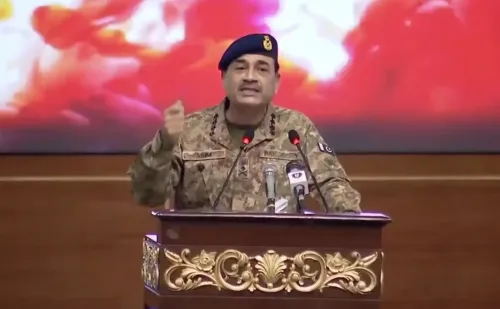
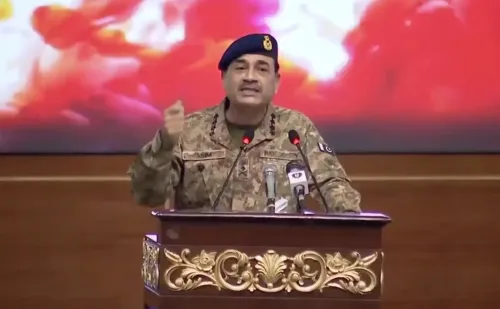
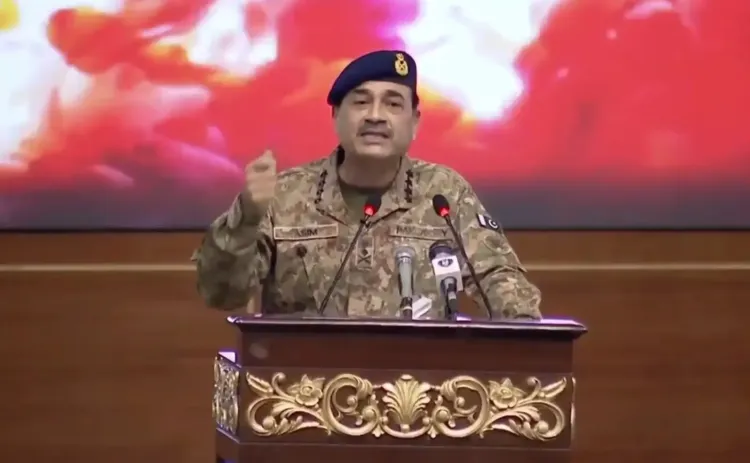
On 17 April 2025, Munir delivered a notable speech in Islamabad to a gathering of expatriates, emphasising civilisational and ideological distinctions. He stated that Muslims differ from Hindus
Point of View
Munir has personalised: a COAS who is himself a Hafiz-e-Quran lends the ideological project a legitimacy no predecessor could claim. The naming of Pakistan's retaliatory operation 'Bunyan al-Marsoos' — drawn verbatim from the Quran — signals that religious framing is no longer rhetorical decoration but operational identity. Crucially, the use of terms like 'Fitna al-Khawarij' and 'Fitna al-Hindustan' reveals a military that is now deploying Islamic theological vocabulary to delegitimise both domestic insurgents and regional rivals simultaneously. This convergence of faith and force — directed inward at the TTP and outward at India — makes the Pakistani Army's ideological trajectory one of the most consequential variables in South Asian security.
NationPress
21 Sept 2026
Frequently Asked Questions
Who is Asim Munir and why is he significant in Pakistan's military history?
General Asim Munir is Pakistan's current Chief of the Army Staff (COAS), appointed in November 2022. He is notable as a Hafiz-e-Quran — one who has memorised the entire Quran — and the son of an Imam, making him uniquely positioned among Pakistani army chiefs to consolidate the military's Islamic ideological identity.
When did the Islamisation of the Pakistani Army begin?
The process began in a limited form under Ayub Khan but accelerated significantly under General Zia-ul-Haq in the late 1970s and 1980s. Zia formally replaced the army's secular motto with an Islamic one and encouraged religious observance as part of military culture.
What is 'Operation Bunyan al-Marsoos' and what does the name mean?
'Operation Bunyan al-Marsoos' was Pakistan's retaliatory military operation launched on 10 May in response to India's Operation Sindoor. The name is Arabic for 'a solid cemented structure' and is drawn directly from the Quran, symbolising unity among believers fighting for a righteous cause.
What are 'Fitna al-Khawarij' and 'Fitna al-Hindustan'?
These are official Pakistani government-mandated terms. 'Fitna al-Khawarij' is used to refer to the Tehreek-e-Taliban Pakistan (TTP), invoking the historical Kharijites from early Islamic history. 'Fitna al-Hindustan' is applied to Baloch separatist groups, with Pakistan alleging Indian support for them. Pakistan's DG-ISPR regularly uses both terms in official press briefings.
What was the significance of Asim Munir's April 2025 speech?
On 17 April 2025, Munir addressed Pakistani expatriates in Islamabad, emphasising civilisational distinctions between Muslims and Hindus and reaffirming the Two-Nation Theory. He also reiterated Pakistan's claim over Kashmir. Five days later, a terrorist attack killed 26 civilians, mostly tourists identified as Hindus, in Pahalgam, Jammu and Kashmir, drawing scrutiny to the timing and tone of his remarks.