Pakistan PECA amendment 2025: 600 journalists reject cybercrime law over free speech
Synopsis
Six hundred Pakistani journalists united in Islamabad to reject the PECA amendment 2025, backed by damning data: 233 documented incidents against reporters in 16 months, including 67 assaults, 34 PECA-linked complaints, and AI-generated smear videos targeting women journalists. The government's simultaneous move to withhold ads from Dawn signals a multi-front squeeze on Pakistan's independent press.
Key Takeaways
600 journalists in Islamabad formally rejected the PECA amendment 2025 on 30 July , calling it unconstitutional.
The Pakistan Press Foundation recorded 233 incidents against journalists between January 2025 and April 2026 , including 67 assaults , 11 arrests , and 3 abductions .
34 of the recorded criminal complaints directly invoked PECA .
Journalist Benazir Shah reported an AI-generated video of her was circulated via an account followed by the federal information minister.
The government reportedly withheld official advertisements from Dawn newspaper in an alleged bid to apply financial pressure.
Journalist unions have demanded a full legislative review; no formal government response had been issued at the time of reporting.
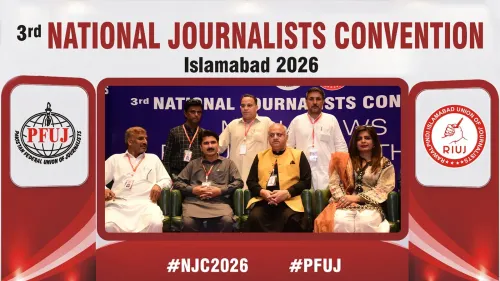
Around 600 Pakistani journalists and media practitioners gathered in Islamabad on 30 July to formally reject the Prevention of Electronic Crimes Act (PECA) amendment 2025, declaring it incompatible with the freedom of speech guaranteed under Pakistan's constitution. The protest, convened under the joint banner of the Pakistan Federal Union of Journalists and the Rawalpindi-Islamabad Union of Journalists, represents one of the largest unified stands by the country's press community against the legislation.
What the Convention Resolved
Delegates at the convention called for a full legislative review of the PECA amendment, arguing the law has been weaponised against reporters and commentators rather than deployed as a genuine cybersecurity measure. According to reports, the gathering produced a rare display of solidarity across rival media factions. Journalists at the event described deteriorating working conditions — collapsing pay, rising intimidation, and the systematic erosion of professional reputations built over years.
The declaration issued by participants framed the crisis not as a narrow professional grievance but as a broader assault on civil liberties in Pakistan.
Scale of the Crackdown: Key Data
The Pakistan Press Foundation (PPF) documented at least 233 incidents involving journalists between January 2025 and April 2026. The breakdown is stark: 67 assaults, 67 criminal complaints, 11 arrests, 11 detentions, and 3 abductions. Of those criminal complaints, 34 directly invoked PECA. Notices and summonses from the National Cyber Crime Investigation Agency (NCCIA) have become a recurring pattern, reportedly issued most often after coverage that authorities found inconvenient.
Rights groups and media freedom assessors cited in the reporting characterise PECA as having shifted from a contested cybercrime statute into what they describe as a central instrument in the state's pressure campaign against the press.
Gendered Abuse and Digital Intimidation
The PPF report highlighted a particularly troubling dimension of the crackdown: targeted digital abuse against women journalists. In one documented case, journalist Benazir Shah reported that an AI-generated video of her had been circulated online through an account followed by the federal information minister. The report described such tactics as deeply personal, gendered, and designed less to challenge a story than to destroy a journalist's reputation.
This comes amid a broader pattern of intimidation that extends beyond courtrooms — spanning physical assaults, detentions, legal complaints, and coordinated digital harassment campaigns.
Economic Pressure on the Press
Coercion has not been limited to legal tools. According to the PPF report, the government withheld official advertisements from Dawn, one of Pakistan's leading English-language newspapers, in what the foundation characterised as a deliberate attempt to financially squeeze an independent outlet. The move underscores how economic levers are being used alongside legal ones to discipline coverage.
What Comes Next
Journalist unions have demanded a legislative review of the PECA amendment, though no formal government response had been issued at the time of reporting. Press freedom organisations are expected to escalate international advocacy in the coming weeks. The trajectory of PECA enforcement — and whether Islamabad responds to domestic and global pressure — will determine whether Pakistan's already strained press environment stabilises or deteriorates further.
Point of View
Economic, and digital tools deployed in combination. The PPF's 233-incident count over 16 months is not an outlier; it is a trend line. What makes this moment different is the documented use of AI-generated content to target women journalists, a tactic that is cheap, deniable, and scalable. The government's non-response to the convention's demands, and its simultaneous ad boycott of Dawn, suggests Islamabad is not interested in negotiation. International press freedom bodies now face a credibility test: whether their advocacy carries any operational weight against a state that has systematically insulated its coercive tools from domestic accountability.
NationPress
14 Sept 2026
Frequently Asked Questions
What is the PECA amendment 2025 in Pakistan?
The Prevention of Electronic Crimes Act (PECA) amendment 2025 is a Pakistani law that critics say has been repurposed from a cybersecurity statute into a tool for suppressing press freedom. Journalist unions and rights groups argue it is being used to file criminal complaints against reporters whose coverage displeases authorities.
Why are Pakistani journalists protesting against PECA?
Around 600 journalists gathered in Islamabad to reject PECA, citing 233 documented incidents of press freedom violations in 16 months, including assaults, arrests, and 34 criminal complaints directly invoking the law. They argue it conflicts with free speech protections in Pakistan's constitution.
What did the Pakistan Press Foundation report find?
The Pakistan Press Foundation documented at least 233 incidents involving journalists between January 2025 and April 2026, covering 67 assaults, 67 criminal complaints, 11 arrests, 11 detentions, and 3 abductions. It also flagged the use of AI-generated videos to target women journalists and the withholding of government ads from Dawn newspaper.
Who is Benazir Shah and what happened to her?
Benazir Shah is a Pakistani journalist who reported that an AI-generated video of her was circulated online through an account followed by the federal information minister. The Pakistan Press Foundation described the incident as a gendered, reputation-destroying tactic rather than a journalistic rebuttal.
What are journalist unions demanding from the Pakistan government?
The Pakistan Federal Union of Journalists and the Rawalpindi-Islamabad Union of Journalists have demanded a full legislative review of the PECA amendment 2025. No formal government response to their demands had been issued at the time of reporting.