Pakistan journalists slam PECA amendments, demand Parliament review media laws
Synopsis
At a national convention in Islamabad, Pakistani journalists formally declared PECA amendments a tool of press suppression and demanded a full parliamentary review of media laws. A Freedom Network report released the same month documented 129 journalist safety violations in one year — including two murders and 58 PECA-invoked legal cases — with state authorities suspected in over 60 per cent of incidents.
Key Takeaways
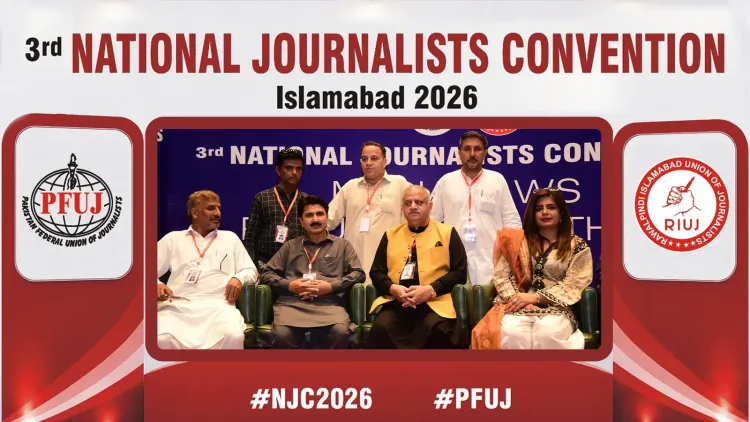
The PFUJ and RIUJ held a National Journalists Convention in Islamabad on 24 May , concluding with the Islamabad Declaration .
Journalists condemned PECA 2016 amendments as a ‘draconian black law’ and demanded Parliament review all media laws inconsistent with Article 19 of the Constitution.
Daily Dawn was specifically named as a target of government advertising pressure aimed at influencing editorial content.
Freedom Network documented 129 verified journalist safety violations between April 2025 and March 2026 , including 2 murders and 58 PECA-invoked legal cases .
State authorities were suspected perpetrators in over 60 per cent of violations; Punjab and Khyber Pakhtunkhwa were the most dangerous regions.
Hundreds of media workers have lost jobs amid record-high inflation, with employers allegedly denying basic rights including EOBI registration and health insurance.
Journalists across Pakistan have called on Parliament to review all media legislation and condemned recent amendments to the Prevention of Electronic Crimes Act (PECA) 2016 as a “draconian black law, specifically engineered to facilitate the arm-twisting of journalists and the suppression of Pakistan’s media landscape.” The demand emerged from a national convention held in Islamabad on 24 May, organised jointly by the Pakistan Federal Union of Journalists (PFUJ) and the Rawalpindi-Islamabad Union of Journalists (RIUJ).
The Islamabad Declaration
The two-day National Journalists Convention on ‘Media Laws, Regulations, and Ethics’ concluded with a formal declaration demanding that Parliament repeal or revise all laws inconsistent with Article 19 of Pakistan’s Constitution, which guarantees freedom of speech. The document, dubbed the Islamabad Declaration, also condemned what journalists described as the government’s broken promise that media laws “would never be weaponised against the press.”
Delegates raised alarm over the use of public advertising as a coercive instrument, alleging that editorial independence was being compromised through the selective withdrawal of government ad revenue. The declaration specifically named daily Dawn as a target of this policy, stating the newspaper was being denied both public-sector advertisements and, reportedly, private corporate advertising — with businesses allegedly being pressured to withhold support.
Job Losses and Employment Rights
Beyond legal threats, journalists voiced concern over a worsening employment crisis, particularly in electronic media. Delegates said layoffs were being carried out without justification, leaving hundreds of media workers jobless at a time of record-high inflation. The convention condemned the denial of basic employment rights — including health insurance, gratuity, and registration under the Employees’ Old-Age Benefits Institution (EOBI) — to media personnel.
Freedom Network Report: 129 Violations in One Year
The convention’s concerns were reinforced by a report released in early May 2026 by Freedom Network, an Islamabad-based media watchdog, to mark World Press Freedom Day on 3 May. Titled ‘Regulatory Repression of Freedom of Expression – Legal Controls and PECA Undermine Media and Journalism in Pakistan’, the report documented at least 129 verified incidents of journalist safety violations between April 2025 and March 2026.
According to the report, legal threats and physical violence accounted for nearly two-thirds of these cases. The breakdown included two murders, five murder threats, 58 legal cases (mostly PECA-invoked), 16 assaults, 11 threats to harm, and two cases of kidnapping and enforced disappearance. State authorities were identified as the suspected leading perpetrators, responsible for over 60 per cent of violations, primarily through legal and custodial actions.
Punjab and Khyber Pakhtunkhwa were identified as the most dangerous regions for journalists, while murders in Sindh and Balochistan underscored persistent risks. Non-state actors, including militant groups and criminal networks, were also cited as contributors to threats, assaults, and killings.
PECA: ‘Most Consequential Instrument’ Against Free Speech
Freedom Network described the amended PECA as the most “consequential instrument” being deployed to restrict journalists and free speech practitioners in Pakistan. The report noted that PECA provisions were increasingly being used in 2025 and 2026 to criminalise lawful expression, target dissent, and intimidate journalists, lawyers, and political commentators.
The report highlighted convictions of human rights lawyers, including Imaan Mazari and Hadi Ali Chattha, as examples of how custodial sentences were being used to deter dissent. Defamation cases, regulatory suspensions, and internet shutdowns were also cited as tools further undermining independent journalism.
Freedom Network Executive Director Iqbal Khattak said: “The weaponisation of PECA has created a climate of fear where journalists are compelled to self-censor to avoid legal repercussions,” calling it “one of the most serious threats to media freedom in Pakistan today.”
Broader Context and What Comes Next
This comes amid a sustained deterioration in Pakistan’s press freedom rankings. The PFUJ and RIUJ have called for immediate legislative action, and the Islamabad Declaration is expected to be formally submitted to parliamentary committees. Whether the government engages with these demands — or continues to use regulatory and financial levers against critical media — will be closely watched by press freedom organisations globally.
Point of View
But the convention’s formal invocation of Article 19 signals a shift toward constitutional challenge — a harder argument for the government to dismiss. What mainstream coverage often misses is the economic dimension: job insecurity and withheld advertising are quieter but equally effective censorship tools. The Freedom Network’s finding that state actors account for over 60 per cent of violations is a direct accountability indictment that deserves far more scrutiny than it typically receives.
NationPress
25 Sept 2026
Frequently Asked Questions
What is the Islamabad Declaration on media laws in Pakistan?
The Islamabad Declaration is a formal statement issued at the conclusion of the National Journalists Convention held on 24 May in Islamabad, organised by the PFUJ and RIUJ. It demands that Parliament review all media laws contrary to Article 19 of Pakistan’s Constitution and condemns PECA 2016 amendments as tools of press suppression.
What is PECA and why are journalists protesting against its amendments?
The Prevention of Electronic Crimes Act (PECA) 2016 is a Pakistani law originally enacted to address cybercrime. Journalists argue that recent amendments have transformed it into an instrument to criminalise lawful expression, intimidate reporters, and suppress dissent, with Freedom Network describing it as the most ‘consequential’ tool being used against press freedom in the country.
How many journalist safety violations were recorded in Pakistan in the past year?
Freedom Network documented at least 129 verified incidents of journalist safety violations between April 2025 and March 2026. These included two murders, 58 PECA-invoked legal cases, 16 assaults, and two cases of kidnapping and enforced disappearance.
Which regions of Pakistan are most dangerous for journalists?
According to the Freedom Network report, Punjab and Khyber Pakhtunkhwa were the most dangerous regions for journalists, while murders in Sindh and Balochistan highlighted persistent risks in those provinces as well.
What role does advertising pressure play in Pakistani media censorship?
The Islamabad Declaration alleged that the government uses public advertisement allocation as a financial lever to dictate editorial content. Daily Dawn was specifically cited as a newspaper being denied both government and, reportedly, private-sector advertising as a form of economic coercion.