Balochistan journalists observe Black Day, cite 97 press freedom violations in 2025-26

Synopsis
Journalists in Balochistan marked Black Day with black armbands and protest marches — and the timing was stark. A fresh watchdog report confirms 97 violations against Pakistani journalists in just 11 months, with government officials allegedly behind nearly two-thirds of cases, and a new legal weapon — PECA — now being used to grind down dissent through process rather than outright violence.
Key Takeaways
Journalists across Balochistan observed Black Day on 4 November 2026 , marking the anniversary of Pakistan's 2007 emergency and protesting media dismissals, bureau shutdowns, and salary non-payment.
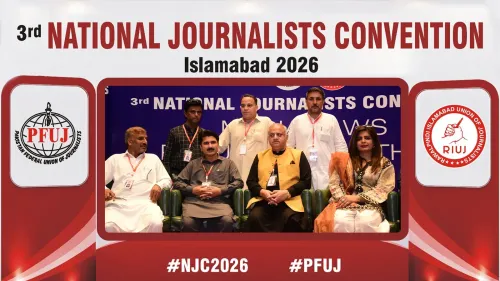
The protest was called by the Pakistan Federal Union of Journalists (PFUJ) .
Freedom Network's Impunity Report 2026 documented 97 violations against journalists between October 2025 and August 2026 , down from 142 in the previous cycle.
Violations included one killing , three attempted assassinations , 18 murder threats , and 11 assaults ; Punjab recorded the highest count at 49 cases .
Government authorities and officials were alleged instigators in nearly two-thirds of reported cases, according to victims or their families.
The NCCIA and PECA were identified as key instruments in a 'legal siege' targeting digital and independent journalists.
Journalists across Pakistan's Balochistan province observed 'Black Day' on Tuesday, 4 November 2026, marking the anniversary of the November 3, 2007 emergency and protesting the forced dismissal of media professionals, closure of bureau offices, and widespread salary non-payment. The demonstration, held at the call of the Pakistan Federal Union of Journalists (PFUJ), drew participants to press clubs across the province, according to local media reports.
How Journalists Protested
Journalists wore black armbands, hoisted black flags at press clubs, and held organised protests across Balochistan to draw attention to the deteriorating state of the media industry in Pakistan. The protests targeted multiple grievances simultaneously — job insecurity, bureau shutdowns, and persistent wage delays — signalling deep structural distress within the regional media ecosystem. Leading Pakistani daily Dawn reported on the demonstrations.
The Scale of Press Freedom Violations
The protests coincided with the release of an alarming assessment by an Islamabad-based media watchdog. According to Freedom Network's annual Impunity Report 2026, titled 'From Violence to Lawfare: Process as Punishment for Journalists', at least 97 attacks and other violations against journalists were documented between October 2025 and August 2026 — down from 142 in the preceding reporting cycle. However, the report cautioned that lower numbers did not translate into greater safety on the ground.
The report stated: 'About 10 cases a month (against media personnel), their nationwide spread and severity in the period showed that fewer violations did not mean greater safety.' It was authored by journalist Adnan Rehmat and Freedom Network Executive Director Iqbal Khattak, with technical assistance from International Media Support (IMS).
Breakdown of Violations
The 97 documented cases from October 2025 to August 2026 included one work-related killing, three attempted assassinations, 18 threats of murder or harm, 13 legal actions, 32 threats of legal actions, and 11 assaults. Punjab reported the highest number at 49 cases, followed by Khyber Pakhtunkhwa, Islamabad, and Balochistan. Digital and independent journalists were targeted most frequently.
Notably, victims or their families alleged that government authorities and officials were instigators in nearly two-thirds of reported cases — a finding that points to systemic, state-adjacent pressure rather than isolated incidents.
The 'Lawfare' Threat to Online Journalism
The report identified the National Cyber Crime Investigation Agency (NCCIA) and the Prevention of Electronic Crimes Act (PECA) as central instruments in what it described as a 'legal siege' targeting online journalism. It documented a recurring procedural pattern applied to journalists: complaint, notice, inquiry, appearance, FIR, arrest, bail, and eventual relief, apology, or unresolved prosecution. Critics argue this cycle effectively punishes dissent regardless of whether a case reaches conviction.
Khattak said, 'Despite the presence on the statute books of two laws to combat impunity for crimes against journalists, such a finding should be a matter of concern for those at the helm of affairs of the two safety commissions established under these laws.'
What This Signals for Pakistan's Media
This is the second consecutive year in which Freedom Network has documented a formal decline in raw violation counts, yet characterised Pakistan as a 'deeply hostile environment' for journalism. The convergence of the Black Day protests in Balochistan with the release of this national data underscores a widening crisis — from physical attacks to legal attrition — that industry observers say is reshaping how journalists operate, particularly in conflict-sensitive provinces. How the two safety commissions respond to Khattak's challenge will be closely watched by press freedom advocates in the months ahead.
Point of View
And rightly so. When government officials are allegedly behind two-thirds of cases, the problem is not random violence but structural impunity. The shift from physical attacks to PECA-driven 'lawfare' is arguably more corrosive: it doesn't silence journalists with a bullet — it buries them in procedure. Pakistan's two safety commissions for journalists exist on paper; the question of whether they function in practice remains unanswered, and that silence is itself a data point.
NationPress
4 Nov 2026
Frequently Asked Questions
Why did journalists in Balochistan observe Black Day on 4 November 2026?
Journalists observed Black Day to mark the anniversary of Pakistan's November 3, 2007 emergency declaration and to protest the forced dismissal of media professionals, the shutdown of bureau offices in Balochistan, and non-payment or delayed payment of salaries. The protest was organised at the call of the Pakistan Federal Union of Journalists (PFUJ).
What did Freedom Network's Impunity Report 2026 find about press freedom in Pakistan?
The report documented 97 attacks and other violations against journalists between October 2025 and August 2026, compared with 142 in the preceding cycle. Despite the decline in numbers, Freedom Network characterised Pakistan as a 'deeply hostile environment' for journalism, noting that about 10 cases per month still reflected serious severity and nationwide spread.
Who were the main alleged instigators of violations against journalists in Pakistan?
According to the Freedom Network report, victims or their families alleged that government authorities and officials were instigators in nearly two-thirds of documented cases. Digital and independent journalists were among the most frequently targeted.
How is PECA being used against journalists in Pakistan?
The Prevention of Electronic Crimes Act (PECA) has been deployed by the National Cyber Crime Investigation Agency (NCCIA) in a pattern the report describes as 'lawfare' — using legal process itself as punishment. Journalists face a recurring cycle of complaint, FIR, arrest, and bail, often ending in unresolved prosecution, which critics say suppresses dissent without requiring a conviction.
Which region of Pakistan recorded the most violations against journalists?
Punjab recorded the highest number of cases at 49, followed by Khyber Pakhtunkhwa, Islamabad, and Balochistan, according to the Freedom Network Impunity Report 2026 covering October 2025 to August 2026.