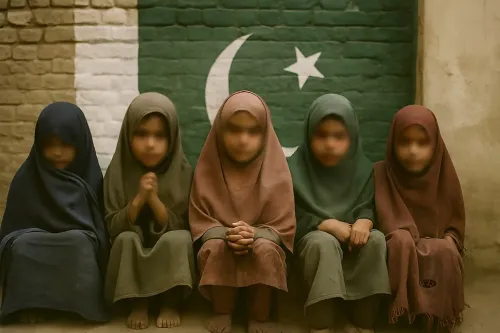
Digital abuse in Pakistan: Women, minorities face sextortion and deepfakes, DRF report finds

Synopsis
Pakistan's Digital Rights Foundation handled over 5,000 cyber harassment cases in 18 months — and that may be the least alarming figure in its report. With AI making abuse more scalable and anonymous, children as young as six are now targeted, women journalists face orchestrated silencing campaigns, and access to justice remains out of reach for most survivors outside major cities.
Key Takeaways
The Digital Rights Foundation (DRF) handled 5,041 cyber harassment cases between May 2024 and December 2025 via its helpline.
92% of helpline users reported reduced risk after support; 93% received digital safety advice.
Sextortion , hacking , and deepfake imagery are identified as the fastest-growing threats, accelerated by Artificial Intelligence.
Children as young as six years old are being targeted through grooming and AI-enabled abuse, according to the DRF's April annual report.
79% of cases are referred to the National Cyber Crime Investigation Agency (NCCIA) , but access to justice remains uneven, particularly outside major cities.
Women journalists are disproportionately targeted with orchestrated abuse designed to remove them from public discourse.
Women, religious minorities, and gender minorities in Pakistan face escalating digital intimidation, according to a new report by the Digital Rights Foundation (DRF). The report, whose findings were cited in editorials by Pakistani dailies Dawn and The News International, identifies sextortion, hacking, and deepfake imagery as rapidly emerging threats — with Artificial Intelligence accelerating the scale and anonymity of abuse.
Scale of the Crisis
Between May 2024 and December 2025, the DRF's cybersecurity helpline handled 5,041 new cases. Of those who sought assistance, 64% received a swift response, 93% were counselled on digital safety practices, and 92% reported a reduced sense of risk following support. The numbers, analysts note, represent only reported cases — the actual scale of digital harassment is believed to be significantly larger.
How Harassment Operates Online
According to the DRF's security helpline, harassment in Pakistan's digital space does not always take overt forms. It operates through coded language, slang, political and faith-based insinuations, and what the foundation describes as 'context-specific hate campaigns.' Algorithms and social media dynamics further amplify identity-centric harm, making it harder for victims to seek redress or even identify the source of abuse.
The DRF has called on authorities to deploy digital tools to address compromised accounts, hacking, blackmail, fraud, and image-based violations — arguing that individual-level solutions such as switching off devices are insufficient. 'The state must clean up the internet environment, especially for marginalised sections, with targeted campaigns to spread awareness about digital safety,' an editorial in Dawn noted, citing the foundation's position.
Children and Women Bear the Heaviest Burden
An earlier annual report by the DRF, released in April, flagged a particularly alarming dimension: children as young as six years old are being drawn into ecosystems of digital harm involving grooming, sexual exploitation, and AI-enabled abuse. The report warned that the state is 'woefully unprepared' to confront this reality.
Women, the DRF found, continue to bear the heaviest burden of digital violence. Non-consensual image sharing, blackmail, and sextortion are described as part of a 'continuum of gendered harassment designed to silence, shame and intimidate.' Women journalists are identified as frequent targets, with orchestrated abuse campaigns aimed at pushing them out of public discourse.
For survivors outside major cities, access to justice is further constrained. Even though 79% of cyber harassment cases are reportedly referred to the National Cyber Crime Investigation Agency (NCCIA), the process often requires travel, resources, and resilience that many victims — particularly those in rural or semi-urban areas — do not possess.
The AI Factor
The DRF's April report underscored Artificial Intelligence as the primary driver transforming harassment into something 'more scalable, more anonymous and far harder to trace.' Deepfake imagery, in particular, has emerged as a tool of targeted abuse against women and gender minorities, enabling perpetrators to fabricate compromising content with little technical expertise.
What the DRF Is Calling For
The foundation has urged the Pakistani state to move beyond reactive measures and invest in structural interventions — including targeted awareness campaigns, stronger legal frameworks, and digital tools that can assist victims in recovering compromised accounts and documenting evidence. As AI-enabled abuse continues to outpace regulatory responses, the DRF's findings point to a widening gap between the scale of harm and the systems designed to address it.
Point of View
Not merely a law-enforcement gap. Pakistan has a cyber crime agency, but routing 79% of cases through NCCIA while leaving rural survivors without realistic access is a system that looks functional on paper and fails in practice. The AI dimension sharpens the urgency: deepfakes and scalable anonymous harassment are not problems that awareness campaigns alone can contain. What is missing is a legal framework that keeps pace with the technology — and political will to apply it to cases involving women and religious minorities, groups whose digital safety has historically been treated as secondary.
NationPress
6 Oct 2026
Frequently Asked Questions
What did the Digital Rights Foundation report find about Pakistan?
The Digital Rights Foundation found that women, religious minorities, and gender minorities face escalating digital intimidation in Pakistan, with sextortion, hacking, and deepfake imagery identified as emergent threats. Between May 2024 and December 2025, the DRF's helpline handled 5,041 new cases.
How is Artificial Intelligence changing cyber harassment in Pakistan?
According to the DRF's April annual report, AI is transforming harassment into something more scalable, more anonymous, and far harder to trace. Deepfake imagery and AI-enabled abuse now target children as young as six, in addition to women and gender minorities.
Who is most affected by digital abuse in Pakistan?
Women bear the heaviest burden of digital violence, according to the DRF. Women journalists are frequently targeted with orchestrated abuse campaigns. Religious and gender minorities also face identity-centric harm amplified by algorithms and social media dynamics.
What role does the National Cyber Crime Investigation Agency play?
According to the DRF, 79% of cyber harassment cases in Pakistan are referred to the National Cyber Crime Investigation Agency (NCCIA). However, access to justice remains uneven — survivors outside major cities often cannot afford the travel and resources required to pursue cases.
What is the Digital Rights Foundation calling for?
The DRF is urging the Pakistani state to invest in structural interventions, including targeted digital safety awareness campaigns, stronger legal frameworks, and tools to help victims recover compromised accounts. It argues that individual-level responses such as switching off devices are not a solution.