Pakistan's forced conversion machine: Christian girl, 14, vanishes amid fabricated documents

Synopsis
A 14-year-old Christian domestic worker vanishes in Pakistan, and when her father goes to the police, he is handed fabricated conversion and marriage papers. The case is not an outlier — it is a template. From cross-border WhatsApp threats to a Federal Constitutional Court ruling that upheld a 13-year-old's marriage, Pakistan's institutional machinery is reportedly working to legitimise, not stop, the forced conversion of minority girls.
Key Takeaways
Nisha Bibi , a 14-year-old Christian girl from Pakistan , was allegedly taken by a married Muslim man who forcibly converted and married her.
Her father Abbas Masih was presented with fabricated conversion and marriage documents when he approached police.
A separate case in April involved Jia Liaqat, 16 , kidnapped and allegedly married online to a man in the UAE after her father received threatening calls from Dubai .
On 25 March , Pakistan's Federal Constitutional Court declared the marriage of Christian girl Maria Bibi — reportedly 13 years old — to a Muslim man valid, drawing outrage from the Pakistan Catholic Bishops' Conference (PCBC) .
Rights reports describe a systematic pipeline: abduction, fabricated documentation, judicial validation, and cross-border trafficking of minority girls aged 12–17 .
The disappearance of Nisha Bibi, a 14-year-old Christian girl from Pakistan, has laid bare a systematic pattern of forced religious conversion and coerced marriage targeting minority women and girls — a pattern that rights reports describe as one of the most severe intersections of gender-based violence and religious discrimination in the country today.
What Happened to Nisha Bibi
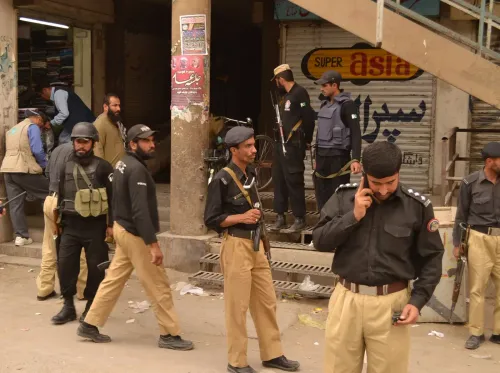
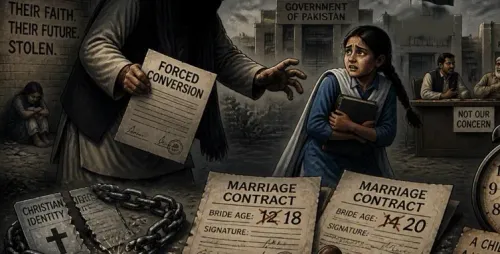
Nisha Bibi, who worked as a domestic helper, was taken by a married Muslim man who allegedly exploited her medical vulnerability, forcibly converted her to Islam, and married her. When her father, Abbas Masih, a daily wage labourer, approached the police, he was confronted with a conversion certificate and marriage documents that claimed his daughter had converted months earlier and entered the marriage of her own free will.
'We were shocked to see an alleged conversion certificate and marriage documents presented as proof,' Abbas Masih said, insisting the paperwork was fabricated to shield the perpetrator from prosecution. A statement was also reportedly submitted before a magistrate alleging that Nisha was 18 years old and was seeking protection from her own family — a claim her father has categorically denied.
A Documented Pattern of Abduction and Erasure
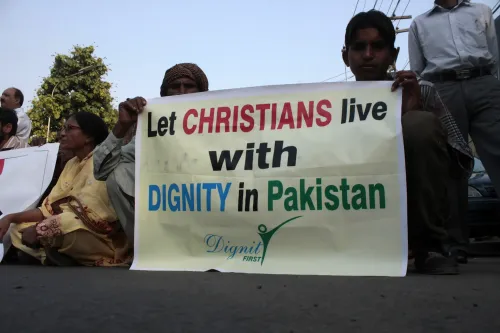
According to a report in the European Times, the victims in such cases are overwhelmingly minors — aged between 12 and 17 — who are abducted, threatened, and forced into marriages subsequently legitimised through fabricated conversion certificates. 'In Pakistan today, being born female and non-Muslim often means being stripped of autonomy, identity, and legal protection,' the report stated.
A strikingly similar case emerged in April, when Jia Liaqat, a 16-year-old Christian girl, was kidnapped while her parents worked in the fields. Weeks later, her father received a WhatsApp call from a man in Dubai warning him to drop the case. Jia was allegedly married online to a Muslim man in the UAE. Rights observers say the case illustrates a cross-border trafficking pipeline: local abduction, digital coercion, and police inaction working in concert.
Courts Under Scrutiny
The judiciary's role has drawn sharp criticism from Pakistan's Catholic community. In April, the Pakistan Catholic Bishops' Conference (PCBC) expressed alarm after the Federal Constitutional Court upheld the marriage of a Christian minor, arguing that courts are not consistently applying laws that prohibit marriage under the age of 18. PCBC President Bishop Samson Shukardin stated that cases involving abducted Christian girls are being adjudicated inconsistently with the law.
In a separate statement, Catholic Archbishop Khalid Rehmat OFM Cap of Lahore expressed displeasure over the court's ruling. The controversy centres on a 25 March decision by a two-member bench of the Federal Constitutional Court declaring the marriage between Christian girl Maria Bibi and Muslim man Sheheryar Ahmed valid. The court rejected a petition by Maria's father, Shahbaz Masih, who stated his daughter — reportedly around 13 years old — was unlawfully detained in July 2025. The bench held that while underage marriage is penalised under Pakistani law, such marriages are not rendered invalid.
The Broader Rights Crisis
Rights analysts describe the mechanics as deliberate: abduction, coercion, fabricated documentation, and judicial validation. 'Religious conversion is exploited as a cover for sexual violence, while police and courts — whether through negligence or complicity — shield perpetrators,' the European Times report noted. The trafficking pipeline, according to the report, follows a clear sequence: abducted girls are assaulted, declared 'converted,' and married to their captors, effectively erasing them from their communities of origin.
This is not an isolated phenomenon. Pakistan's minority Christian community, which accounts for a small fraction of the country's population, has repeatedly flagged the selective enforcement of child marriage laws as a structural vulnerability that disproportionately affects non-Muslim girls. With no signs of legislative or judicial correction on the horizon, advocates warn that the machinery enabling these cases remains fully operational.
Point of View
It is a green light. Pakistan's child marriage laws exist on paper but are applied selectively, and the selection criterion, according to rights observers, is religion. The cross-border dimension — threats from Dubai, online marriages to men in the UAE — signals that this is no longer a local law-and-order failure but an organised trafficking network operating with domestic impunity. Until the courts close the 'invalid but not void' gap in child marriage law, every conversion certificate remains a get-out-of-prosecution card.
NationPress
18 Sept 2026
Frequently Asked Questions
Who is Nisha Bibi and what happened to her?
Nisha Bibi is a 14-year-old Christian girl from Pakistan who worked as a domestic helper and was allegedly taken by a married Muslim man. He reportedly exploited her medical condition, forcibly converted her to Islam, and married her. When her father Abbas Masih approached the police, he was shown fabricated documents claiming she had converted voluntarily and was 18 years old.
What is the pattern of forced conversions targeting Christian girls in Pakistan?
According to rights reports, the pattern involves abduction of minority girls aged 12 to 17, followed by coercion, fabricated conversion certificates, and court-validated marriages to their captors. Police inaction and, in some cases, judicial complicity allow perpetrators to evade prosecution by using religious conversion as legal cover.
What did Pakistan's Federal Constitutional Court rule on child marriage?
On 25 March, a two-member bench of Pakistan's Federal Constitutional Court declared the marriage of Christian girl Maria Bibi — reportedly around 13 years old — to Muslim man Sheheryar Ahmed valid. The court held that while underage marriage is penalised under Pakistani law, such marriages are not considered legally void, a ruling that drew sharp condemnation from the Pakistan Catholic Bishops' Conference.
What is the Pakistan Catholic Bishops' Conference saying about these cases?
The Pakistan Catholic Bishops' Conference (PCBC) has expressed alarm over courts not consistently applying laws that ban marriage under the age of 18. PCBC President Bishop Samson Shukardin stated that cases involving abducted Christian girls are being adjudicated inconsistently with the law, while Catholic Archbishop Khalid Rehmat OFM Cap of Lahore issued a separate statement of protest over the Federal Constitutional Court ruling.
How does the cross-border dimension work in these cases?
In the case of Jia Liaqat, a 16-year-old Christian girl kidnapped in April, her father received a threatening WhatsApp call from a man in Dubai warning him to drop the case. Jia was allegedly married online to a Muslim man in the UAE. Rights observers say this illustrates a cross-border trafficking pipeline combining local abduction, digital coercion, and police inaction.