Pakistan report: 1,000 Christian girls abducted, forced to marry annually
Synopsis
A damning ICC report documents five cases of Christian girls in Pakistan abducted, forcibly converted, and married to older Muslim men — part of an estimated 1,000 such abductions annually. Courts have repeatedly sided with the accused, with judges ruling girls of 'mature age' despite documentary evidence to the contrary. The report exposes a legal architecture that critics say makes escape nearly impossible.
Key Takeaways
An ICC report estimates roughly 1,000 girls , many of them Christian, are abducted annually in Pakistan and forced to convert and marry.
Sabir was kidnapped at gunpoint on 3 July 2025 ; her family won a Lahore High Court order for her return, but her abductor allegedly fired gunshots at their home on 20 April .
Maria Shahbaz , aged 13 at abduction, was ruled of 'mature age' by Pakistan's Federal Constitutional Court , allowing her to remain with a 40-year-old accused.
Shaheen , aged 12 , was found chained in a cattle pen on 5 December 2020 ; her family eventually won custody in February 2021 .
Courts frequently deny custody to parents unable to produce birth certificates, a structural gap that critics say enables abusers.
The ICC is calling for mandatory age verification and closure of legal loopholes that allow forged marriage certificates to override parental evidence.
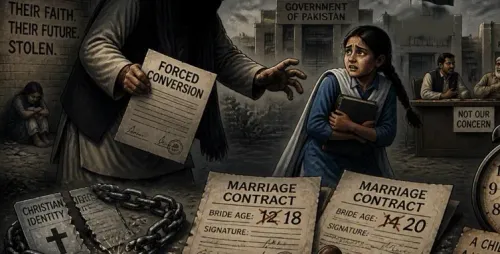
A new report by International Christian Concern (ICC) has raised serious alarm over the systematic abduction, forced conversion, and coerced marriage of Christian girls in Pakistan, estimating that roughly 1,000 girls — a significant proportion of them Christian — are kidnapped from their homes every year. The report, which documents five individual cases, finds that victims are typically discovered months later, having been forced to convert to Islam and marry older Muslim men.
How the System Fails Victims' Families
According to the ICC report, when families approach the courts, they frequently cannot produce birth certificates to establish that their daughters are underage. Judges have, in several documented instances, awarded custody of the girl to the accused man and denied parents any further contact. Critics argue this structural gap in the judicial process effectively legitimises abductions carried out under the cover of claimed marriages.
Key Cases Documented in the Report
The report profiles five cases that illustrate the pattern. Sabir was kidnapped at gunpoint on 3 July 2025 by Usman Ali, who had earlier been rejected when he proposed marriage. Ali subsequently submitted a forged marriage certificate to court, claiming Sabir had converted to Islam and consented to the union. After a prolonged legal battle, the Lahore High Court reviewed evidence of threats and coercion and ordered Ali to return Sabir to her family in September 2024. However, when Sabir became engaged to a Christian man, Ali reportedly fired gunshots at her family's home on 20 April. According to the ICC report, 'Since then, her family has moved from place to place every few days to survive.'
Maria Shahbaz, who was 13 years old at the time of her abduction in July 2024, was kidnapped, forcibly converted, and married against her will to a 40-year-old man. Her father presented documents to the court attesting to her age. Pakistan's Federal Constitutional Court nonetheless ruled that Shahbaz was of 'mature age' and could remain with the accused.
Shaheen, a 12-year-old Christian girl from Faisalabad, was abducted in 2020. Authorities located her six months later, on 5 December 2020, chained and confined to a cattle pen at the home of Khizar Ahmad Ali, aged 45. She bore visible bruises and other marks. Although Shaheen later stated in court — reportedly out of fear — that she had converted and married of her own will, her family continued the legal fight and won custody in February 2021.
Huma Younus, then 14 years old, was kidnapped from her home in Karachi in 2019 while her parents were away. She was forced to convert and marry her abductor, Abdul Jabbar. Courts did not, according to the report, adequately address her family's appeals.
In the case of Masih, a 10-year-old girl from Faisalabad, she was abducted by a 40-year-old polygamous man who subsequently gave her to another individual, Shoukat Shah. When her parents located her and requested her return, Shah refused, arguing that having converted Masih to Islam, she could not be returned to Christian parents. The ICC report noted that Christian activists helped the family file a complaint and prove Masih was underage, but that Masih herself stated in 2024 that she would remain with her Muslim husband.
Broader Pattern and Context
The ICC report situates these cases within a broader social acceptance of child marriage in parts of Pakistan, where religious conversion is sometimes used as a legal shield against prosecution. Human rights organisations have repeatedly flagged Pakistan's minority communities — including Christians and Hindus — as disproportionately vulnerable to such abductions. This is not the first time international bodies have raised concerns; similar findings have appeared in reports by the United States Commission on International Religious Freedom (USCIRF) and various United Nations special rapporteurs.
What Happens Next
The ICC has called on Pakistani authorities to close the legal loopholes that allow forged marriage certificates to override parental testimony and documentary evidence of a child's age. Advocacy groups are also pressing for mandatory age verification before courts can recognise any conversion-linked marriage. Whether Pakistani lawmakers will act on these recommendations remains uncertain, given the political sensitivity of the issue.
Point of View
Yet Pakistani courts continue to treat forged marriage certificates as sufficient grounds to override parental testimony and age documents. The structural failure here is deliberate in its design: the absence of mandatory birth registration among minority communities creates an evidentiary gap that abusers exploit with near-impunity. What is missing from the public discourse is accountability for the judges who have ruled girls of 'mature age' against all evidence — without that accountability, legislative fixes will remain cosmetic.
NationPress
27 Sept 2026
Frequently Asked Questions
How many girls are abducted and forced to convert in Pakistan each year?
According to an ICC report, roughly 1,000 girls — many of them Christian — are kidnapped from their homes annually in Pakistan. They are typically found months later, having been forced to convert to Islam and marry older Muslim men.
What is the International Christian Concern report about?
The ICC report documents five cases of Christian girls in Pakistan who were abducted, forcibly converted, and coerced into marriage, highlighting how courts have repeatedly failed to protect victims or their families. It calls for legal reforms including mandatory age verification before courts can recognise conversion-linked marriages.
Why do Pakistani courts often side with the accused in these cases?
According to the ICC report, families frequently cannot produce birth certificates to prove their daughters are underage, leaving judges with limited grounds to reject forged marriage certificates submitted by the accused. Critics argue this evidentiary gap structurally disadvantages minority families.
What happened in the case of Sabir, the Christian girl kidnapped in 2025?
Sabir was abducted at gunpoint on 3 July 2025 by Usman Ali after she rejected his marriage proposal. The Lahore High Court later ordered her return after reviewing evidence of coercion, but Ali reportedly fired gunshots at her family's home on 20 April after learning of her engagement to a Christian man.
Who are the other victims named in the ICC report?
The report profiles Maria Shahbaz (kidnapped at 13 in July 2024), Shaheen (abducted at 12 from Faisalabad in 2020 and found chained in a cattle pen), Huma Younus (14, kidnapped in Karachi in 2019), and Masih (10, abducted from Faisalabad and later given to another man who refused to return her to her Christian family).