Pakistan's nuclear 'First Use' doctrine and sole-officer command raise global alarm
Synopsis
Pakistan is now the only nuclear state where a single military officer controls nuclear use — a structural anomaly cemented by a 2025 constitutional change. Combined with a 'First Use' doctrine, battlefield tactical nukes, and the unresolved legacy of A.Q. Khan's global proliferation network, the Fair Observer report paints a picture of a nuclear arsenal with fewer checks than any other in the world.
Key Takeaways
Pakistan rejects the No First Use doctrine, explicitly reserving the right to launch a nuclear strike first in any conflict scenario.
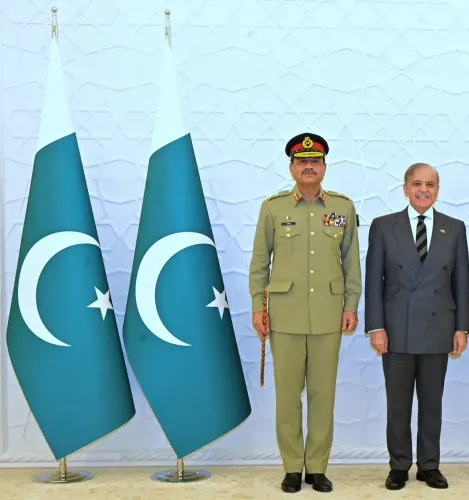
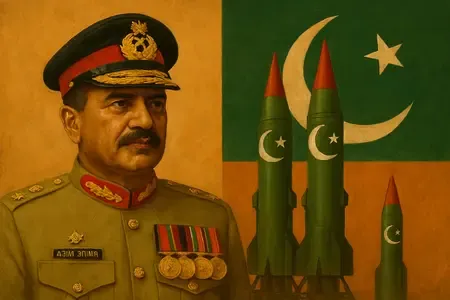
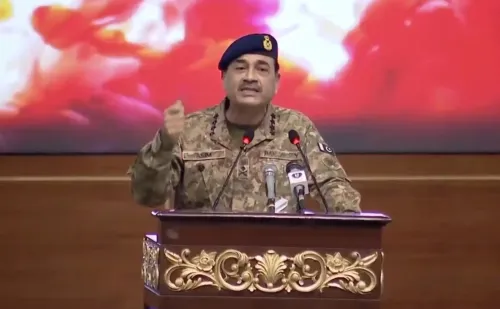
A 2025 Constitutional Amendment places sole nuclear command authority with the Chief of Defence Forces — making Pakistan the only nuclear state with such a structure.
Pakistan's development of Tactical Nuclear Weapons (TNWs) has raised fears of a 'use it or lose it' dilemma and the risk of unauthorised launch by field commanders.
Abdul Qadeer Khan built a nuclear black market in the 1990s that supplied Iran , North Korea , and Libya with centrifuge technology and weapons designs.
Khan was pardoned in 2004 by President Pervez Musharraf after confessing to the transfers; analysts argue the network could not have run without institutional support.
Former strategist Khalid Ahmed Kidwai stated the doctrine ensures 'full coverage of the Indian landmass' with 'no place to hide.'
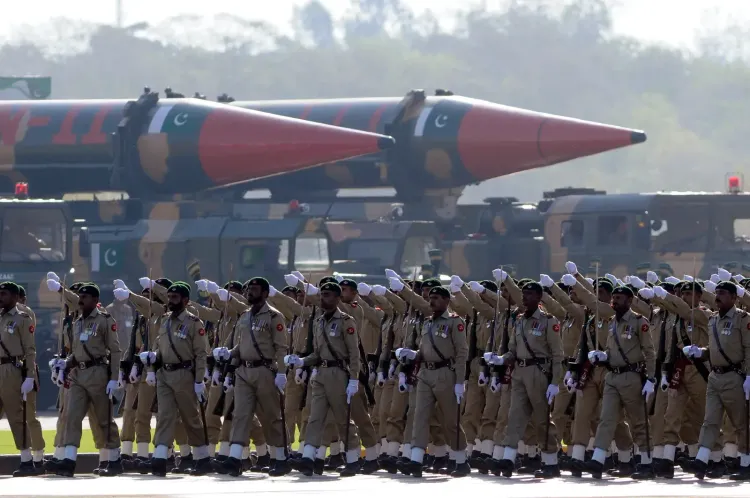
Pakistan's nuclear posture continues to draw sharp international scrutiny, with its explicit rejection of a No First Use (NFU) doctrine and a 2025 Constitutional Amendment that concentrates nuclear command authority in a single military officer — making it, according to a Fair Observer report, the only nuclear-armed state to do so. The assessment, published in July 2025, describes Pakistan as a deeply volatile nuclear power whose military-dominated command structure is contributing to an increasingly precarious regional security environment.
Full-Spectrum Deterrence Aimed at India
Pakistan's declared nuclear strategy is built around full-spectrum deterrence — explicitly calibrated to counter India across strategic, operational, and tactical levels of conflict. The Fair Observer report quotes former Pakistani military strategist Khalid Ahmed Kidwai, who stated the doctrine was designed to ensure 'full coverage of the Indian landmass' and that India would have 'no place to hide.'
Critically, Islamabad's posture rejects the NFU principle, meaning Pakistan reserves the right to launch a nuclear strike first in a conflict scenario. Analysts note this posture lowers the threshold for nuclear use and complicates crisis management in any India-Pakistan confrontation.
Single-Officer Nuclear Authority: A Global First
The Constitutional Amendment of 2025 transferred operational control of Pakistan's nuclear arsenal to the Chief of Defence Forces, dramatically consolidating military power over nuclear decision-making. According to the report, this makes Pakistan the only nuclear-armed state in the world where authority over nuclear use is vested in a single military officer — a structure that non-proliferation experts argue removes institutional checks and raises the risk of unilateral action.
Tactical Nuclear Weapons and the 'Use It or Lose It' Risk
International concern has also grown over Pakistan's development of Tactical Nuclear Weapons (TNWs), which are designed for battlefield deployment in conventional military conflicts. Analysts warn that TNWs significantly lower the nuclear threshold and create a dangerous 'use it or lose it' dilemma — a scenario in which lower-level field commanders may feel compelled to deploy weapons before they can be captured or neutralised. The report cautions that such dynamics materially increase the likelihood of escalation to full-scale nuclear war.
The A.Q. Khan Proliferation Legacy
The report also revisits Pakistan's deeply troubling nuclear proliferation record, tracing it to Abdul Qadeer Khan, who reportedly stole classified centrifuge technology and nuclear blueprints while working as a subcontractor for URENCO in the Netherlands in the 1970s. Khan subsequently built what the report describes as 'the world's most dangerous nuclear black market' by the 1990s.
According to the report, Khan's network supplied Iran with critical P-1 and P-2 centrifuges and weapons designs, traded enrichment hardware with North Korea, and attempted to export a turnkey nuclear programme — including weapons designs and over a million components — to Libya. Overtures were also reportedly made to Iraq. After confessing to these transfers in 2004, Khan was pardoned by then Pakistani President Pervez Musharraf.
Questions Over Military Complicity
Multiple international analysts and non-proliferation experts cited in the report argue that Khan's global trafficking network could not have operated for decades without at least tacit support or knowledge from elements within Pakistan's military and intelligence establishment. The report notes that many Pakistanis reportedly believed Khan had taken personal blame to shield the wider establishment — particularly the military — from accountability. These allegations have never been formally investigated by Pakistani authorities, and the military has consistently denied institutional involvement.
As Pakistan continues to expand its arsenal and consolidate military control over nuclear operations, the international community faces renewed pressure to address the structural risks embedded in Islamabad's nuclear posture.
Point of View
Why has no institutional review ever been conducted? The silence itself is a data point.
NationPress
11 Oct 2026
Frequently Asked Questions
What is Pakistan's 'First Use' nuclear doctrine?
Pakistan's 'First Use' doctrine means Islamabad explicitly reserves the right to launch a nuclear strike first in a conflict, without waiting to absorb a nuclear attack. This is in direct contrast to a No First Use (NFU) policy and lowers the threshold for nuclear escalation, particularly in any confrontation with India.
What did Pakistan's 2025 Constitutional Amendment change about nuclear command?
The 2025 Constitutional Amendment transferred control of Pakistan's nuclear operations to the Chief of Defence Forces, concentrating authority in a single military officer. According to a Fair Observer report, this makes Pakistan the only nuclear-armed state in the world where nuclear use authority rests with one individual rather than a broader civilian-military structure.
Why are Pakistan's Tactical Nuclear Weapons considered particularly dangerous?
Tactical Nuclear Weapons are designed for battlefield use in conventional conflicts, which significantly lowers the bar for nuclear deployment. Analysts warn they create a 'use it or lose it' dilemma — field commanders may feel pressured to use the weapons before they can be captured — raising the risk of unauthorised launches and rapid escalation to full-scale nuclear war.
What was A.Q. Khan's nuclear proliferation network?
Abdul Qadeer Khan, who reportedly stole centrifuge technology from URENCO in the Netherlands in the 1970s, built what analysts describe as the world's most dangerous nuclear black market by the 1990s. His network supplied Iran, North Korea, and Libya with centrifuges, enrichment hardware, and weapons designs; he was pardoned by President Pervez Musharraf in 2004 after confessing to the transfers.
Did Pakistan's military know about A.Q. Khan's proliferation activities?
Multiple international analysts and non-proliferation experts have argued that Khan's network could not have operated for decades without at least tacit support or knowledge from elements within Pakistan's military and intelligence establishment. Pakistani authorities have denied institutional involvement, and no formal independent investigation has been conducted.