Why Are People Protesting in Pakistan's Khyber Pakhtunkhwa for the Torkham Border Reopening?
Click to start listening
Synopsis
In a significant demonstration in Khyber Pakhtunkhwa, residents rallied for the reopening of the Torkham border, emphasizing its critical role in their livelihoods. As economic hardships mount, they call for urgent action from both nations.
Key Takeaways
- Protest in Khyber Pakhtunkhwa demands Torkham border reopening.
- Participants include various local stakeholders affected by the closure.
- Economic impact is severe, with many families facing poverty.
- Calls for inclusion of tribal leaders in future negotiations.
- Border serves as a crucial trade gateway to Central Asia.
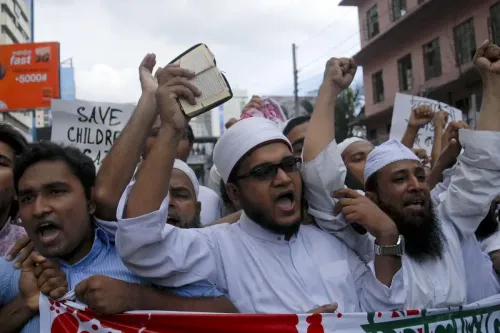
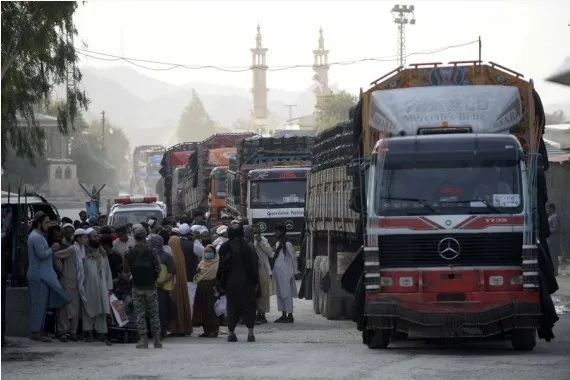
Islamabad, Jan 5 (NationPress) Residents organized a demonstration in the Landi Kotal region of Pakistan's Khyber Pakhtunkhwa, advocating for the swift reopening of the Torkham border, as reported by local media on Monday.
Participants in the protest, which took place on Sunday under the banner of the All Borders Coordinators Council, included traders, transporters, tribal leaders, daily wage workers, political activists, and members of civil society.
Individuals from various organizations and groups, who have been adversely affected by the border closure with Afghanistan since October 12, joined the protest, according to Pakistan's renowned daily, Dawn.
Speakers at the event highlighted that the closure has led to the economic devastation of thousands, particularly tribesmen who depend on cross-border trade for their livelihoods.
They described the Torkham border as a vital trade route to Central Asia, emphasizing its significance as an economic lifeline for countless families.
Protesters stated that all commercial activities in the town have come to a halt due to the border shutdown.
They revealed that hundreds of families are experiencing severe poverty and financial hardships, with many resorting to loans for basic survival.
The demonstrators urged both Afghanistan and Pakistan to decouple bilateral trade from political and security concerns, advocating for more frequent travel across the border.
They also called for influential tribal elders and trade representatives to be included in future Pak-Afghan peace and trade discussions, pointing out their historical role in resolving conflicts between the two nations.
In December last year, reports indicated that daily wage laborers and porters in Pakistan were suffering financially due to the persistent border closure, resulting in the loss of their part-time jobs.
Many of these workers are seeking employment in Punjab and Sindh, while others have been borrowing funds from family and friends to cover daily expenses, even pulling their children out of school due to an inability to pay tuition fees.
It was reported that some unemployed daily-wage laborers and porters have turned to substance abuse as a coping mechanism for their mental distress.
Speaking to Dawn, a local man named Mansoor Ali shared that he had to abandon his FSc computer science course due to financial constraints and is now carrying luggage for Afghan and Pakistani nationals at the border for meager wages.
The leader of the Torkham Labourers and Porters Association, Ali Shinwari, expressed concerns that disillusioned young laborers might align with extremist groups seeking to exploit their vulnerable circumstances.
He also warned that some young tribesmen could be recruited by drug dealers who offer lucrative compensation.
Following military operations near the Durand Line in October last year, Pakistan closed all trade routes with Afghanistan. This prompted Afghan authorities to advocate for industrialists and traders to seek alternative routes, avoiding Pakistan altogether.
Point of View
The ongoing protests in Khyber Pakhtunkhwa underscore a critical intersection of economics and politics. With livelihoods at stake, it is imperative for both governments to prioritize trade facilitation, ensuring that local communities are not caught in the crossfire of geopolitical tensions. The voices of local leaders and citizens must be amplified in discussions that shape their futures.
NationPress
06/01/2026
Frequently Asked Questions
What is the reason for the protest in Khyber Pakhtunkhwa?
The protest is aimed at demanding the immediate reopening of the Torkham border, which has been closed since October, severely impacting local livelihoods.
Who participated in the protest?
Participants included traders, transporters, tribal elders, daily wage workers, political activists, and members of civil society.
What are the economic impacts of the border closure?
The border closure has led to economic hardships for many families, resulting in job losses, increased poverty, and reliance on loans for survival.
What do the protesters want from the governments of Pakistan and Afghanistan?
Protesters demand that trade be decoupled from political issues and that influential local leaders be included in future peace and trade discussions.
What alternatives have been suggested for trade routes?
After the border closure, Afghan authorities have suggested that traders seek alternative routes instead of relying on Pakistan.