Iran's Pezeshkian: Contact with new Supreme Leader Khamenei 'very difficult'
Synopsis
Iranian President Pezeshkian has publicly admitted that communication with newly appointed Supreme Leader Mojtaba Khamenei is 'very difficult at the moment' — a rare acknowledgment of internal strain as Iran simultaneously navigates crippling sanctions, a naval blockade on the Strait of Hormuz, and an active military confrontation with the United States and Israel.
Key Takeaways
Iranian President Masoud Pezeshkian said communication with new Supreme Leader Mojtaba Khamenei is 'very difficult at the moment.' Former Supreme Leader Ali Khamenei was killed on 28 February in a joint US-Israel strike, according to Pezeshkian.
Mojtaba Khamenei was selected as Supreme Leader by the Assembly of Experts in early March.
Iran and Oman are reportedly close to finalising a new single shipping route through the Strait of Hormuz for two to four months.
Iran has conditioned reopening the strait on tangible US implementation of agreed commitments, according to a source close to the negotiating team.
Iran is facing intensified banking sanctions , curbs on foreign transactions, a naval blockade , and an active war, Pezeshkian said.
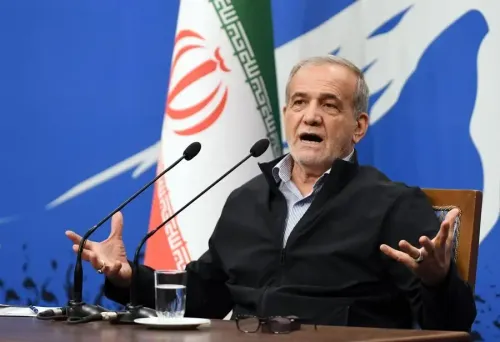
Iranian President Masoud Pezeshkian has acknowledged that communication with the country's new Supreme Leader Mojtaba Khamenei is 'very difficult at the moment,' while insisting that his leadership remains a 'great strength' for Iran as it navigates what he described as its most challenging period in recent memory. The remarks were published on the official website of the Iranian President's office on Wednesday.
What Pezeshkian Said
Pezeshkian stated that the United States and Israel killed Iran's former Supreme Leader Ali Khamenei on 28 February out of 'desperation,' expecting the country to collapse in the aftermath of what he called a 'brutal' action. 'However, the country continued, and our (new) beloved leader was selected,' he said. 'Our new dear leader's presence is a very great strength for us to be able to continue this path, although communication with him is very difficult at the moment,' Pezeshkian added.
Iran's Mounting Pressures
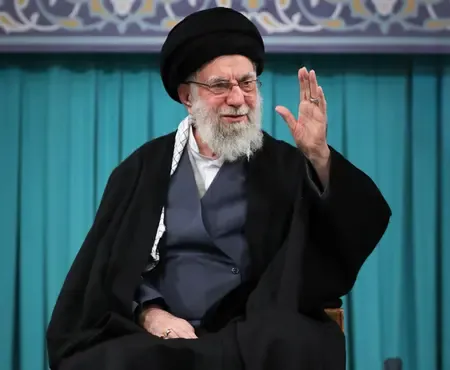
The Iranian president described the country as facing its 'most difficult' circumstances, citing intensified banking sanctions, curbs on foreign transactions, a naval blockade, and an ongoing war. Mojtaba Khamenei, son of Ali Khamenei, was formally selected as Iran's new Supreme Leader by the country's Assembly of Experts in early March, following the death of his father.
Strait of Hormuz: Negotiations and Conditions
This comes amid reports that Iran and Oman are close to finalising new arrangements for commercial shipping through the Strait of Hormuz. Under the proposed agreement, the existing temporary northern and southern routes would be replaced by a single new route passing through Iranian territorial waters, reportedly for a period of two to four months.
An informed source close to the Iranian negotiating team told the semi-official Fars News Agency that any reopening of the strait hinges on 'tangible US implementation of its commitments.' The source added that the US Treasury Department's removal of sanctions on an Iraqi airline on Wednesday was unrelated to the Iran-US Memorandum of Understanding (MoU).
Background: The Escalation Timeline
Iran tightened its control over the Strait of Hormuz on 28 February, barring safe passage to vessels belonging to or affiliated with Israel and the United States, following their joint strikes on Iranian territory. The US military subsequently launched multiple waves of strikes against Iranian targets, stating these were aimed at 'degrading Iran's ability to threaten commercial shipping' in response to Iranian attacks on vessels in the strait. Iran, in turn, responded with missile and drone attacks targeting US military bases and facilities across the region.
With communication channels to the new Supreme Leader reportedly constrained and multilateral tensions unresolved, the trajectory of both the Hormuz negotiations and the broader Iran-US standoff will remain closely watched in the weeks ahead.
Point of View
An economic siege, and a leadership transition, all at once. The Hormuz negotiations with Oman offer a potential off-ramp, but tying reopening to 'tangible US commitments' keeps the leverage ambiguous and the standoff structurally unresolved. Whether Mojtaba Khamenei can consolidate authority quickly enough to steer coherent policy through this convergence of crises is the central question that mainstream coverage has so far underweighted.
NationPress
20 Sept 2026
Frequently Asked Questions
What did Iranian President Pezeshkian say about Supreme Leader Mojtaba Khamenei?
Pezeshkian said that while the new Supreme Leader's presence is a 'great strength' for Iran, communication with him is 'very difficult at the moment.' The remarks were published on the official website of the Iranian President's office on Wednesday.
Who is Mojtaba Khamenei and how did he become Supreme Leader?
Mojtaba Khamenei is the son of former Supreme Leader Ali Khamenei. He was selected as Iran's new Supreme Leader by the country's Assembly of Experts in early March, following the death of his father on 28 February.
What happened to Iran's former Supreme Leader Ali Khamenei?
According to President Pezeshkian, Ali Khamenei was killed on 28 February in a joint strike by the United States and Israel, which he described as an act of 'desperation.' Iran has characterised the action as 'brutal.'
What is the current status of the Strait of Hormuz?
Iran tightened control over the Strait of Hormuz on 28 February, barring safe passage to vessels linked to Israel and the US. Iran and Oman are reportedly close to finalising a new single shipping route through the strait, but Iran has conditioned any reopening on tangible US implementation of agreed commitments.
What pressures is Iran currently facing?
President Pezeshkian described Iran as enduring its 'most difficult' circumstances, citing intensified banking sanctions, restrictions on foreign transactions, a naval blockade, and an ongoing war with the US and Israel.